
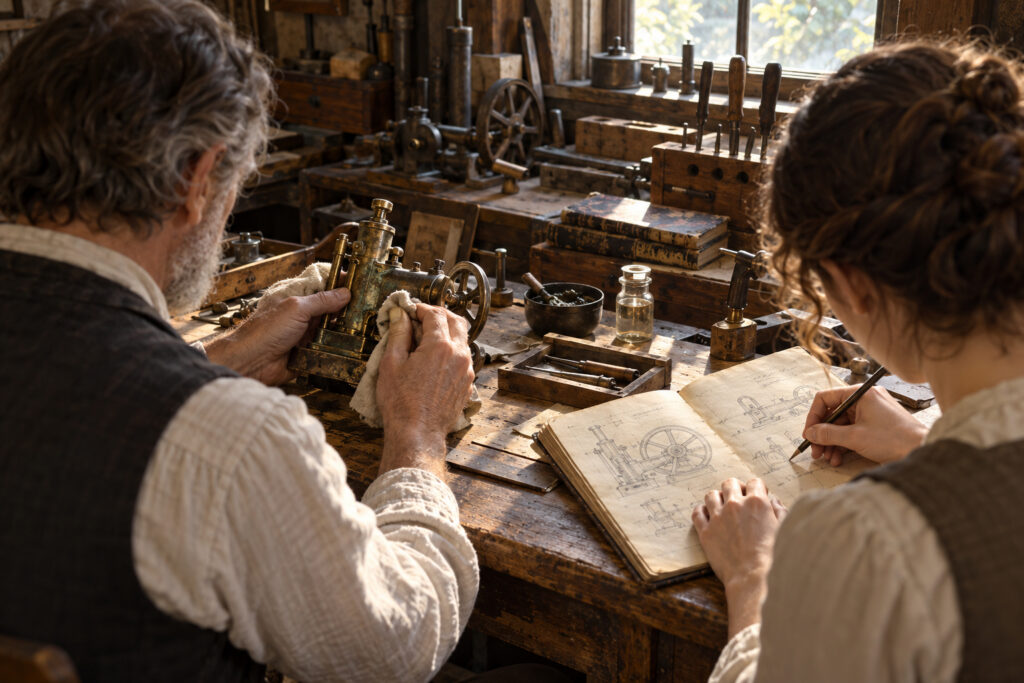
Many productive lives pass with little public notice yet leave durable traces in tools and routines. This profile explores one such nineteenth-century inventor whose name rarely appears in popular accounts. By tracing formative experiences, working methods, and posthumous recognition, we can learn how practical creativity shapes everyday life. The story highlights patterns useful for understanding other overlooked contributors.
Origins and Early Influences
Born into a household where making and mending were daily tasks, the inventor developed a habit of close observation and hands-on experimentation. Early apprenticeship in a modest workshop taught material properties and an economical approach to design. Exposure to local trades encouraged adaptations rather than radical reinvention, producing solutions fitted to immediate needs. Informal networks of artisans provided feedback and incremental improvements to prototypes.
These roots shaped a pragmatic mindset focused on utility and reliability over spectacle. Small-scale constraints often promoted clever simplifications that outlived more elaborate contemporaries.
Crafting Practical Solutions
Work in the workshop emphasized iterative refinement: an idea was sketched, tried, revised, and retested until it met specific performance goals. Materials were chosen for availability and durability, minimizing complexity while maximizing function. Many inventions were incremental improvements—a new joint here, a better fastener there—that cumulatively increased efficiency. Documentation was sparse, communicated mostly through demonstration and apprenticeship rather than formal patents or publications.
This approach produced widely used tools that improved workflows without attracting headline attention. Practical influence often spread through use rather than citation.
Confronting Challenges and Misunderstanding
The inventor faced skepticism from well-funded competitors who favored novelty and spectacle, making it difficult to secure formal recognition. Limited access to capital and legal protection meant many innovations were adopted informally and their origins obscured. Health, family obligations, and market fluctuations further constrained the ability to scale production or patent ideas. These pressures created a cycle where usefulness translated into adoption but not authorship in historical records.
Understanding these obstacles helps explain why many contributors remain peripheral in dominant narratives. It also clarifies how institutional and economic factors shape whose names get recorded.
Rediscovery and Ongoing Relevance
Later researchers and restorers often uncover practical designs in surviving artifacts, workshop notes, or oral accounts, leading to renewed appreciation. Preservation efforts and material studies reveal layered contributions to specific technologies and practices. Modern makers sometimes revive these pragmatic solutions for sustainable, low-tech contexts, demonstrating enduring value. Recognition grows through specialized scholarship and hands-on reconstruction projects.
Rediscovery reframes the inventor’s work as foundational rather than marginal. It offers a model for valuing everyday ingenuity across historical periods.
Conclusion
Examining the life of an unsung nineteenth-century inventor reveals how quiet, persistent creativity shapes practical life. Recognition often arrives slowly, through material study and revival by practitioners. Valuing these stories expands our understanding of innovation and its social roots.