
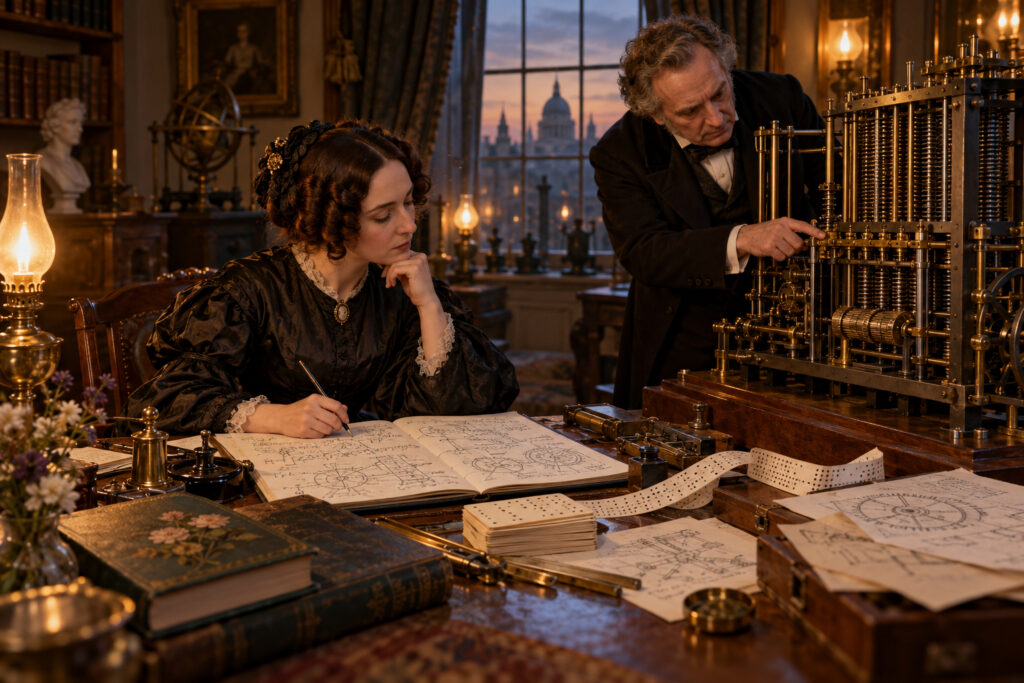
Ada was born into a storybook contradiction: the daughter of Lord Byron, the Romantic poet, and Anne Isabella Milbanke, who insisted her daughter study mathematics to curb what she saw as Byron’s dangerous temperament. That pruning worked in a curious way. Ada grew up reading numbers and novels, taught by tutors who fed her a steady diet of algebra, logic and mechanical diagrams. By her twenties she moved in scientific circles in London, not as an abstract theorist but as a persistent, curious interlocutor.
Her life was short—she died in 1852 in her mid-thirties—but the work she left behind kept growing in influence. She married William King, who later became the Earl of Lovelace, and entered the aristocratic world even as she kept close friendships with engineers and mathematicians. The most consequential of those friendships was with Charles Babbage.
A Meeting of Minds with Charles Babbage
Babbage had designed the Analytical Engine, a hypothetical mechanical computer that used punch cards and separate memory and processing—ideas decades ahead of their time. In 1842–43 a young Italian engineer, Luigi (Luigi) Federico Menabrea, published an article describing Babbage’s machine. Ada translated that article into English and added extensive notes of her own, labeled A through G. Her notes were longer than the original paper and contained the key seeds of her reputation.
In Note G she worked through what has since been called an algorithm: a step‑by‑step set of operations the Engine would follow to compute Bernoulli numbers. That algorithm is often cited as the first published computer program. More than technique, Ada’s writing showed a different way of thinking: she imagined machines not merely as number crunchers but as devices that could manipulate symbols according to rules, and therefore could, in principle, compose music or elaborate patterns—activities that reached beyond arithmetic.
Legacy: Beyond the First Programmer Label
People often call Ada the “first computer programmer,” and the label has stuck because her notes anticipated modern software concepts. But her contribution is subtler: she extended Babbage’s engineering into a conceptual space, arguing that computation could be abstract and creative. That idea mattered when, more than a century later, electronic computers made such abstractions practical.
Her name has been carried forward in surprising ways. In the 1980s the U.S. Department of Defense named a programming language “Ada” in her honor, and each October the world marks Ada Lovelace Day to celebrate women in STEM. These honors reflect the curious blend of sensibility she embodied—part poet, part analyst—and the long reach of a mind that treated machines as more than mechanical toys.
Conclusion
Ada Lovelace is memorable because she bridged moods and methods. She took Babbage’s gears and Menabrea’s notes and asked what a machine might mean. That question—posed in pencil and ink in the 1840s—helped open a space where computing became an idea as much as an instrument, and it still shapes how we imagine machines today.