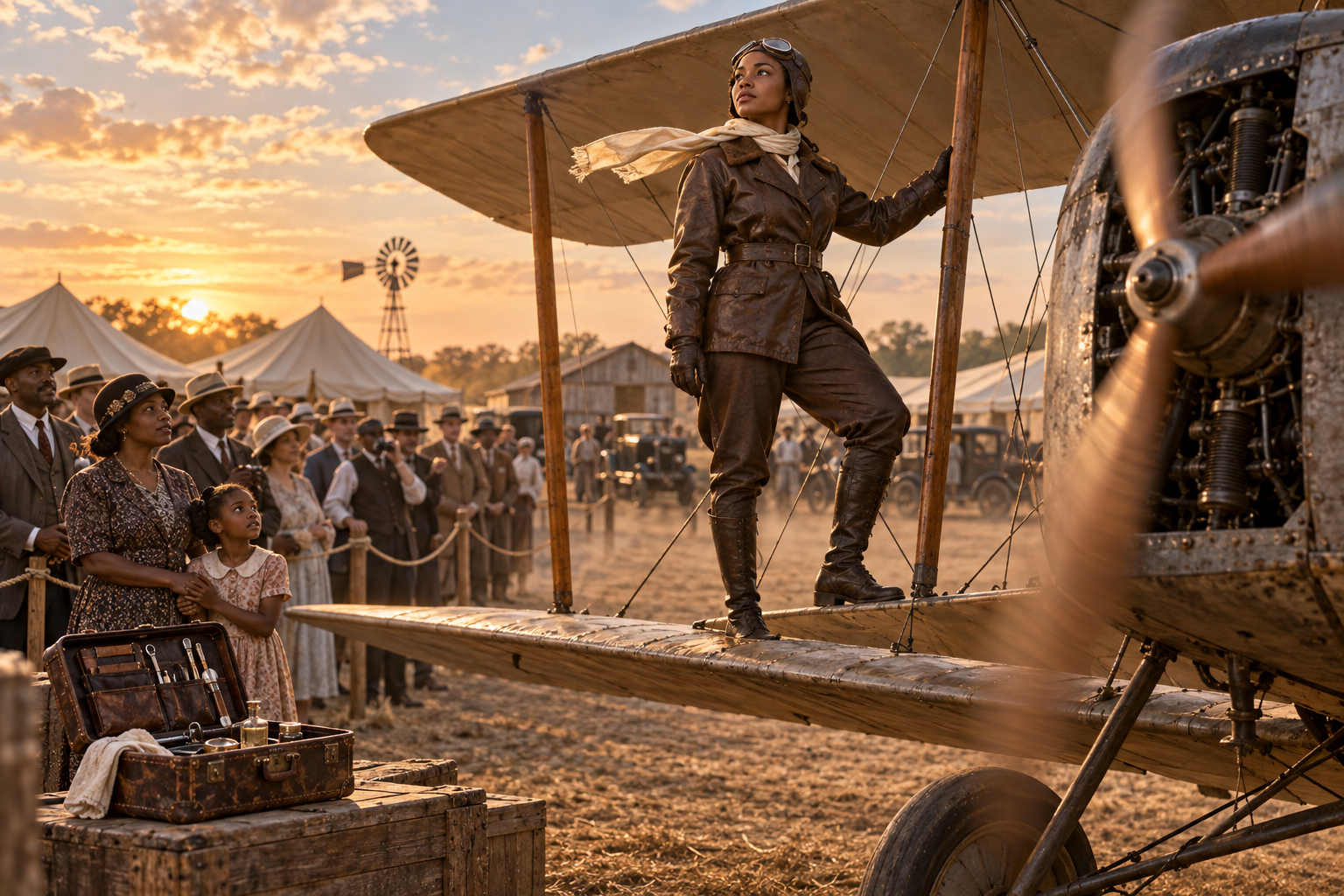
Born in 1892 in a small Texas town, Bessie Coleman began life far from the glamour of airshows. Her family worked the same scarred fields as many Black and mixed‑heritage families in the post‑Reconstruction South. As a young woman she moved to Chicago, where she earned a living as a manicurist and watched the new age of flight with hungry curiosity. The planes she saw were usually piloted by white men; for Black Americans and women, the cockpit felt like a closed room.
Learning to Fly—In French
Coleman solved the barrier in the most literal way: she went around it. Determined to train as a pilot, she saved money, studied French, and traveled to Europe because U.S. flight schools refused to admit her. In 1921 she earned her pilot’s license from a school in France, becoming the first Black woman anywhere to do so. That achievement mattered less for the certificate itself than for what it proved—race and gender were not natural limits on courage or skill, only man‑made obstacles to be outflanked.
Barnstorming, Principles, and Plans
Back in the United States, Coleman turned her license into a public life. She performed in barnstorming exhibitions, flying daring circuits and doing parachute‑assisted stunts to draw crowds. She refused to be cataloged as a novelty act; she refused to perform for segregated audiences and insisted on equal pay. Beyond the spectacle, she used her growing fame to argue that other Black Americans—especially young women—should learn to fly. Coleman spoke openly about opening a flight school for Black pilots, an idea she never had the chance to realize.
Death and Afterall
Her life ended abruptly in 1926 during a rehearsal for an aerial show in Texas, when the aircraft she was in unexpectedly crashed. The tragedy cut short a brief but incandescent career. For many contemporary observers the shock lay in the suddenness; for the communities she inspired, the loss crystallized what she had already accomplished.
Conclusion
Bessie Coleman’s story is stubbornly modern. She rewired expectations—about race, gender, and who could claim the new technologies of the twentieth century—by moving herself into unfamiliar spaces, learning another language, and refusing second‑class conditions. Her ambition was practical and contagious: she wanted planes, not parades, to be available to people like her. Today she is remembered not merely as a daredevil but as a practical early advocate for inclusion in the air, an emblem of a century when ordinary barriers were first forced open by extraordinary people.