
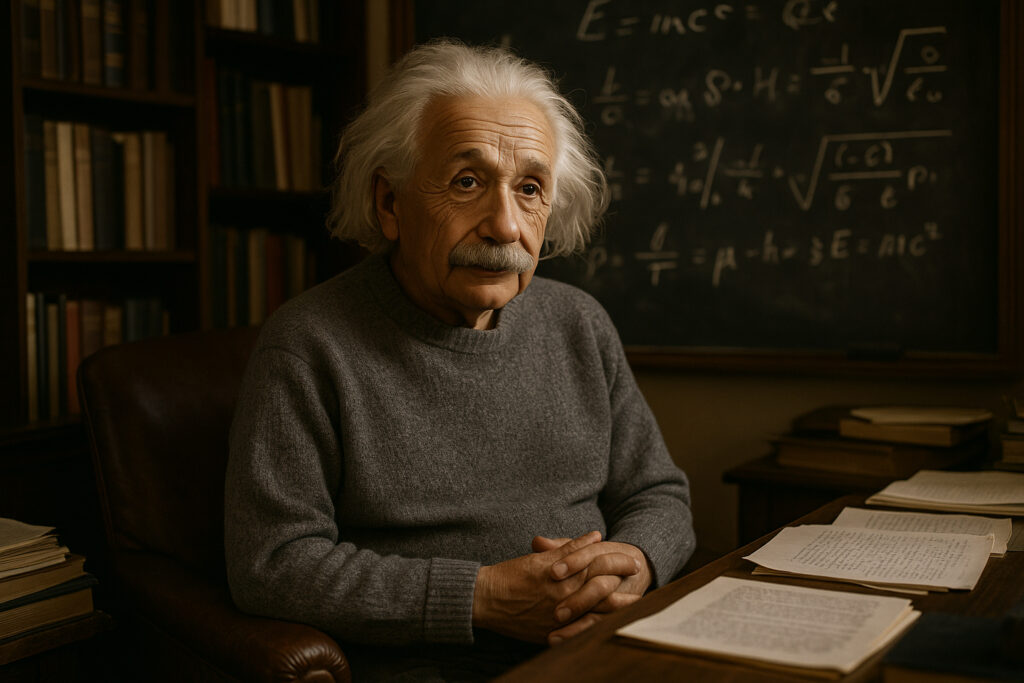
Few names in history are as synonymous with genius as Albert Einstein. His revolutionary ideas changed how humanity perceives time, space, and energy—redefining reality itself. Beyond his equations, Einstein’s curiosity, imagination, and humility transformed not only science but also the way we think about knowledge and the human mind’s potential.
1. The Theory That Changed Everything
In 1905, Einstein published his Theory of Special Relativity, introducing the now-famous equation E=mc², which revealed that energy and mass are interchangeable. This single insight reshaped physics, linking the smallest particles to the vastness of the universe.
A decade later, his General Theory of Relativity revolutionized our understanding of gravity—not as a force, but as the curvature of space and time itself. These ideas became the foundation of modern cosmology, explaining black holes, gravitational waves, and even the expansion of the universe.
2. A Mind Fueled by Imagination
Einstein often said, “Imagination is more important than knowledge.” His genius wasn’t rooted in memorization or formulas—it came from his ability to visualize complex ideas.
He conducted “thought experiments,” imagining himself riding alongside a beam of light or falling freely in space. These mental exercises led to insights that traditional science could never have achieved through equations alone.
3. The Human Side of the Scientist
Despite his monumental discoveries, Einstein was deeply human—curious, humorous, and humble. He opposed war, advocated for civil rights, and supported education for all. He used his fame not for personal gain, but to promote peace and intellectual freedom.
His letters, jokes, and writings reveal a man who believed that compassion and curiosity were just as important as logic and intellect.
4. Einstein’s Enduring Legacy
Einstein’s influence extends far beyond physics. His theories paved the way for GPS technology, nuclear energy, and advances in quantum mechanics. More profoundly, his work reshaped how humanity perceives reality—showing that truth can be fluid, relative, and dependent on perspective.
Even today, scientists build upon his ideas, exploring realms like quantum gravity and dark energy. Einstein’s legacy continues to inspire anyone who dares to ask “why?” and imagine “what if?”
Conclusion
Albert Einstein didn’t just change science—he changed the way we think about the universe and ourselves. His brilliance lay in blending creativity with logic, turning curiosity into cosmic truth. As long as humanity continues to question, dream, and explore, Einstein’s spirit of discovery will forever guide our understanding of reality.