
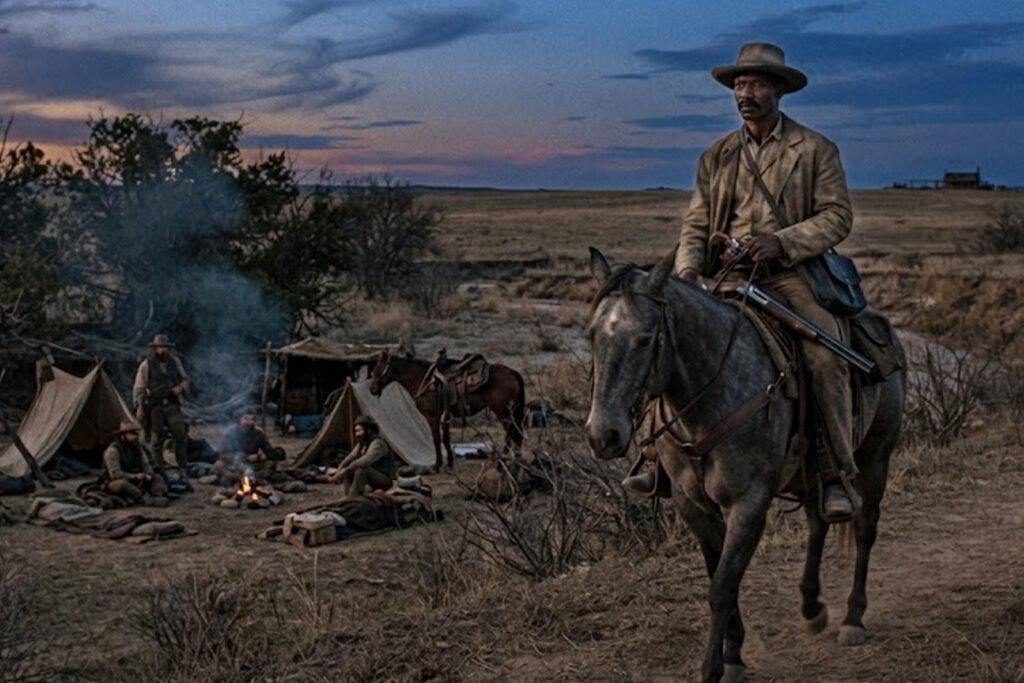
Bass Reeves was born into slavery in Arkansas around 1838 and carried the surname of his owner’s family. During the Civil War he fled into the vast, lawless maze of Indian Territory (today’s eastern Oklahoma). There he learned to ride, track, and speak several Native American languages—skills that would make him indispensable to the federal lawmen who followed.
The shift from fugitive to federal officer was dramatic. Reeves never went back to the cotton fields. Instead, he married and settled in the territory he knew better than most outsiders, building a reputation for toughness, patience, and an almost uncanny ability to find fugitives who thought the land would hide them.
On the beat of a dangerous district
In the 1870s Reeves began serving as a deputy U.S. marshal, working in the sprawling Western District of Arkansas and Indian Territory. That jurisdiction was notorious—a mosaic of tribal lands, outlaw camps, and towns where federal authority was often the only law. Reeves tracked robbery gangs, horse thieves, and violent fugitives across hundreds of miles of rough country, frequently alone and on horseback.
Accounts from the time and later historians credit him with arresting thousands of criminals and with numerous shootouts; exact numbers vary. He worked for the federal court at Fort Smith, the venue associated with Judge Isaac C. Parker, and his duties were relentless: warrants, extraditions, and the grim business of bringing violent men to trial.
How he worked—and why stories follow him
Reeves’s methods were a mix of quiet craft and moral steadiness. He was a master tracker, could blend into a crowd, and often used disguises—posing as a peddler or a farmer to close in on suspects. He carried two pistols and a shotgun, but contemporaries noted he preferred to take prisoners alive when possible; many tales stress he prized the law’s process over frontier vengeance.
Legend clings to Reeves: he is said to have arrested his own son for murder, and to have once single-handedly captured eight highwaymen. Some stories have grown with time. Historians caution that precise counts of arrests or kills are disputed, yet the pattern is clear—he was fearless, fair enough to be respected by victims and villains, and so effective that outlaws learned to fear the quiet deputy on a gray horse.
Conclusion
Bass Reeves vanished from popular memory for decades after his 1910 death, overshadowed by dime-novel lawmen and tall tales. In recent years writers and filmmakers have rediscovered him as one of the most remarkable lawmen of the American frontier: a Black man who rose from slavery to enforce federal law in some of the toughest country in the United States, leaving behind a legacy of skill, restraint, and a handful of unforgettable stories.