
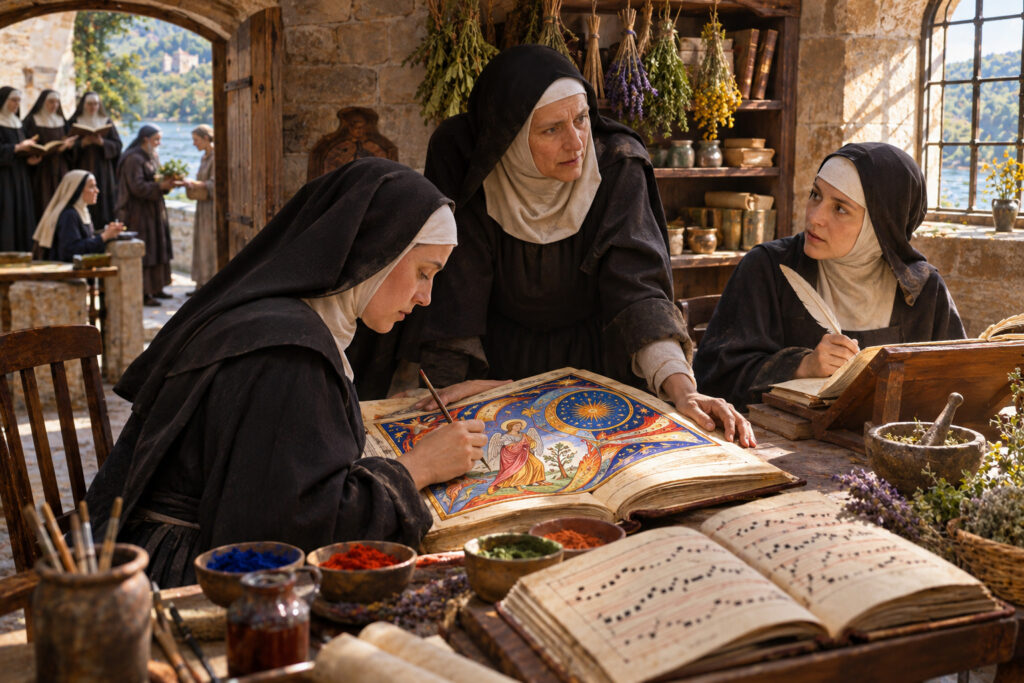
Hildegard was born in the Rhineland in 1098 into a noble family and—by the custom of the age—was given to a convent as an oblate. Tradition holds she was the tenth child, a detail that shaped how her family and community saw her future. She spent decades at the monastery of Disibodenberg under the care of a charismatic abbess, and later founded her own house at Rupertsberg near Bingen. From those riverbank rooms she ran a bustling religious community, negotiated with bishops and patrons, and kept a remarkably busy correspondence for a woman cloistered from the world.
Visions made into books
Hildegard claimed she experienced visionary revelations from childhood. Rather than hide them, she recorded them. Her major visionary work, Scivias, presents a sequence of images and theological reflection meant to guide the faithful. Hildegard’s texts mix apocalyptic imagery, moral counsel, and a vivid sensory imagination—bright colors, anthropomorphic figures, and cosmic metaphors that medieval readers found arresting. While some contemporaries doubted visionary women, Hildegard secured validation from powerful figures in the church, and her books circulated widely across Europe.
Music, drama, and a surprising practical side
Hildegard’s musical legacy is immediate: a corpus of plainchant that survives as some of the most distinctive medieval melody. Her collection, often called the Symphonia, and a liturgical play, Ordo Virtutum, show a composer who thought about voice, drama, and theological argument in one sweep. But she was not only a mystic and musician. Two shorter works commonly attributed to her—on natural history and medical remedies—compile herbal knowledge and practical treatments. These texts approach nature as a moral and therapeutic system: plants, stones, and animals appear as signs and helpers for human health. That combination of ethereal vision and hands-on herbalism is part of what makes Hildegard feel surprisingly modern.
A public abbess who kept arguing
Hildegard did not fade quietly into convent life. She traveled to consult with church leaders, wrote blunt letters to abbots and emperors, and defended her right to publish. Her voice could be imperious: she scolded bishops, advised rulers, and urged reform when she thought it necessary. After her death in 1179, her reputation shifted—venerated by some, dismissed by others—but manuscripts of her music and visions kept her alive in medieval memory.
Conclusion
Hildegard of Bingen resists tidy labels. She was a mystic whose visions became theology, a composer whose melodies still move choirs, and a practical thinker who compiled remedies and natural observations. In a century that usually kept women out of public theological debate, she found ways to speak, sing, and write that echo across the centuries.