
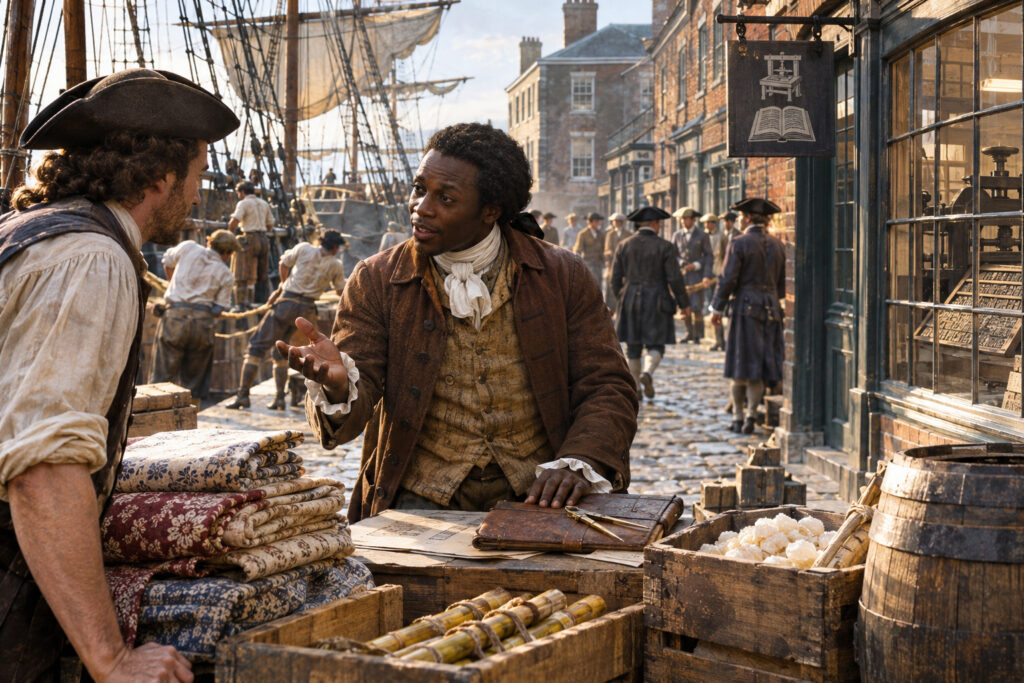
Olaudah Equiano is best known because his 1789 autobiography became one of the most widely read first-person accounts of enslavement in the eighteenth century. He wrote of being taken from his childhood home in West Africa, separated from family, and forced onto a crowded ship bound for the Americas. His book’s opening scenes—anxiety on deck, the reek and press of human bodies, the confusion of languages—helped British and European readers imagine what abolitionists called the Middle Passage.
A Seaman, a Merchant, and a Freedman
Equiano did not remain a static figure in a single place. Enslaved as a child, he later served on British ships, learned the work of a sailor, and picked up trades and languages. Over years he moved between the Caribbean, Britain, and North America, living in very different worlds: shipboard life, markets, and the growing ports of the British Atlantic. In the mid-1760s he secured his legal freedom and set up as a small-scale entrepreneur, selling goods and offering services that kept him on the move.
Those movements mattered because they let Equiano write from more than one vantage point. He described the mechanics of oceanic commerce, the social workings of port towns, and the religious communities that shaped his later life. He converted to Christianity and used its vocabulary to address readers who might otherwise ignore the testimony of an African-born man. That rhetorical choice—mixing seafaring detail with a moral appeal—made his Narrative unusually effective at persuading British audiences.
Public Life and an Uncertain Past
When Equiano published his Narrative he joined the abolitionist conversation as both eyewitness and public figure. His book was used at meetings, cited in pamphlets, and translated into other languages. He also supported efforts connected to Sierra Leone, the settlement aimed at resettling formerly enslaved people, and he campaigned publicly for abolitionist causes in Britain.
Historians still debate some personal facts—most notably his place of birth. Equiano insisted he was born in what is now southeastern Nigeria; some documentary records hint at other possibilities. That uncertainty does not erase the power of his testimony. The Narrative remains one of the clearest surviving portraits of how the Atlantic slave trade shaped individual lives, economies, and public opinion.
Conclusion
Olaudah Equiano matters because his life crossed so many worlds: African village, slave ship, seaport, and the pamphlet-rich parlors of reformers. His book turned those crossings into a story that unsettled polite readers and helped build momentum against the trade that had uprooted him. Read today, it reads as both a personal survival tale and a document that helped change how an entire empire thought about slavery.