
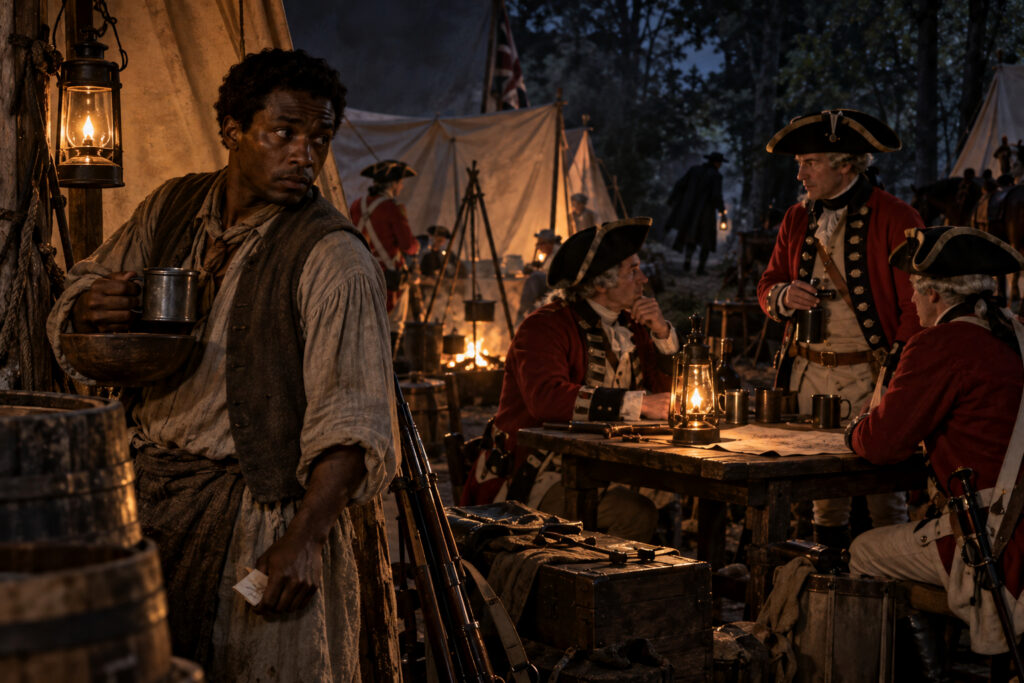
James Armistead was born into slavery in Virginia around the middle of the 18th century and owned by a York County patriot named William Armistead. He was not a soldier in the conventional sense; his role in the American Revolution began when the Marquis de Lafayette asked for volunteers to gather information inside British lines. Armistead took the risk. Disguised as a runaway laborer and servant, he slipped into British encampments and behaved the way an enslaved man expected to behave—humble, deferential, unthreatening—while watching and remembering.
Playing a Double Game in the British Camp
Armistead’s work reads like a spy novel. He won the trust of British officers by pretending to be a runaway slave and sometimes by posing as an interpreter or servant to other escaped servants. That trust let him hear conversations, learn troop dispositions, and report back to Lafayette and other American commanders. He spent months moving between camps, carrying reports written in code and relaying plans that the British thought were safe from prying ears.
His intelligence proved particularly valuable in 1781 when British forces under General Cornwallis moved through Virginia. The information Armistead funneled helped Lafayette and allied commanders piece together British movements and intentions—contributions that fed into the campaigns culminating at Yorktown.
Freedom Won, Life Lived Quietly
After the war Armistead could not simply walk away from the legal realities of slavery. The Marquis de Lafayette supported his claim for freedom: Lafayette provided testimony about Armistead’s service when Virginia legislators considered the case. In 1787 the Virginia legislature granted him his freedom, and he adopted the name James Armistead Lafayette in honor of the general who had vouched for him.
He settled back in Virginia and worked as a farmer. Records show him later petitioning for a veteran’s pension and living into the early 19th century; he died in 1830. For decades his story was a quiet footnote in Revolutionary War histories, but modern retellings have restored his place as a key intelligence asset whose courage and quick thinking mattered at a decisive moment.
Conclusion
James Armistead Lafayette’s life forces a different kind of Revolutionary narrative: not only battles and generals, but the risky, unglamorous espionage of an enslaved man who used others’ assumptions about him as cover. His work didn’t just gather facts; it helped shift momentum in a campaign that produced American independence—and his later manumission underscores how close service to a fledgling republic and the institution of slavery remained, even where their interests briefly converged.