
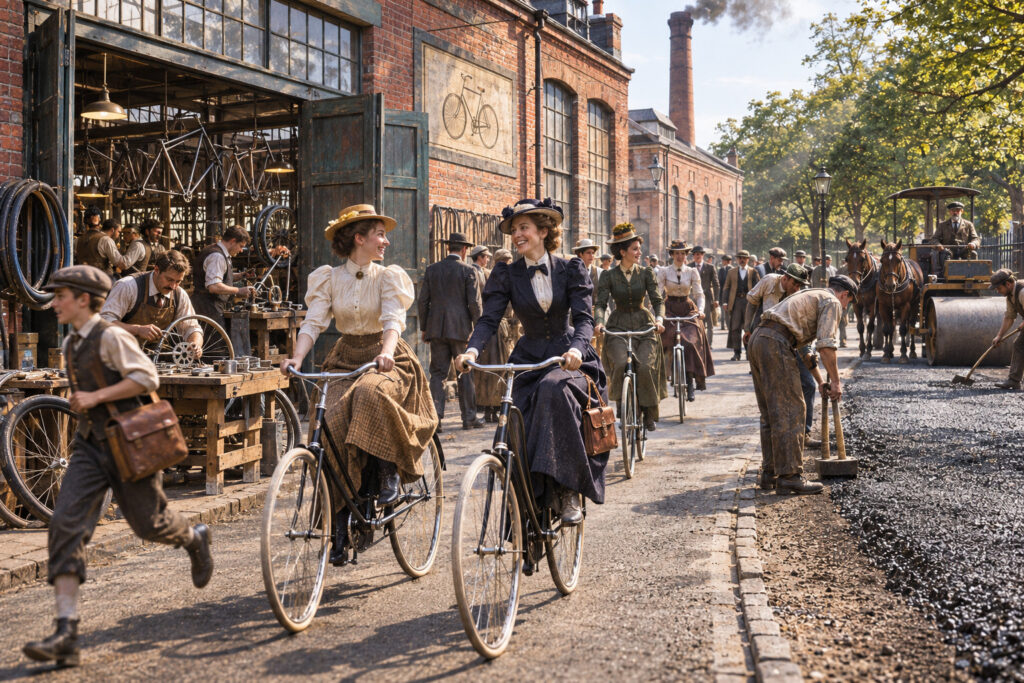
What we now picture as a simple bicycle was the product of a furious decade of tinkering in the 1880s and 1890s. The clattering, back-breaking penny-farthing gave way to the lower, chain-driven “safety” bicycle — John Kemp Starley’s Rover of 1885 is the familiar turning point — and then to pneumatic tires, popularized by John Boyd Dunlop in 1888. Those two technical reversals made cycling practical for ordinary people: faster, steadier, and far less terrifying than a high-wheeler.
That practicality turned into industry. Workshops and factories churned out frames, spokes, and rubber tubes. Bicycle makers refined mass-production techniques that would later be adopted by automobile and motorcycle builders. The bicycle supply chain — from metalworking to rubber manufacture — became a training ground for an entire generation of engineers and mechanics.
Everyday revolutions
By the 1890s bicycles were everywhere: delivery boys, weekend riders, women in skirts lifted for practicality. Ordinary mobility expanded. A rural trip that once took a day by foot could be done in a few hours. For women, the bicycle carried particular force. It offered independent travel and practical pressure to loosen restrictive clothing; fashions shifted toward shorter skirts and the shirtwaist, and cycling clubs became social spaces where women could meet outside the watchful eye of chaperones.
Clubs matter. Organizations like the League of American Wheelmen, formed in 1880, were not just social networks; they lobbied for better roads, organized long-distance rides, and turned cycling into a civic movement. Weekend excursions, tour maps, and bicycle magazines created a lively subculture that crossed class lines in surprisingly visible ways.
Good roads, new machines, and unexpected legacies
One of the bicycle boom’s least obvious legacies was infrastructure. Cyclists demanded smoother routes, and their campaigns — the Good Roads Movement in the United States is the best-known example — built the case, public and political, for paved roads. Those same roads accelerated the rise of the automobile when it arrived. The boom also seeded skills and suppliers: carriage and bicycle shops became early automobile garages; pneumatic tires and chain drives migrated to motor vehicles; even the Wright brothers applied bicycle-shop precision and materials to their experiments in flight.
Conclusion
The bicycle boom was more than a fad about two-wheeled freedom. It reshaped how cities and countryside connected, nudged social norms, and quietly prepared industries for the machine age. Look at a quiet bike lane today and you’ll see a long trail of technological fixes, social changes, and political fights that began the moment a safer, lighter bicycle made getting somewhere that much easier.