

Uncover History’s Secrets with Daily Updates!
Daily News Entertainment
  • Home
  • History
  • Biographies
  • Eras
  • Regions
  • Timeline
No Result
View All Result
History Ours
  • Home
  • History
  • Biographies
  • Eras
  • Regions
  • Timeline
No Result
View All Result
History Ours
No Result
View All Result

Bahis vergilendirmesi Türkiye’de devlet kontrolündedir, ancak yeni açılan casino siteleri gibi uluslararası sitelerde oyuncular kendi kazançlarını yönetir.

Home History

Intersections, Households, and Social Life in Market Towns

in History
Intersections, Households, and Social Life in Market Towns

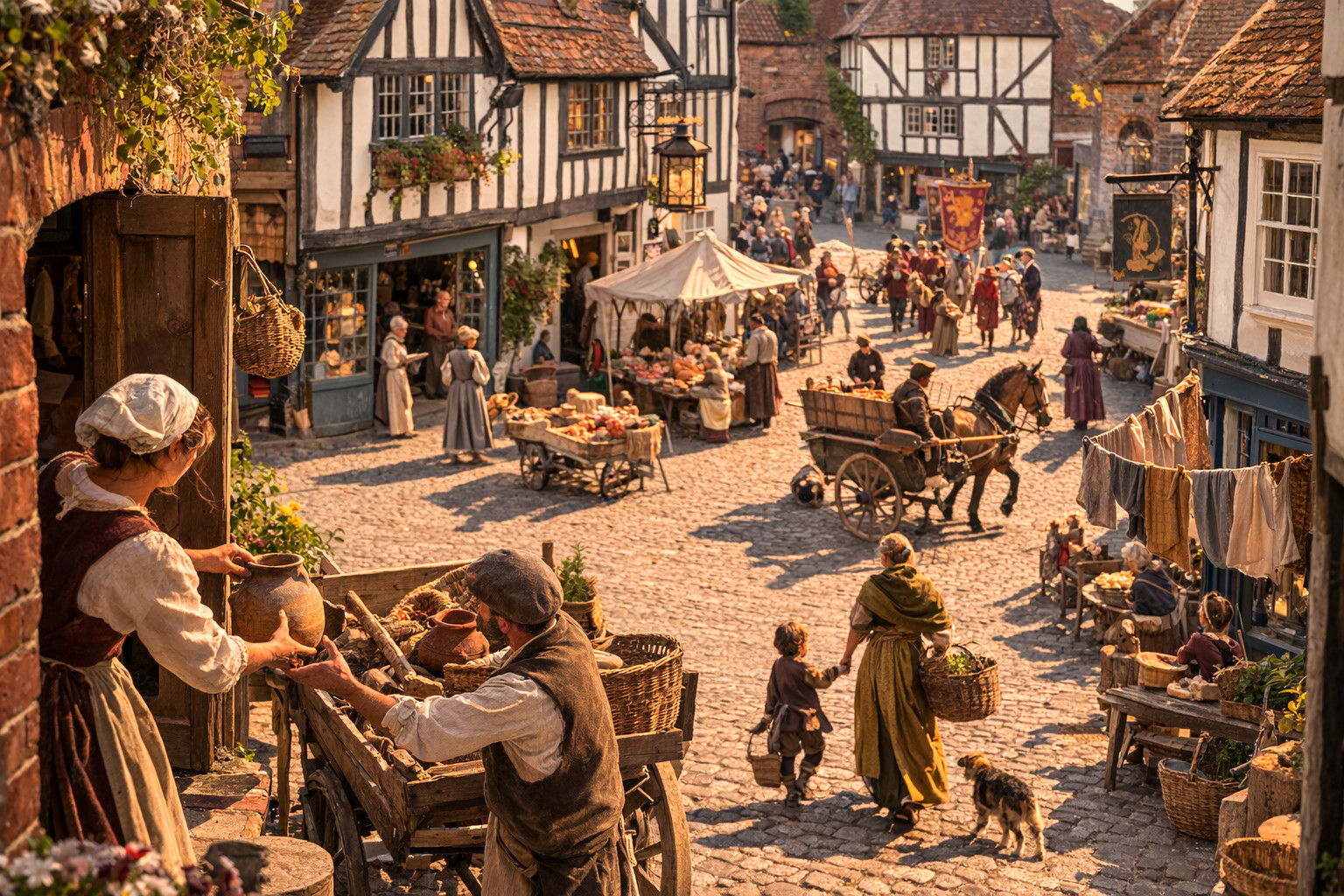
Small market towns were shaped by a mesh of streets, stalls, and domestic spaces that structured daily life.
Residents navigated overlapping roles as traders, neighbors, and ritual participants in settings where commerce and conviviality met.
This article examines how physical layout, household organization, and daily rhythms forged social networks and cultural practices.
Understanding these patterns helps explain how urban life evolved long before industrial transformation.

Market Spaces and Daily Commerce

Market squares and lanes functioned as more than places to buy and sell; they were central meeting points where information, goods, and obligations circulated. Vendors and craftsmen found niches defined by access, visibility, and customary rights, which shaped patterns of trade and social interaction. Local regulation and communal norms mediated disputes and determined who could occupy particular pitches on market days. Over time these routines produced recognizable zones of activity that villagers and townspeople both used and contested.

These commercial geographies also reflected social hierarchies and economic strategies. Traders adapted their practices to seasonal demands and to the ebb and flow of visiting customers.

Domestic Life and Neighborhood Ties

Households in market towns combined living, production, and storage, making the domestic scale a crucial unit of urban economy. Many families ran workshops or sold surplus from their front rooms, so neighbors regularly witnessed and participated in work processes. Kinship ties, apprenticeship arrangements, and informal credit networks reinforced obligations between households and sustained daily commerce. The material layout of homes—courtyards, cellars, and shopfronts—shaped how privacy and public life were negotiated.

Neighborhoods therefore became arenas of mutual aid and social surveillance. Informal rituals, like shared meals and labor exchanges, strengthened communal resilience in times of scarcity.

Movement, Work Rhythms, and Rituals

Patterns of movement—whether merchants arriving by cart, craftsmen commuting between sites, or parishioners attending services—produced temporal rhythms that organized the week. Market days, religious festivals, and seasonal fairs punctuated routines and encouraged long-distance contacts that linked towns to wider regions. These recurring events created opportunities for negotiation, gossip, and the transmission of fashions and ideas. Processions and public ceremonies also reinforced communal identities while allowing elites and commoners to perform social roles.

Consequently, mobility and ritual combined to generate both continuity and change in urban life. They helped towns adapt economically while preserving cultural frameworks for collective action.

Conclusion

Market towns were living systems where space, household practice, and movement intertwined.
Their streets and homes encoded social relationships that guided everyday decisions and long-term strategies.
Studying these interactions sheds light on how communities organized life before modern urban planning emerged.


Previous Post

Practical Workflow for Creating Accurate Historical Timelines

Next Post

Lighting, Sanitation, and Civic Order in Historic Towns

Related Posts

Lighting, Sanitation, and Civic Order in Historic Towns
History

Lighting, Sanitation, and Civic Order in Historic Towns

March 13, 2026
Markets, Memory, and Mobility in Small Historic Towns
History

Markets, Memory, and Mobility in Small Historic Towns

March 8, 2026
Neighborhood Routines and Material Culture in Market Towns
History

Neighborhood Routines and Material Culture in Market Towns

March 8, 2026
Hidden Histories: What Daily Items Reveal About Communities
History

Hidden Histories: What Daily Items Reveal About Communities

March 3, 2026
Next Post
Lighting, Sanitation, and Civic Order in Historic Towns

Lighting, Sanitation, and Civic Order in Historic Towns

Search..

No Result
View All Result

Recent Articles

Lighting, Sanitation, and Civic Order in Historic Towns

Lighting, Sanitation, and Civic Order in Historic Towns

March 13, 2026
Intersections, Households, and Social Life in Market Towns

Intersections, Households, and Social Life in Market Towns

March 13, 2026
Practical Workflow for Creating Accurate Historical Timelines

Practical Workflow for Creating Accurate Historical Timelines

March 12, 2026
Designing Timeline Layouts That Guide Public Understanding

Designing Timeline Layouts That Guide Public Understanding

March 12, 2026
Everyday Borders: Stories of Regional Change and Memory

Everyday Borders: Stories of Regional Change and Memory

March 11, 2026

Subscribe Us

By clicking submit, I authorize History Ours and its affiliated companies to: (1) use, sell, and share my information for marketing purposes, including cross-context behavioral advertising, as described in our Terms of Service and Privacy Policy, (2) supplement the information that I provide with additional information lawfully obtained from other sources, like demographic data from public sources, interests inferred from web page views, or other data relevant to what might interest me, like past purchase or location data, (3) contact me or enable others to contact me by email with offers for goods and services from any category at the email address provided, and (4) retain my information while I am engaging with marketing messages that I receive and for a reasonable amount of time thereafter. I understand I can opt out at any time through an email that I receive, or by clicking here

Subscribe To Our Newsletter

By clicking submit, I authorize History Ours and its affiliated companies to: (1) use, sell, and share my information for marketing purposes, including cross-context behavioral advertising, as described in our Terms of Service and Privacy Policy, (2) supplement the information that I provide with additional information lawfully obtained from other sources, like demographic data from public sources, interests inferred from web page views, or other data relevant to what might interest me, like past purchase or location data, (3) contact me or enable others to contact me by email with offers for goods and services from any category at the email address provided, and (4) retain my information while I am engaging with marketing messages that I receive and for a reasonable amount of time thereafter. I understand I can opt out at any time through an email that I receive, or by clicking here.

© 2026 History Ours | All Rights Reserved

  • Contact Us
  • Privacy Policy
  • Terms of Service
  • Unsubscribe
  • Privacy Choices
  • Contact Us
  • Privacy Policy
  • Terms of Service
  • Unsubscribe
  • Privacy Choices

© 2026 History Ours | All Rights Reserved

No Result
View All Result
  • Home
  • History
  • Biographies
  • Eras
  • Regions
  • Timeline

© 2026 History Ours | All Rights Reserved

Skip to content
Open toolbar Accessibility Tools

Accessibility Tools

  • Increase TextIncrease Text
  • Decrease TextDecrease Text
  • GrayscaleGrayscale
  • High ContrastHigh Contrast
  • Negative ContrastNegative Contrast
  • Light BackgroundLight Background
  • Links UnderlineLinks Underline
  • Readable FontReadable Font
  • Reset Reset