
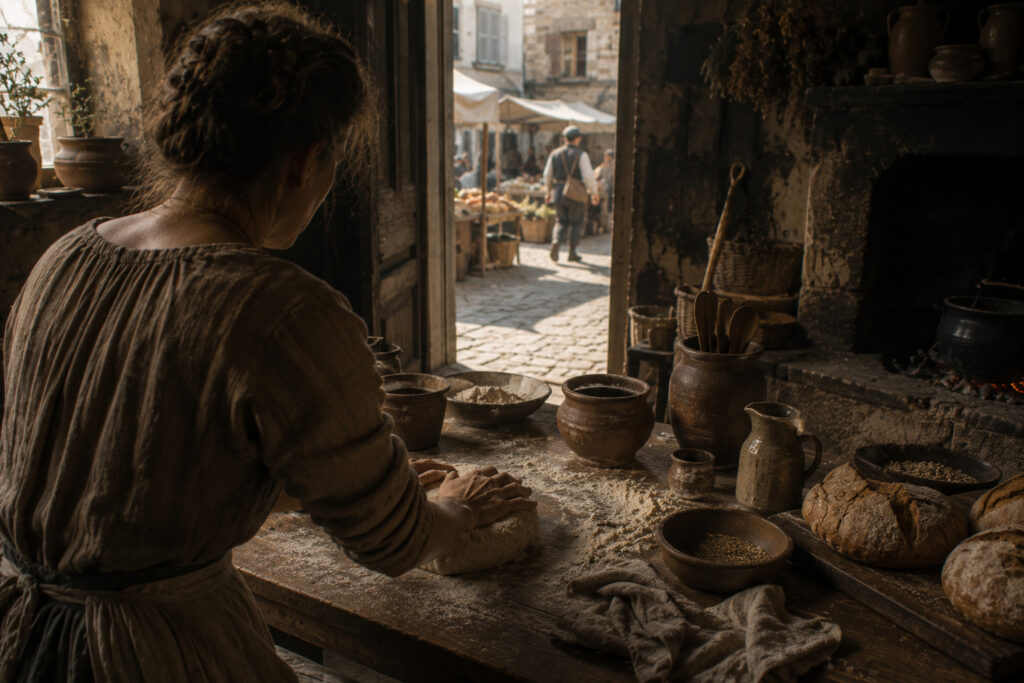
Neighborhood kitchens were more than places to prepare meals; they acted as hubs of production, exchange, and social memory.
In many historic towns household cooking connected domestic routines to market days, festivals, and seasonal labor.
The flows of ingredients, recipes, and labor across thresholds shaped urban rhythms and relationships between neighbors.
Looking at these foodways helps us understand how everyday practices structured public life and urban space.
Domestic Kitchens as Productive Spaces
In preindustrial and early industrial towns kitchens functioned simultaneously as sites of consumption and domestic manufacture, where preservation, baking, brewing, and small-scale processing took place alongside family life.
These activities required tools, storage, and arrangement of space, and they often determined when and how households interacted with nearby markets or itinerant traders.
Women’s labor in food preparation was central to household economies, and recipes circulated through kinship ties, apprenticeships, and casual exchange among neighbors.
Consequently, kitchens were nodes in broader economic networks rather than isolated private rooms; they contributed to the town’s resilience and material culture.
Street Food, Vendors, and Market Circuits
Street vendors and market stalls extended domestic production into public streets, offering cooked dishes, baked goods, and preserved foods to passersby and late-shift workers.
These vendors negotiated regulations, guild restrictions, and public order while shaping the soundscape and aroma of market quarters, drawing customers through scent and display.
Market circuits connected rural producers to urban consumers, and the timing of sales — morning bread, midday pies, evening soups — mapped onto occupational schedules and ritual practices.
Thus, street food both complemented household kitchens and created a parallel economy that sustained diverse urban populations.
Material Culture and Food Rituals
Utensils, hearths, communal ovens, and storage vessels reveal how material objects structured cooking practices and social obligations in town neighborhoods.
Ceramics and metalwork not only served functional needs but signaled status, taste, and belonging in competitive and cooperative social contexts.
Food-centered rituals — from market feasts to seasonal preserves — reinforced communal calendars and provided occasions for negotiation of identity and mutual aid.
Studying these material traces and rituals uncovers everyday strategies for survival, hospitality, and neighborhood cohesion across changing economic conditions.
Conclusion
Historic neighborhood kitchens and urban foodways offer a window into how daily practices shaped public life and social networks.
They show the interplay between private labor and public exchange, revealing invisible infrastructures of community care.
Understanding these dynamics enriches our view of urban history and the material foundations of civic life.