Uncover History’s Secrets with Daily Updates!
Daily News Entertainment
  • Home
  • History
  • Biographies
  • Eras
  • Regions
  • Timeline
No Result
View All Result
History Ours
  • Home
  • History
  • Biographies
  • Eras
  • Regions
  • Timeline
No Result
View All Result
History Ours
No Result
View All Result

Bahis vergilendirmesi Türkiye’de devlet kontrolündedir, ancak yeni açılan casino siteleri gibi uluslararası sitelerde oyuncular kendi kazançlarını yönetir.

Home History

Notices, Gossip, and Gesture Around the Market Cross

in History
Notices, Gossip, and Gesture Around the Market Cross

Small market towns were shaped as much by signals and social performance as by goods.
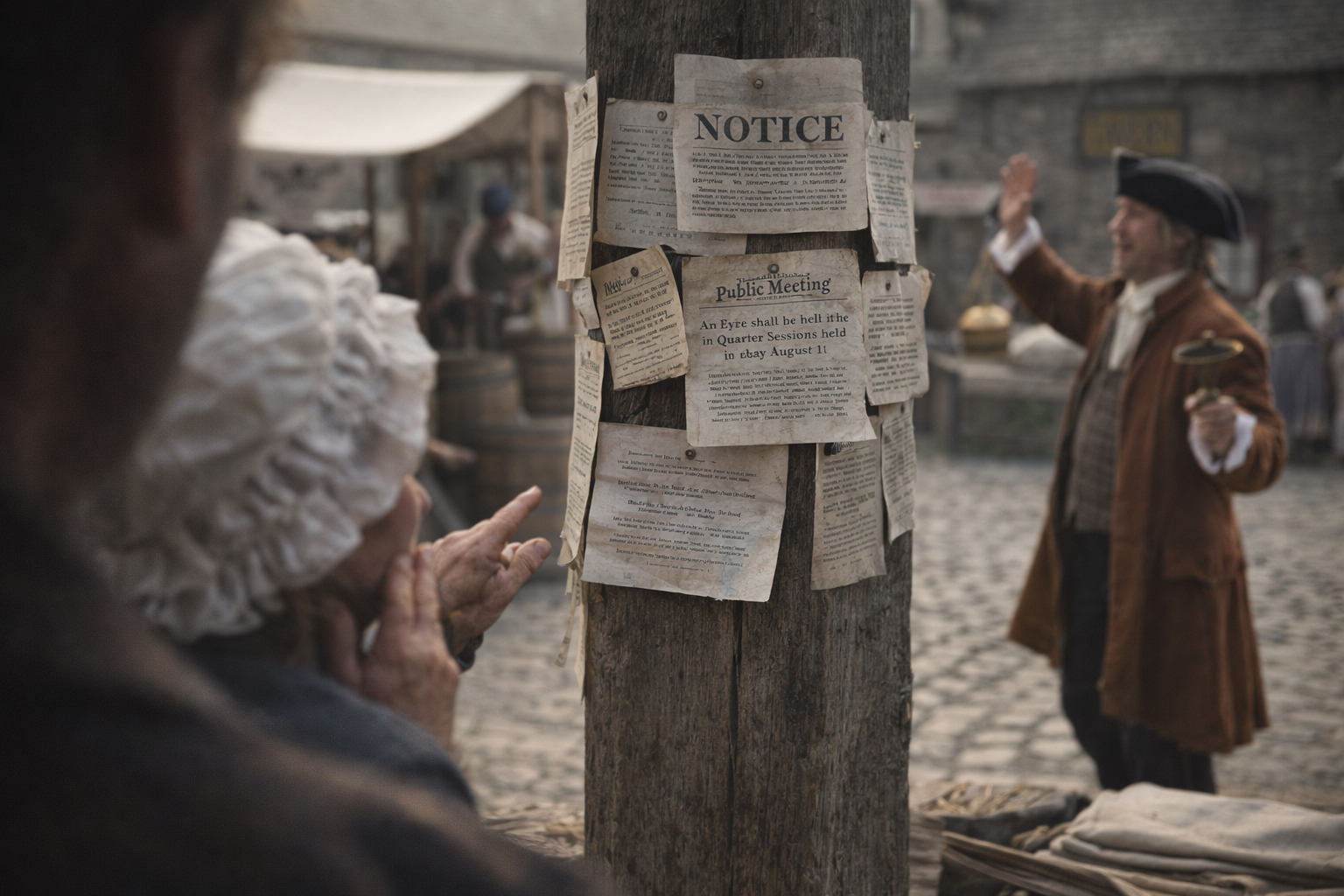
Notices nailed to a post, the ring of a bell, a trader’s raised voice — each carried meaning.
Daily life at the market cross was a choreography of announcement, bargaining and dispute.
Studying these gestures helps recover how people organized information, authority and trust.
This piece examines the visible and spoken practices that structured communal life.

Public Announcements and the Market Cross

Officials used the market cross as the primary locus for formal pronouncements and legal notices. Proclamations, new regulations, and the calling of courts were posted there so that traders and residents could be kept informed. Broadsides and pasted notices circulated regulations but also opinions; a posted sheet could draw attention or provoke response. Because literacy varied, proclamations were often read aloud by a town criers or repeated in conversation.

In short, the cross made officialdom visible and accountable. Its placement in the busiest public space ensured announcements reached a wide audience.

Gossip, Taverns and Informal News Networks

Beyond formal notices, gossip and oral exchange animated the market day. Taverns, alehouses, and market stalls functioned as information hubs where news about prices, marriages, debts, and disputes spread rapidly. Women, apprentices, and itinerant traders moved stories between households as part of daily routines. Rumor could be corrective or corrosive, shaping reputations as surely as any posted notice.

  • Taverns and alehouses where patrons exchanged news
  • Market stalls as nodes of repeated contact
  • Church gatherings and guild meetings that circulated updates
  • Travelers and hawkers bringing news from other towns

These informal channels complemented official announcements and often translated them into local terms. Understanding both is necessary to reconstruct how information actually moved.

Material Signals and Bodily Gesture

Physical markers and performances communicated status, intent, and availability. Shop signs, colored cloth, and the arrangement of stalls signaled the kind of goods sold and the identities of traders. Bells, gestures such as raised hands, or the wearing of particular garments signaled times to trade, to stop, or to celebrate. These cues reduced transaction costs in crowded spaces and made social roles legible at a glance.

Material culture and gesture worked together to govern flows of people and goods. They made the market intelligible even to newcomers.

Conclusion

The market cross and its surrounding practices formed a dense web of communication.
Formal notices and informal talk together produced public order and social knowledge.
Attending to these everyday signals enriches our view of pre-modern urban life.


Previous Post

Postal Routes and Rumor: Information Flow in Historic Towns

Next Post

Building Empathy When Writing Short Biographies

Related Posts

Notices, Gossip, and Gesture Around the Market Cross
History

Postal Routes and Rumor: Information Flow in Historic Towns

March 28, 2026
Hidden Infrastructure of Market Towns and Everyday Life
History

Hidden Infrastructure of Market Towns and Everyday Life

March 23, 2026
Market Streets and Social Worlds of Small Towns
History

Market Streets and Social Worlds of Small Towns

March 23, 2026
Waterways, Mills, and the Pulse of Market Town Economies
History

Waterways, Mills, and the Pulse of Market Town Economies

March 18, 2026
Next Post
Building Empathy When Writing Short Biographies

Building Empathy When Writing Short Biographies

Search..

No Result
View All Result

Recent Articles

Choosing Effective Timeframes for Historical Analysis

Choosing Effective Timeframes for Historical Analysis

March 30, 2026
Criteria and Methods for Naming Historical Eras

Criteria and Methods for Naming Historical Eras

March 30, 2026
Framing a Life: Practical Steps for Biographical Research

Framing a Life: Practical Steps for Biographical Research

March 29, 2026
Building Empathy When Writing Short Biographies

Building Empathy When Writing Short Biographies

March 29, 2026
Notices, Gossip, and Gesture Around the Market Cross

Notices, Gossip, and Gesture Around the Market Cross

March 28, 2026

Subscribe Us

By clicking submit, I authorize History Ours and its affiliated companies to: (1) use, sell, and share my information for marketing purposes, including cross-context behavioral advertising, as described in our Terms of Service and Privacy Policy, (2) supplement the information that I provide with additional information lawfully obtained from other sources, like demographic data from public sources, interests inferred from web page views, or other data relevant to what might interest me, like past purchase or location data, (3) contact me or enable others to contact me by email with offers for goods and services from any category at the email address provided, and (4) retain my information while I am engaging with marketing messages that I receive and for a reasonable amount of time thereafter. I understand I can opt out at any time through an email that I receive, or by clicking here

Subscribe To Our Newsletter

By clicking submit, I authorize History Ours and its affiliated companies to: (1) use, sell, and share my information for marketing purposes, including cross-context behavioral advertising, as described in our Terms of Service and Privacy Policy, (2) supplement the information that I provide with additional information lawfully obtained from other sources, like demographic data from public sources, interests inferred from web page views, or other data relevant to what might interest me, like past purchase or location data, (3) contact me or enable others to contact me by email with offers for goods and services from any category at the email address provided, and (4) retain my information while I am engaging with marketing messages that I receive and for a reasonable amount of time thereafter. I understand I can opt out at any time through an email that I receive, or by clicking here.

© 2026 History Ours | All Rights Reserved

  • Contact Us
  • Privacy Policy
  • Terms of Service
  • Unsubscribe
  • Privacy Choices
  • Contact Us
  • Privacy Policy
  • Terms of Service
  • Unsubscribe
  • Privacy Choices

© 2026 History Ours | All Rights Reserved

No Result
View All Result
  • Home
  • History
  • Biographies
  • Eras
  • Regions
  • Timeline

© 2026 History Ours | All Rights Reserved

Skip to content
Open toolbar Accessibility Tools

Accessibility Tools

  • Increase TextIncrease Text
  • Decrease TextDecrease Text
  • GrayscaleGrayscale
  • High ContrastHigh Contrast
  • Negative ContrastNegative Contrast
  • Light BackgroundLight Background
  • Links UnderlineLinks Underline
  • Readable FontReadable Font
  • Reset Reset