
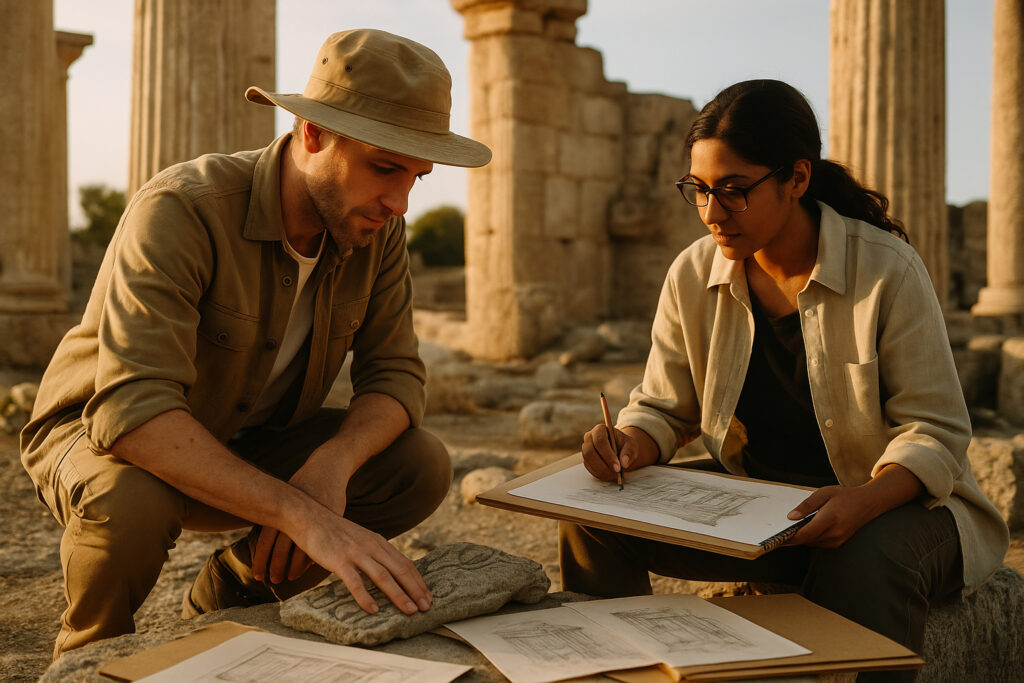
History is more than words on a page—it lives in the paintings, sculptures, and buildings that time leaves behind. Art and architecture are visual records of human progress, belief, and imagination. By studying them, we don’t just see what ancient people built or painted—we understand how they lived, what they valued, and how they saw the world.
1. Art as a Reflection of Society
From prehistoric cave paintings to Renaissance masterpieces, art captures the essence of its era. Ancient Egyptian murals tell stories of gods and kings, while Greek sculptures celebrate the beauty of the human form. Each brushstroke and carving is a glimpse into the minds of people long gone.
In modern times, art continues to document social and political change—offering historians a vibrant record of revolution, resistance, and rebirth. Every piece, whether a mural or a digital installation, helps reconstruct how humanity has evolved.
2. Architecture: The Stone Memory of Civilization
While art captures emotion, architecture captures structure—literally. From the Pyramids of Giza to Gothic cathedrals and Mughal palaces, buildings stand as testaments to a civilization’s innovation and values.
Architectural styles reveal cultural exchange: Roman arches influenced European cathedrals, while Islamic geometry inspired modern design. Even ruins tell a story. The remains of Pompeii or the temples of Angkor Wat offer physical evidence of daily life, belief systems, and craftsmanship from centuries ago.
3. Restoring and Reimagining the Past
Preservation and restoration play vital roles in reconstructing history. Modern technology—like 3D scanning, digital modeling, and virtual reconstruction—allows historians and architects to rebuild lost heritage sites.
For instance, digital recreations of ancient cities such as Babylon and Palmyra have made it possible to study architecture destroyed by time or conflict. Through these reconstructions, art and design become tools not just for memory, but for revival.
4. The Intersection of Creativity and Archaeology
Art and architecture bridge the gap between science and imagination. Archaeologists uncover fragments; artists visualize what once stood. This collaboration transforms ruins into immersive experiences that allow modern audiences to step back in time.
Museums, exhibitions, and even video games now use artistic reconstructions to breathe life into history, showing that creativity is essential to understanding the past.
Conclusion
Reconstructing history through art and architecture keeps the past alive—not as a distant memory, but as a living dialogue between eras. Each restored painting and rebuilt monument reminds us that beauty and culture endure beyond time. In understanding how humans once shaped their world, we find inspiration to build—and preserve—our own.