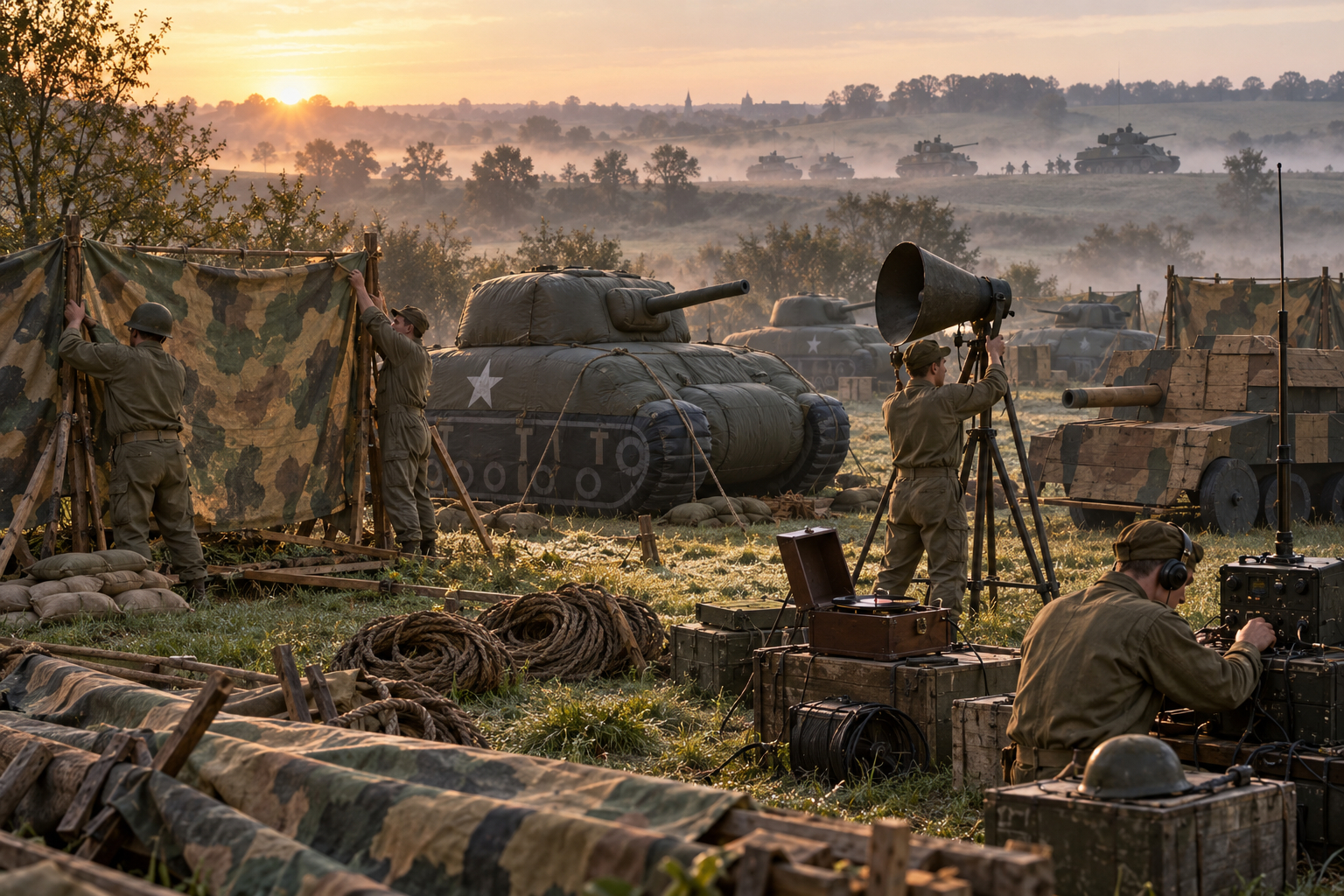
In 1944 the U.S. Army quietly recruited painters, set designers, sound engineers and sculptors into a single, unusual formation: the 23rd Headquarters Special Troops, today usually called the Ghost Army. Roughly 1,100 men served in the unit. They were not meant to seize ground or destroy enemy positions; their mission was deception—creating convincing illusions that redirected German forces away from real Allied movements.
Tools of theatrical war
The Ghost Army’s toolbox read like a stage crew’s shopping list. Inflatable tanks and jeeps—rubber decoys that could be hauled into position and popped up to look like armored divisions—were paired with wooden mock-ups to complete the sightline. Large canvas panels painted to resemble camouflage netting and vehicle sides helped sell the image from a distance. More striking were the audio rigs: modified speakers and record players that played layered tracks of tanks rolling, men marching, and field commands at the right volume and distance to fool enemy listeners and forward observers.
Radio deception was another crucial element. Operators transmitted fake chatter mimicking the format and style of actual Allied units, luring German radio-monitoring teams into drawing false conclusions about force size and location. All of this was choreographed with the care of a theater production—lighting, timing and the right backdrop mattered as much as authenticity.
Operations and impact
The Ghost Army followed the front across Europe after D‑Day, staging decoys and diversions at key moments. Their work could be as simple as faking a brigade’s presence to keep enemy reconnaissance officers occupied, or as elaborate as simulating entire corps movements to mask real troop concentrations. Commanders credited these deceptions with helping to blunt German responses and protect genuine formations moving to or from battlefronts.
Because their missions were classified, the unit’s achievements remained largely unknown for decades. The techniques they refined—visual decoys, recorded battlefield acoustics, controlled radio traffic—were an early, improvised form of information and psychological warfare. The men who painted, constructed and broadcast were often artists in civilian life; their professional skills translated into military advantage in ways few had imagined when they enlisted.
Conclusion
The Ghost Army rewrote a wartime playbook: not by sheer firepower, but by convincing the enemy that power existed where it did not. Their story complicates familiar images of World War II as only tanks and infantry; it shows how persuasion, craft and a touch of theatricality became weapons in their own right. Long hidden in the archives, the Ghost Army is now remembered as one of the war’s most inventive units—proof that imagination can be as decisive as ordinance on the battlefield.