
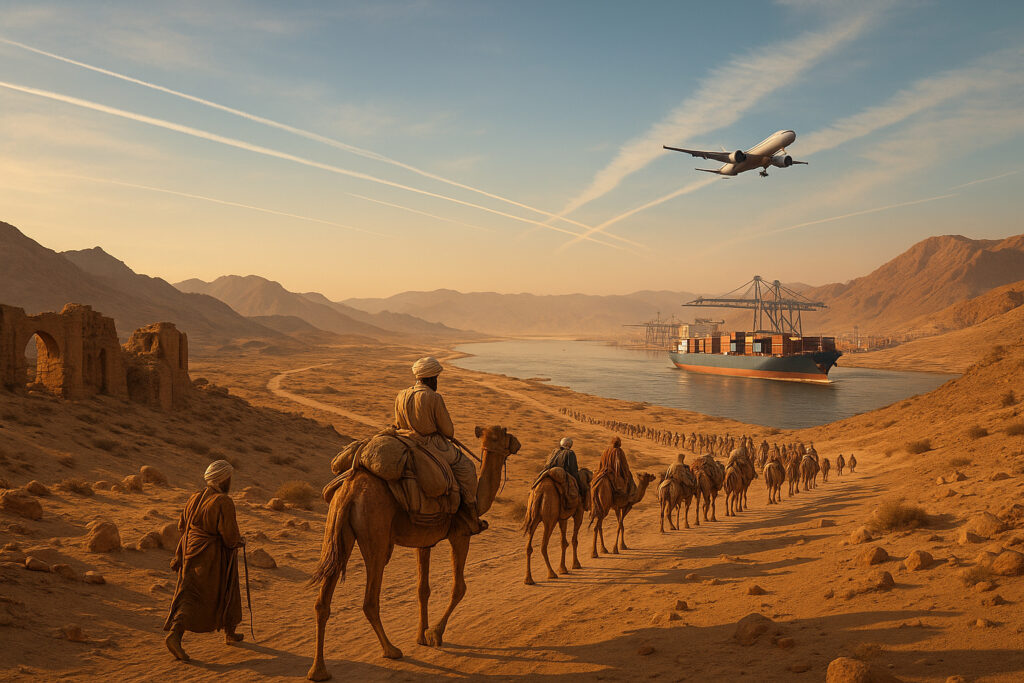
Trade has always been more than the exchange of goods—it’s the exchange of ideas, culture, and innovation. From the dusty paths of the Silk Road to the digital highways of modern commerce, trade routes have shaped economies, connected civilizations, and built the foundations of our globalized world. Each era of trade brought humanity closer together, weaving a story of exploration, ambition, and shared progress.
The Silk Road: The World’s First Superhighway
Stretching over 6,000 kilometers from China to the Mediterranean, the Silk Road was the lifeline of ancient civilization. Silk, spices, gold, and precious stones flowed through bustling caravan cities, but so did something far more valuable—knowledge. Along these routes, merchants, monks, and explorers exchanged philosophies, inventions, and art. Buddhism spread from India to East Asia, paper-making reached the Middle East and Europe, and cultural fusion flourished. The Silk Road proved that trade was as much about connection as it was about commerce.
The Maritime Revolution
As navigation advanced, ocean trade routes became the arteries of global exchange. The Indian Ocean trade network linked Africa, Arabia, India, and Southeast Asia long before European exploration began. Later, the Age of Discovery—led by explorers like Vasco da Gama and Christopher Columbus—expanded trade to a planetary scale. Spices, silver, and textiles transformed empires, while ports like Venice, Calicut, and Malacca became symbols of prosperity and cultural blending.
Industrialization and Global Integration
The 19th century brought steamships, railroads, and telegraphs, shrinking distances and revolutionizing economies. Trade moved from luxury goods to mass production. Colonization, though exploitative, integrated global markets, laying the groundwork for modern capitalism. By the 20th century, international trade agreements and technological innovation had turned the world into an interconnected economic network.
The Digital Silk Road
Today, trade is no longer limited to ships or caravans—it flows through fiber-optic cables and digital platforms. E-commerce, blockchain, and global logistics have created a new kind of Silk Road, one where data is the most valuable commodity. Nations are reimagining trade routes with technology, but the essence remains the same: connection, cooperation, and opportunity.
Conclusion
From camel caravans to cargo planes, trade routes have been the invisible threads weaving human history together. They’ve built cities, shaped cultures, and united continents. The journey from the Silk Road to globalization is a story of how movement—of people, ideas, and ambition—continues to drive progress in an ever-connected world.