
Built to Impress
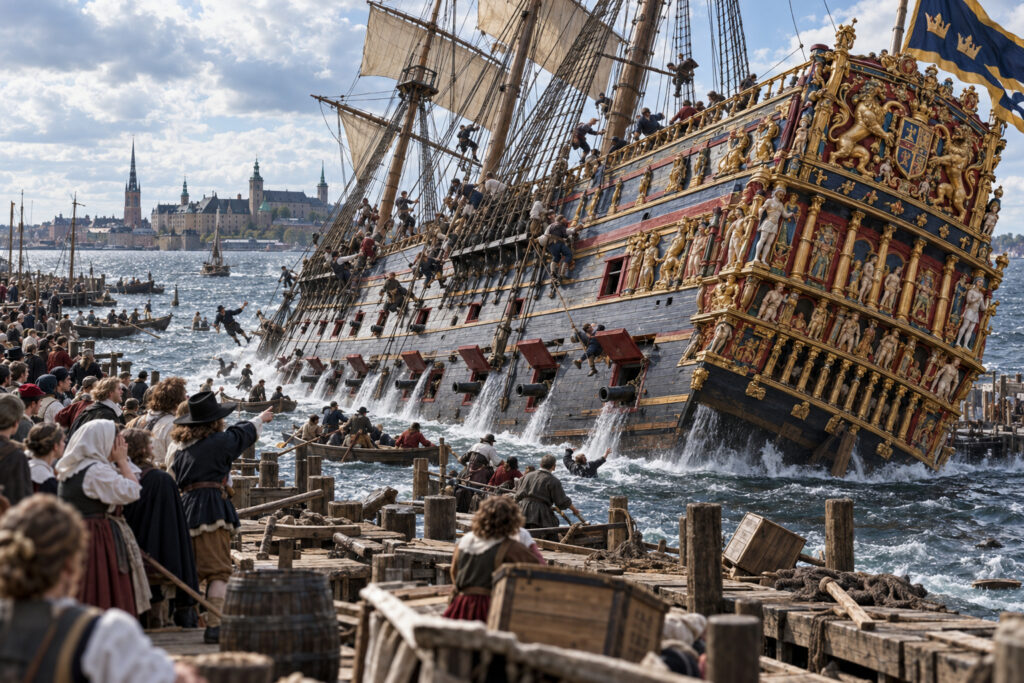
The Vasa was conceived as a floating proclamation of Swedish power: two gun decks, rows of bronze cannons, and a forest of carved figures along her stern and bow. Her timbers were worked into lions, Roman emperors, and saintly saints, painted bright to catch the eye of anyone watching the navy grow. She was expensive, ornate, and rushed into being at a moment when the Swedish crown wanted a fleet that could match continental rivals.
Contemporaries remember her as magnificent — the kind of ship meant to turn heads in any harbor. That very ornament, though, hinted at a deeper problem. The Vasa’s designers piled weight high above the waterline to satisfy royal expectations of armament and show, and in doing so they stacked instability into the hull.
A Short Maiden Voyage
On a gusty summer day, not long after she slid into the water, the Vasa steamed out of Stockholm harbor before a modest crowd. She had hardly cleared the wharves when a gust of wind sent her leaning to one side. Water began to pour in through the lower gunports. Within minutes the great ship lurched, righted and then heeled over again — this time to fatal effect. She sank while still inside the harbor, settling into the cold, brackish Baltic and taking with her sailors, soldiers, and onlookers.
The disaster was not a mystery to later investigators: a design that placed too much weight too high, insufficient ballast, and perhaps pressure from patrons to rush construction combined with inadequate stability testing. The quick loss of the Vasa became an embarrassment precisely because she had been built to symbolize mastery at sea.
From Wreck to Museum
For more than three centuries the Vasa lay buried in silt and mud, remarkably preserved by the Baltic’s low-salinity waters. In 1961 she was raised in an astonishing salvage operation and carefully conserved. What came up with her was a time capsule: thousands of objects, from cannon and carpenters’ tools to clothing fragments, shoes, and personal items that reveal the routines of sailors and craftsmen.
Today the Vasa occupies her own museum in Stockholm. Walk around her and the carvings and gunports still astonish. Seeing the cramped decks and the angle of the gun ports helps explain why she could not hold a broadside and stay upright. The ship that failed at sea now succeeds as an unusually complete window into early 17th-century naval life, shipbuilding, and the politics of prestige.
Conclusion
The Vasa’s story is a compact lesson in how ambition and display can outrun technical judgement. She sank because of choices — political, aesthetic, and engineering — made ashore. Recovered centuries later, she has been reborn not as a weapon but as an exceptionally vivid witness to a vanished age.