
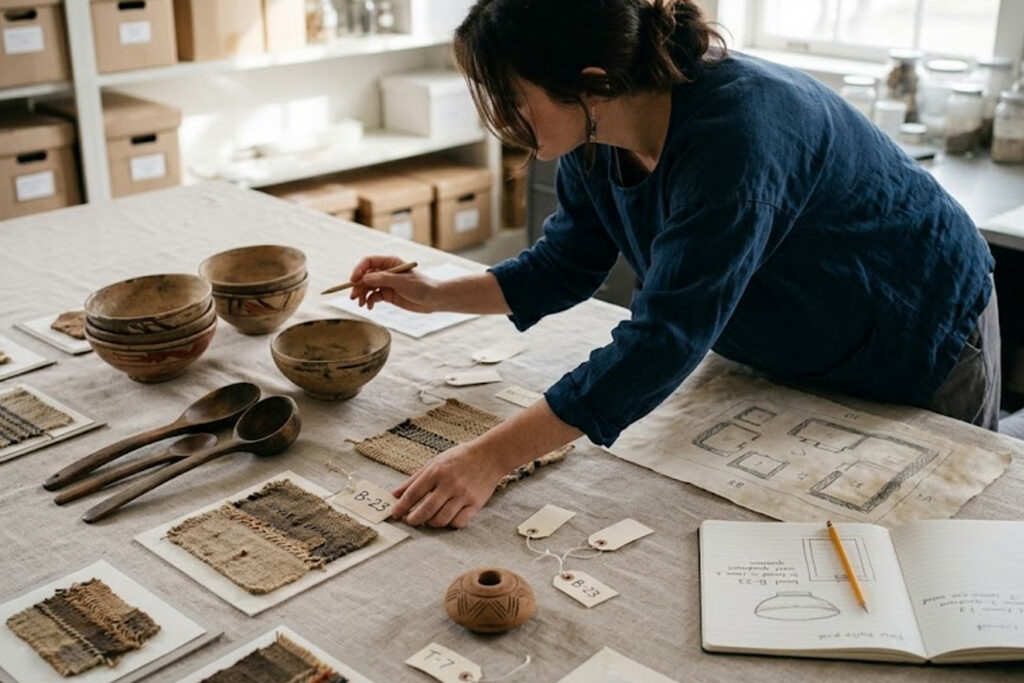
Household objects carry stories that formal records often omit. They reveal routines, values, and the small adaptations people made to daily life. Examining tools, ceramics, textiles, and domestic spaces lets historians reconstruct social relations and economic choices. This approach broadens our understanding of past communities beyond elite narratives.
Everyday Objects as Historical Evidence
Objects used in daily life are tangible witnesses to human behavior and decision-making. They can indicate who performed certain tasks, which technologies were preferred, and how resources were allocated within households. For example, wear patterns on kitchen tools or the distribution of storage vessels can suggest cooking practices and food economies. Material remains complement written records by providing concrete proof of mundane activities.
Careful cataloguing and contextual notes help turn objects into reliable evidence. They must be dated, sourced, and compared across assemblages to avoid misleading conclusions. When combined with oral histories and documents, artifacts form a richer narrative.
Contextualizing Material Culture
Context is essential: isolated finds tell less than items excavated in situ or recorded with provenance. The placement of objects within a dwelling, their association with architectural features, and their stratigraphic relationships all shape interpretation. Spatial patterns within homes can reveal gendered divisions of labor, storage practices, and patterns of social interaction. Without context, objects risk being misread or reduced to mere typologies.
Field notes, maps, and photographs preserve context for later analysis. Digital databases and GIS tools now enable researchers to visualize spatial relationships more clearly. This allows more nuanced arguments about daily life and social organization.
Reading Bias and Methodological Care
Interpreting material culture requires awareness of archaeological and archival bias. Preservation favors durable goods, so fabrics and perishables are often absent from records. Researchers must account for these gaps and avoid projecting modern assumptions onto past behaviors. Experimental archaeology and ethnoarchaeology can test hypotheses about how objects were used.
- Document preservation differences and taphonomic processes.
- Use experimental replication to assess functionality.
- Cross-reference with ethnographic analogies cautiously.
Triangulating multiple lines of evidence reduces the risk of overinterpretation. Teams that combine specialists in material analysis, social history, and conservation produce the most balanced readings.
Applications for Public History
Material-focused narratives connect museum visitors and communities to lived experiences of the past. Exhibits that present objects alongside stories of makers and users encourage empathy and engagement. Community archaeology projects that involve residents in interpreting finds democratize historical knowledge and highlight local memory. Such initiatives make history tangible and relevant to contemporary audiences.
Curators and educators should prioritize accessible explanations and participatory displays. When done thoughtfully, object-based interpretation strengthens public interest in historical research.
Conclusion
Household artifacts illuminate the rhythms and choices of daily life in ways documents cannot. Thoughtful contextual analysis and methodological care turn objects into meaningful historical evidence. Emphasizing material culture invites broader, more inclusive histories of past communities.