
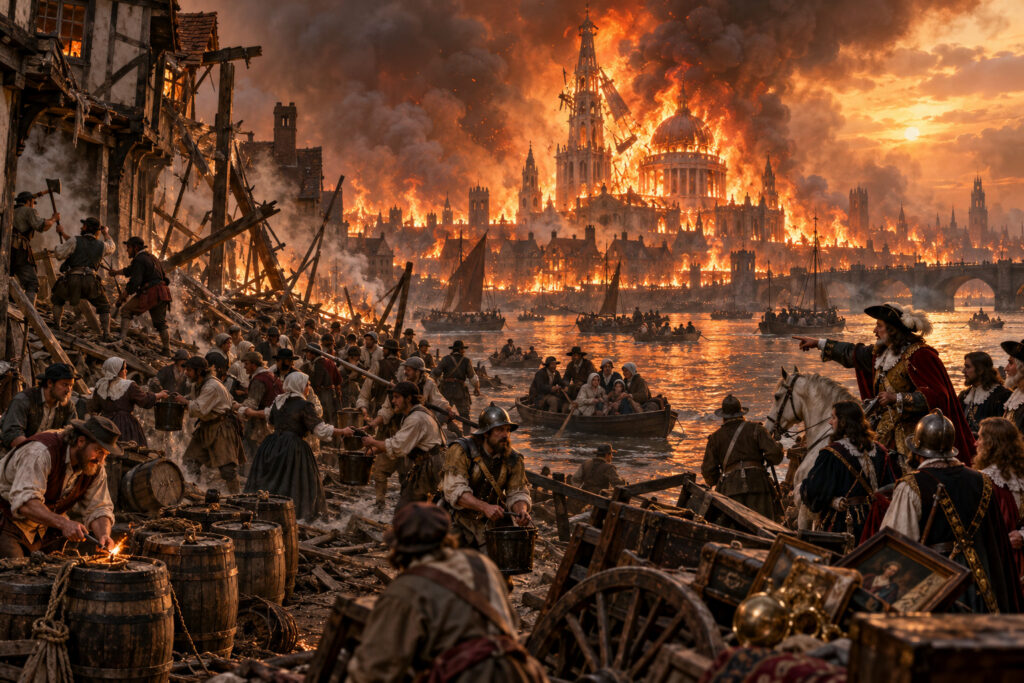
In the small hours of September 2, 1666, a spark in the bakery of Thomas Farriner on Pudding Lane found tinder in a cramped, timber city. Narrow streets, overhanging jettied houses and a long, dry summer made the old City of London especially vulnerable. Smoke and flames were noticed early; diarist Samuel Pepys recorded the alarm and the scramble that followed. Efforts to stop the blaze faltered: the Lord Mayor, uncertain how far to pull down houses, hesitated, and a brisk easterly wind drove the fire across rooftops and down alleys.
Day Two: The Fire Runs Free (September 3)
By dawn on the 3rd the fire had become a massive, moving inferno. Heat leapt from roof to roof; whole blocks ignited when thatch and timber met sparks. Citizens and soldiers formed lines with leather buckets and hooks, trying to tear down burning beams before the flames jumped. The fire crossed the River Fleet and pushed toward the heart of the city. Important timbered public buildings and warehouses—stuffed with goods, grain and oil—fed the blaze. City authorities began to use demolition and imported gunpowder to create break lines, but these measures came late and patchy.
Day Three and Four: St. Paul’s Falls, the Wind Shifts, and Control (September 4–5)
On September 4 the fire reached St. Paul’s Cathedral. The medieval cathedral’s timbers and lead roof made it vulnerable; the great spire collapsed as flames consumed the building’s interior. King Charles II and his brother, the Duke of York, took on visible leadership, directing efforts and ordering more decisive demolitions. A change in the weather was decisive: on the 5th the wind that had fanned the flames shifted and eased. Firefighting became coordinated—lines of soldiers and civilians, newly cut firebreaks and targeted blasting combined to stop the spread. By the evening of the 5th the most destructive phase was over, though smoldering pockets remained for days.
Conclusion
The Great Fire consumed roughly 13,200 houses, 87 parish churches and the medieval St. Paul’s, leaving perhaps 70,000 people homeless. Official death records list surprisingly few fatalities, but the social and economic shock was enormous. The catastrophe cleared swathes of densely packed medieval streets and forced a reinvention of the city: new building regulations, wider streets, and brick in place of timber. Christopher Wren’s later designs—most famously the rebuilt St. Paul’s—gave London a different skyline. The four days in September 1666 remain an unforgettable example of how a single spark, under the worst conditions, can reshape a city for centuries to come.