
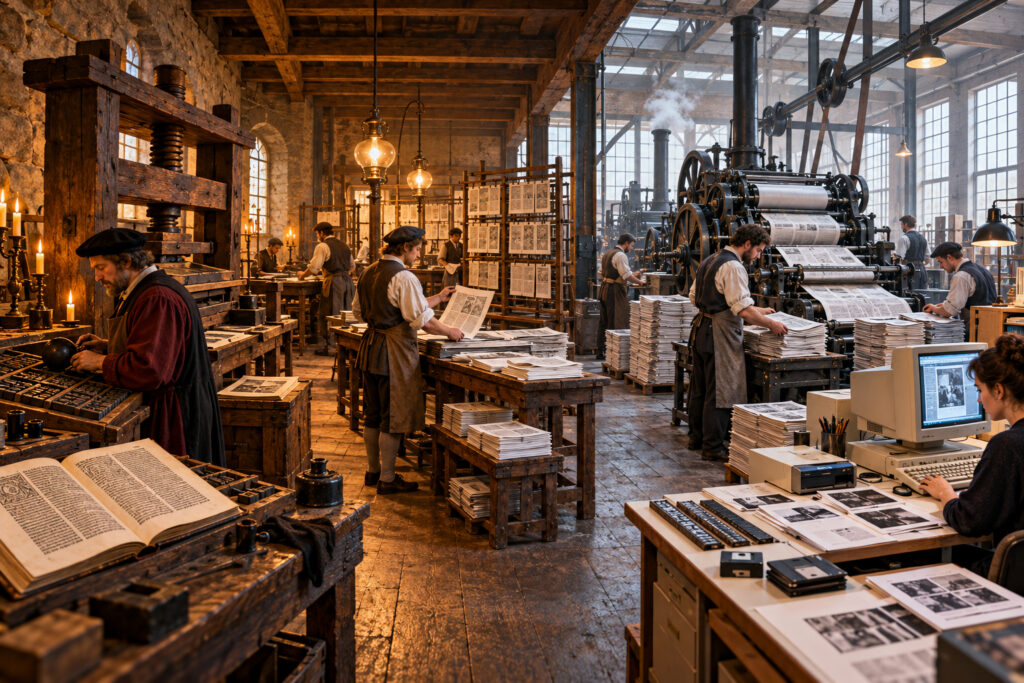
1450s–1500s: Gutenberg and the first printed books
In mid-15th-century Mainz, Johannes Gutenberg combined a hand press, oil-based inks, and movable metal type to produce books faster and more uniformly than manuscript copying allowed. The best-known survivor from that burst of innovation is the Gutenberg Bible (ca. 1455), a dense, two-volume work whose crisp black pages looked unlike anything previously seen in Western Europe. Printers followed Gutenberg across the continent; within fifty years, dozens of towns hosted presses. That expansion turned books from rare luxury objects into increasingly available carriers of information.
1500s–1600s: Mass ideas and early newspapers
As printing spread, its consequences were cultural, not merely technical. Printers in Paris, Venice, Antwerp and elsewhere produced maps, pamphlets and vernacular Bibles. The Reformation offers the clearest example: Martin Luther’s 1517 ideas, printed and reprinted, could travel far beyond their origin in Wittenberg. By the early 17th century the press was again evolving into a faster public medium. The Relation, often cited as Europe’s first regularly published news sheet, appeared around 1605 in Strasbourg, heralding the age of printed news and information marketplaces.
18th–19th centuries: Mechanization and speed
Industrial power changed printing’s scale. Steam-powered presses in the early 1800s and later inventions such as the rotary press multiplied output, turning single-press workshops into factories capable of printing thousands of pages an hour. Newspapers went from elite pamphlets to mass-circulation dailies. Typesetting itself was speeded by machines: Ottmar Mergenthaler’s Linotype (1884) let one operator set entire lines of type mechanically, a breakthrough that fed booming newspaper and book industries and lowered costs for readers.
20th century to 1990s: Offset, phototypesetting, and desktop publishing
In the 20th century offset lithography became the standard for high-volume, high-quality printing, while photographic and electronic typesetting replaced hot-metal methods. By the 1980s, two modest inventions changed the landscape again: the personal computer with graphical interfaces and page-layout software such as Aldus PageMaker (1985). Suddenly, design and publication moved from industrial plants into offices and small shops. The arrival of the internet in the 1990s began shifting attention from ink on paper to pixels on screens, but printing remained foundational for newspapers, books and packaging.
Conclusion
The printing press didn’t end with Gutenberg; it has repeatedly reinvented itself. From hand-cast type in Mainz to mechanized rotary cylinders, from Linotype keyboards to desktop publishing and the web, each leap made information cheaper and faster to distribute. The result is familiar: a world where ideas travel quickly, where pamphlets can spark movements and where the look and speed of text continue to shape public life. The timeline of printing is, in many ways, the timeline of how people learned about the world.