Origins: From Revolt to a Company
The late 16th century turned the Low Countries into a place of restless opportunity. After decades of revolt against Habsburg rule, provinces bound themselves in the Union of Utrecht (1579) and then declared independence as the Dutch Republic. Maritime merchants, long active in Baltic and Mediterranean trade, turned their ships farther afield when Spain and Portugal faltered.
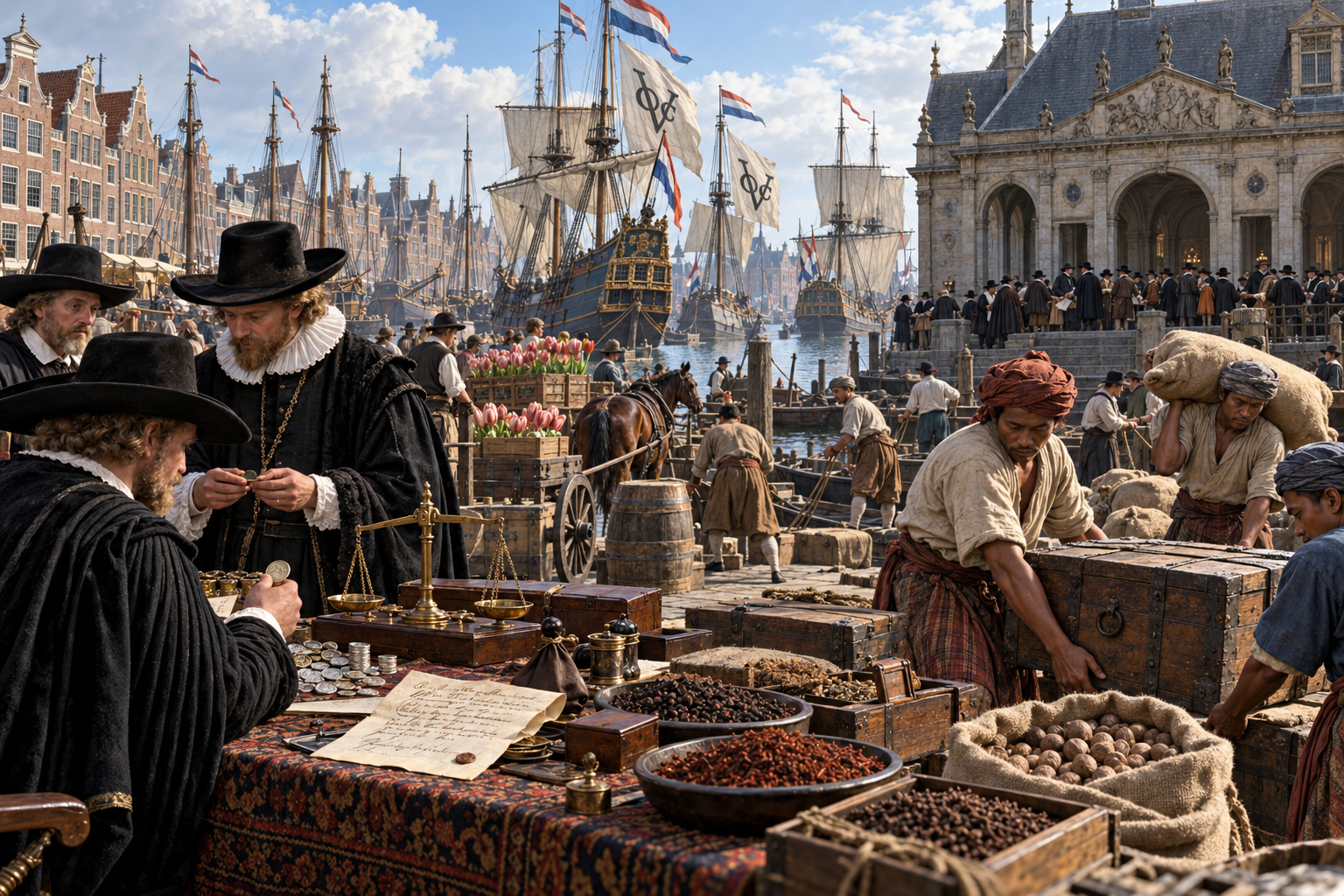
In 1602 these merchants did something unprecedented: they pooled capital and royal privileges to create the Vereenigde Oostindische Compagnie, the VOC. The new company issued transferable shares, promised regular dividends and carried a government license to wage war, make treaties and administer territory. Amsterdam became the financial hub; the VOC the world’s most powerful trading enterprise of its age.
Peak: Spice, Stocks, Cities, and Culture (1619–1670s)
Within two decades the VOC had carved out a network across the Indian Ocean. In 1619 the company established Batavia on Java as its Asian headquarters, turning it into a re-supply and administrative center. The drive to monopolize spices—nutmeg, mace, cloves—led to aggressive campaigns in the Banda Islands and elsewhere to secure supply routes.
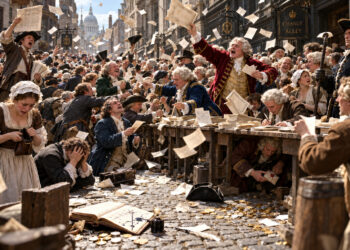
Back home, Amsterdam’s harbor swelled with bullion and goods. The exchange where VOC shares traded became a prototype for modern capital markets. The wealth showed in brick and gable: canals were widened, merchant houses rose, and the city became a magnet for painters like Rembrandt and Vermeer, whose work reflected new urban confidence.
Not every boom was sober. The tulip craze of 1636–1637 remains the era’s most famous speculative mania, a cultural footnote to the financial innovations that made Amsterdam a center of risk and reward.
Cracks and Decline: Competition and War (Late 1600s–1799)
The Dutch Republic fought several naval wars with England in the mid-17th century. The First Anglo-Dutch War (1652–1654) and later conflicts punctured Dutch maritime dominance; the humiliating Dutch defeat at the Raid on the Medway (1667) was a shock even if it did not end Dutch influence immediately.
Over the 18th century the VOC grew fat and administratively strained. Rising competition from the British and French, corruption, and mounting costs of garrisoning distant territories squeezed profits. The Fourth Anglo-Dutch War (1780–1784) further weakened the republic’s global standing. Revolutionary turmoil on the continent toppled old privileges: the Batavian Republic replaced the Dutch Republic in 1795, and the VOC—already hollowed out—was formally dissolved in 1799.
Conclusion
The Dutch Golden Age and the VOC left a mixed legacy. They were engines of trade, finance and artistic achievement, and they helped invent institutions—joint stock companies, stock markets—that shape modern capitalism. They also reshaped distant societies through forceful monopolies and colonial rule. The arc from 1602 to 1799 is a compact story of innovation, wealth, cultural florescence and the costs of empire.