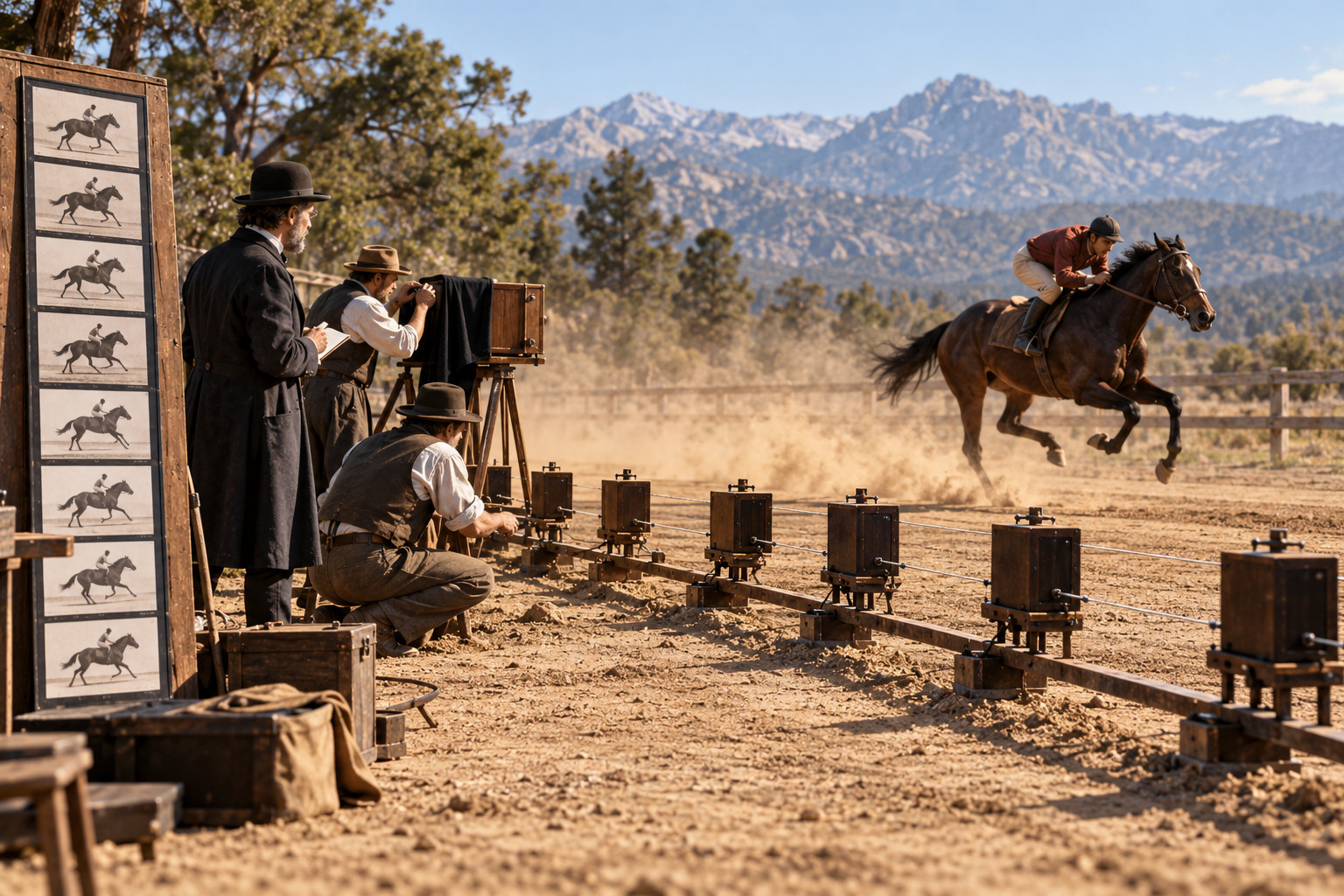
Eadweard Muybridge arrived in the United States in the mid-19th century as a journeyman photographer with an unusual eye for movement. He began by making panoramic views of frontier towns and of the Sierra Nevada that captured more than places: they recorded the rhythms of a landscape under industrial change. His technical skill—fast exposures, careful composition, a willingness to experiment with new negatives and lenses—made him sought after by patrons who wanted both accurate records and striking images.
That practical toughness mattered. Photography then was bulky and unforgiving; to stop a moment in the outdoors you needed a mix of mechanical cunning and stubborn patience. Muybridge had both, and he used them on a question that seemed, at first, almost trivial: how exactly do animals move?
The horse that wouldn’t behave like art
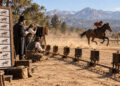
Long before cinema, there was a small bet of scientific curiosity: artists and horsemen disagreed about whether a galloping horse ever had all four feet off the ground. Muybridge tackled the problem with a rig of multiple cameras arranged along a track. When an animal sprang past, wires tripped shutters in rapid succession, freezing slices of motion that no single eye could follow.
The resulting sequences were revelatory. Frames shown in quick succession turned a blur into articulated stages: hooves tucked beneath the body, legs extended, a suspension phase that confirmed what the human eye suspected but had never reliably seen. Those images were not just novelty; they forced painters, anatomists, and engineers to revise how they represented and analyzed movement.
Complicated life, lasting invention
Muybridge’s life was as dramatic as his photographs. He was no passive recorder. In a notorious episode he shot a man he believed had wronged his family; the trial that followed only added to the public fascination with him. Yet his eccentricities did not eclipse his experiments. He refined projection devices that turned his photographic strips into moving pictures and published extensive studies of human and animal locomotion—workers climbing stairs, children running, a cat stalking—that became references for artists and scientists alike.
Those sequences, when viewed today, are surprisingly immediate. They look less like museum artifacts and more like first steps toward cinema and biomechanics: a new visual language for motion built from glass plates and mechanical shutters.
Conclusion
Muybridge sits oddly between craftsman and visionary. He solved a small question about a horse and ended up changing how people studied and pictured movement. The next time a movie shows a sprint or an animal chase, the clarity of that motion owes something to a photographer who learned to stop time and let its parts be seen, one click at a time.