

Born in Vienna in 1914, Hedy Lamarr first turned heads not in Hollywood but in a Czech film called Ecstasy (1933), a picture that scandalized audiences for its daring nudity and expressive camera work. That early notoriety, combined with an exotic persona crafted by studio publicity, brought her to Hollywood in the mid-1930s. She appeared in crowd-pleasing melodramas and costume epics — Algiers (1938) and Samson and Delilah (1949) among them — where she was hailed as one of the most glamorous actresses of her era.
Lamarr’s life off-screen was less typical. She endured a controlling early marriage to Fritz Mandl, an Austrian munitions manufacturer, before fleeing to Paris and eventually to the United States. Studios shaped her public image, but the private Lamarr kept a sharper, less obvious curiosity about mechanical and scientific problems.
The Unlikely Inventor
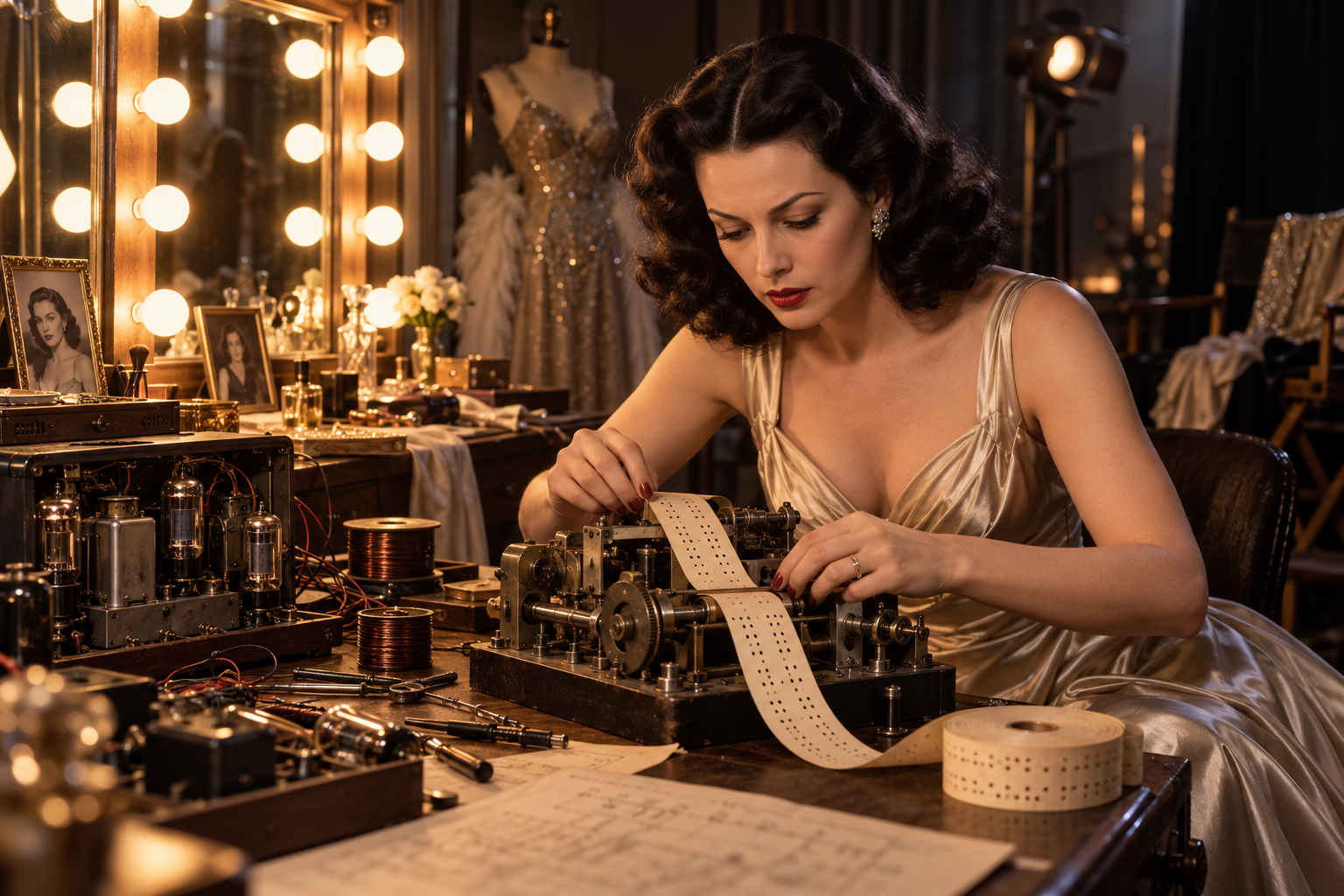
During World War II Lamarr took a new tack. Disturbed by reports of radio-guided torpedoes being jammed, she conceived a way to make radio signals harder to intercept: change the transmitting frequency at short intervals in a pattern known only to sender and receiver. She worked with composer George Antheil, who suggested using a piano-roll mechanism to synchronize the frequency changes.
The two filed a patent in 1941 and were awarded U.S. Patent 2,292,387 in 1942 for a “Secret Communication System.” The invention—commonly called frequency hopping—was not adopted by the Navy at the time, and Lamarr received little recognition while the war went on. The idea, however, preserved a simple brilliance: scramble the signal so an enemy cannot lock on—and make the transmitter and receiver switch frequencies together.
After Hollywood: Recognition and Misunderstanding
For decades the patent gathered dust while Lamarr continued acting. Only later did engineers and historians appreciate how that wartime idea anticipated spread-spectrum techniques, a family of methods that would be used in secure military communications and ultimately inform technologies in cellular systems, Wi‑Fi and Bluetooth.
Late in life Lamarr received belated honors. She won the Electronic Frontier Foundation’s Pioneer Award in 1997 and was posthumously inducted into halls of fame that recognized her technical contribution. Yet popular memory often keeps the glossy star and the inventor in separate boxes: she remains both a symbol of old Hollywood glamour and an emblem of overlooked female ingenuity.
Conclusion
Hedy Lamarr’s story resists easy categorization. She was a movie star whose name sold magazines and a tinkerer whose patent planted a seed for later wireless breakthroughs. The surprise isn’t simply that one woman could move between those worlds; it’s that history took so long to notice how closely they fit.