Uncover History’s Secrets with Daily Updates!
Daily News Entertainment
  • Home
  • History
  • Biographies
  • Eras
  • Regions
  • Timeline
No Result
View All Result
History Ours
  • Home
  • History
  • Biographies
  • Eras
  • Regions
  • Timeline
No Result
View All Result
History Ours
No Result
View All Result
Home Biographies

Finding Coherence in Fragmented Biographical Records

in Biographies
Finding Coherence in Fragmented Biographical Records

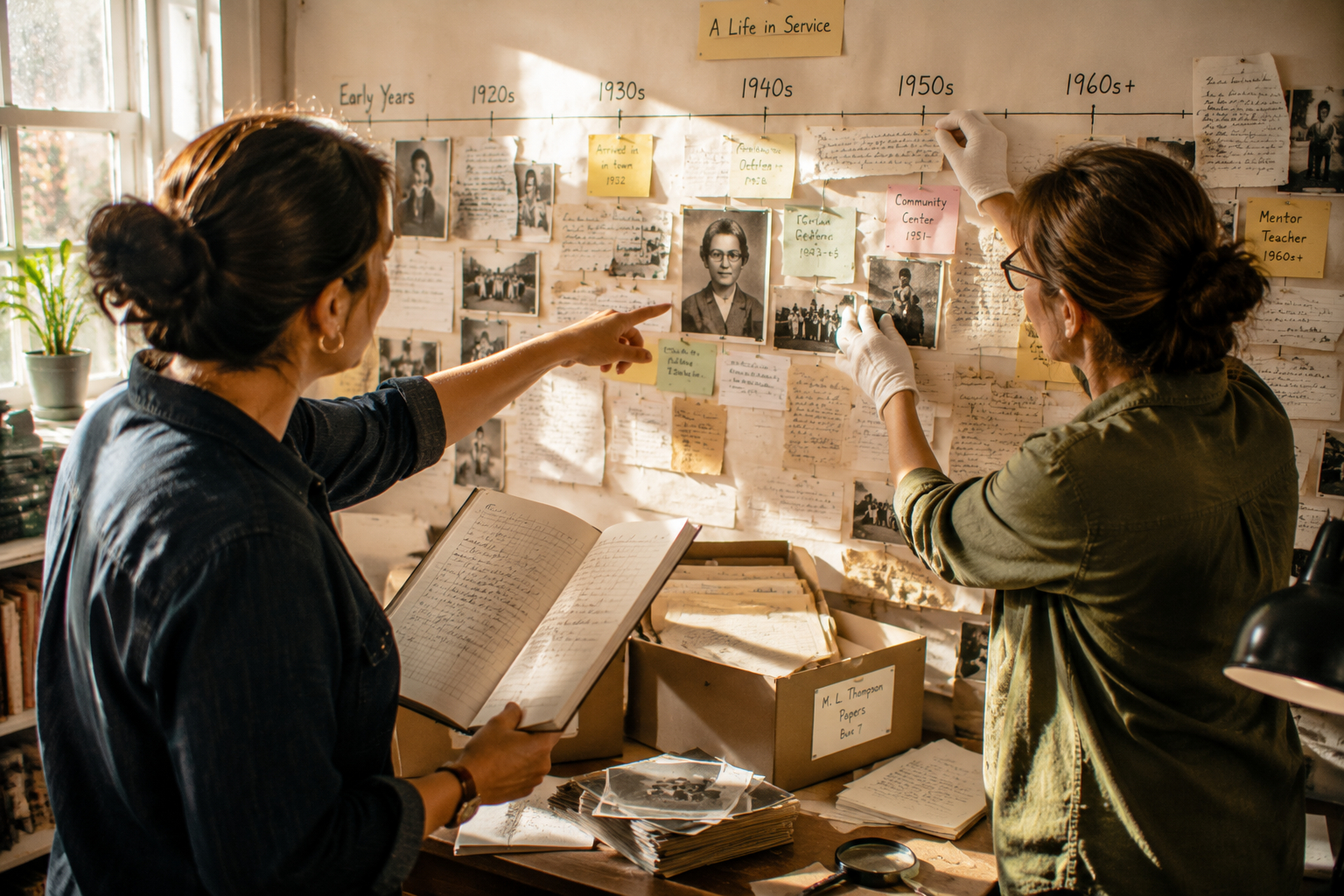
Biographers working with scattered sources face a common challenge: how to turn fragments into a coherent life story while remaining faithful to the evidence.
Good biography balances curiosity about a subject with restraint and care for what the record can justify.
This piece outlines practical strategies for assessing documents, building context, and making transparent narrative choices.
The aim is to help researchers produce readable, responsible portraits from limited materials.

Assessing Sources and Recognizing Gaps

Start by cataloguing what survives: letters, civic records, newspapers, and third‑party accounts each carry different kinds of information and reliability.
Pay attention to silences as well as statements — what is missing often shapes the questions you can answer.
Cross‑check dates, names, and places to reduce the risk of conflating individuals or events with tenuous evidence.
A clear inventory helps prioritize avenues for follow‑up and flags where interpretation will require caution.

Record your judgments about source quality and explain them in notes or an appendix.
Transparency lets readers see where narrative leaps are small and where they are speculative.

Contextualizing Events and Everyday Life

Context turns isolated facts into meaningful detail by locating a subject within social, economic, and cultural frameworks.
Use local histories, material culture studies, and contemporaneous sources to recreate the conditions that shaped choices and constraints.
Avoid imposing presentist assumptions; instead, aim to describe the norms and pressures that contemporaries would have recognized.
Contextual layers help make modest archives speak to broader human experience without overstating individual agency.

  • Look for patterns in routine records, such as tax lists or directories.
  • Compare similar cases to identify plausible life‑course trajectories.

Context enriches portraiture and supports interpretations grounded in evidence rather than conjecture.
It also clarifies which narrative moves are well supported and which remain tentative.

Narrative Choices and Ethical Framing

Every biography is an act of selection; deciding what to include, emphasize, or omit is unavoidable and requires ethical reflection.
State your interpretive choices plainly, noting where imagination fills gaps and where claims rest on strong documentation.
Avoid sensationalizing sparse details to create false coherence or to inflate importance beyond the sources.
Responsible framing respects subjects’ dignity and acknowledges uncertainty as an intrinsic part of historical work.

Footnotes, methodological prefaces, and clear language about probability build reader trust.
Such practices allow concise narrative while preserving scholarly integrity.

Conclusion

Working with fragmentary records demands both analytical rigor and narrative restraint.
By assessing sources carefully, building contextual layers, and signaling interpretive choices, researchers can craft reliable portraits.
These practices make concise, empathetic biographies that respect the past and inform present understanding.

Previous Post

Street-Level Sociability in Historic Market Towns

Next Post

From Documents to Depth: A Practical Guide to Biography

Related Posts

Bass Reeves: The Marshal Who Hunted Outlaws in Indian Territory
Biographies

Bass Reeves: The Marshal Who Hunted Outlaws in Indian Territory

September 15, 2026
Ellen Craft: Passing as a Planter to Secure Freedom
Biographies

Ellen Craft: Passing as a Planter to Secure Freedom

September 15, 2026
Chien‑Shiung Wu: The Physicist Who Proved Parity’s Failure
Biographies

Chien‑Shiung Wu: The Physicist Who Proved Parity’s Failure

September 15, 2026
Robert Smalls: The Enslaved Pilot Who Captured a Confederate Steamer
Biographies

Robert Smalls: The Enslaved Pilot Who Captured a Confederate Steamer

September 15, 2026
Next Post
From Documents to Depth: A Practical Guide to Biography

From Documents to Depth: A Practical Guide to Biography

Search..

No Result
View All Result

Recent Articles

Bass Reeves: The Marshal Who Hunted Outlaws in Indian Territory

Bass Reeves: The Marshal Who Hunted Outlaws in Indian Territory

September 15, 2026
How the Crystal Palace Turned Glass and Iron into a Modern Stage

How the Crystal Palace Turned Glass and Iron into a Modern Stage

September 15, 2026
Anne Bonny: The Pirate Who Broke Rules and Expectations

Anne Bonny: The Pirate Who Broke Rules and Expectations

September 15, 2026
How Haiti Broke Its Chains: A 1791–1804 Timeline

How Haiti Broke Its Chains: A 1791–1804 Timeline

September 15, 2026
From Horses to Wires: How the Pony Express Met the Telegraph

From Horses to Wires: How the Pony Express Met the Telegraph

September 15, 2026

Subscribe Us

By clicking submit, I authorize History Ours and its affiliated companies to: (1) use, sell, and share my information for marketing purposes, including cross-context behavioral advertising, as described in our Terms of Service and Privacy Policy, (2) supplement the information that I provide with additional information lawfully obtained from other sources, like demographic data from public sources, interests inferred from web page views, or other data relevant to what might interest me, like past purchase or location data, (3) contact me or enable others to contact me by email with offers for goods and services from any category at the email address provided, and (4) retain my information while I am engaging with marketing messages that I receive and for a reasonable amount of time thereafter. I understand I can opt out at any time through an email that I receive, or by clicking here

Subscribe To Our Newsletter

By clicking submit, I authorize History Ours and its affiliated companies to: (1) use, sell, and share my information for marketing purposes, including cross-context behavioral advertising, as described in our Terms of Service and Privacy Policy, (2) supplement the information that I provide with additional information lawfully obtained from other sources, like demographic data from public sources, interests inferred from web page views, or other data relevant to what might interest me, like past purchase or location data, (3) contact me or enable others to contact me by email with offers for goods and services from any category at the email address provided, and (4) retain my information while I am engaging with marketing messages that I receive and for a reasonable amount of time thereafter. I understand I can opt out at any time through an email that I receive, or by clicking here.

© 2026 History Ours | All Rights Reserved

  • Contact Us
  • Privacy Policy
  • Terms of Service
  • Unsubscribe
  • Privacy Choices
  • Contact Us
  • Privacy Policy
  • Terms of Service
  • Unsubscribe
  • Privacy Choices

© 2026 History Ours | All Rights Reserved

No Result
View All Result
  • Home
  • History
  • Biographies
  • Eras
  • Regions
  • Timeline

© 2026 History Ours | All Rights Reserved

Skip to content
Open toolbar Accessibility Tools

Accessibility Tools

  • Increase TextIncrease Text
  • Decrease TextDecrease Text
  • GrayscaleGrayscale
  • High ContrastHigh Contrast
  • Negative ContrastNegative Contrast
  • Light BackgroundLight Background
  • Links UnderlineLinks Underline
  • Readable FontReadable Font
  • Reset Reset