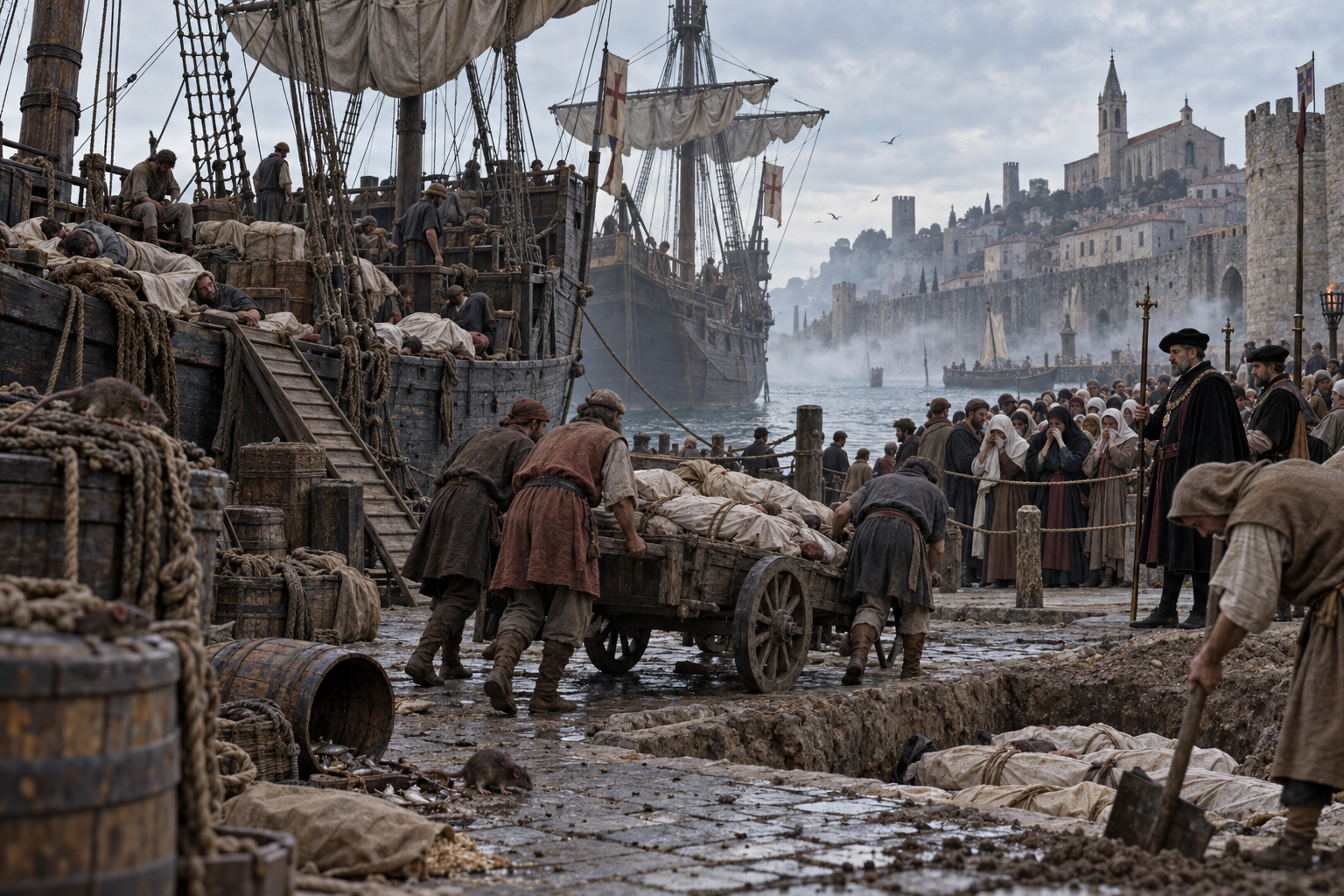
The story often begins at a Black Sea port. In 1346–47 Genoese traders at Caffa (on the Crimean coast) were besieged by Mongol armies; disease moved into the camp and then onto ships that sailed west. By October 1347 those ships reached Messina and Genoa, and with them came a new kind of catastrophe: fever, swollen lymph nodes, and bodies piling up on decks. Contemporary observers described a disease that seemed to arrive overnight and travel as fast as ships could sail.
The first wave and social collapse, 1348–1349
Once the contagion touched Mediterranean ports it raced along trade routes. In 1348 it swept through Italy into France and Spain, and within months reached England—arriving at ports on the south coast and moving inland with merchants, pilgrims, and armies. Towns that had been crowded and noisy fell silent: markets closed, guilds stopped meeting, and funerary practices changed as bodies outpaced graveyards. Civic governments tried quarantines, cordons, and sanitation measures that often arrived too late; in some places officials ordered the closure of taverns and banned public gatherings, while elsewhere panicked mobs blamed outsiders, strangers, or minority communities for the calamity.
Lingering waves and the wider ripple, 1350–1351
By 1350 the first brutal wave had run through most of western Europe, but that did not mean the disease vanished. It returned in waves, appearing in Scandinavia, eastern Europe, and parts of the Islamic world over the next few years. Rural and urban experiences differed: some isolated villages escaped the worst, while many cities lost a large share of their population and saw labor shortages reshape daily life. Economic and social pressure followed in surprising directions—wages rose where labor was scarce, land use shifted, and some long-term institutions weakened as communities rebuilt.
- 1346–47: Disease in the Black Sea region; ships leave Caffa.
- Oct 1347: Infected ships reach Sicily and Genoa.
- 1348: Rapid spread through Mediterranean Europe, into France and Spain.
- 1348–49: England, the Low Countries, and much of central Europe hit.
- 1350–51: Recurrent outbreaks; long-term social and economic consequences unfold.
Conclusion
The Black Death between 1347 and 1351 was not a single instant but a sequence: arrival at ports, a devastating first wave, and recurrent flare-ups that altered societies over decades. Its immediacy—ships carrying the sick, towns sealed, mass graves hastily dug—left traces in art, law, labor, and memory. Historians still debate exact paths and death tolls, but the pattern is clear: a pathogen rode the arteries of medieval commerce and, in doing so, remade the map of Europe.