
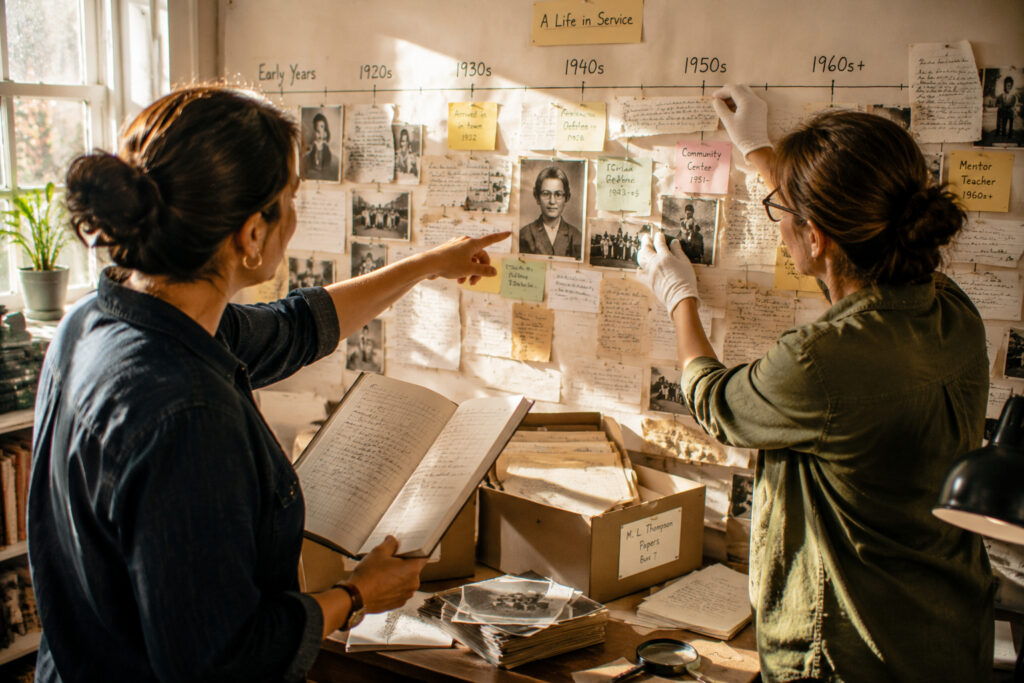
Biographers working with scattered sources face a common challenge: how to turn fragments into a coherent life story while remaining faithful to the evidence.
Good biography balances curiosity about a subject with restraint and care for what the record can justify.
This piece outlines practical strategies for assessing documents, building context, and making transparent narrative choices.
The aim is to help researchers produce readable, responsible portraits from limited materials.
Assessing Sources and Recognizing Gaps
Start by cataloguing what survives: letters, civic records, newspapers, and third‑party accounts each carry different kinds of information and reliability.
Pay attention to silences as well as statements — what is missing often shapes the questions you can answer.
Cross‑check dates, names, and places to reduce the risk of conflating individuals or events with tenuous evidence.
A clear inventory helps prioritize avenues for follow‑up and flags where interpretation will require caution.
Record your judgments about source quality and explain them in notes or an appendix.
Transparency lets readers see where narrative leaps are small and where they are speculative.
Contextualizing Events and Everyday Life
Context turns isolated facts into meaningful detail by locating a subject within social, economic, and cultural frameworks.
Use local histories, material culture studies, and contemporaneous sources to recreate the conditions that shaped choices and constraints.
Avoid imposing presentist assumptions; instead, aim to describe the norms and pressures that contemporaries would have recognized.
Contextual layers help make modest archives speak to broader human experience without overstating individual agency.
- Look for patterns in routine records, such as tax lists or directories.
- Compare similar cases to identify plausible life‑course trajectories.
Context enriches portraiture and supports interpretations grounded in evidence rather than conjecture.
It also clarifies which narrative moves are well supported and which remain tentative.
Narrative Choices and Ethical Framing
Every biography is an act of selection; deciding what to include, emphasize, or omit is unavoidable and requires ethical reflection.
State your interpretive choices plainly, noting where imagination fills gaps and where claims rest on strong documentation.
Avoid sensationalizing sparse details to create false coherence or to inflate importance beyond the sources.
Responsible framing respects subjects’ dignity and acknowledges uncertainty as an intrinsic part of historical work.
Footnotes, methodological prefaces, and clear language about probability build reader trust.
Such practices allow concise narrative while preserving scholarly integrity.
Conclusion
Working with fragmentary records demands both analytical rigor and narrative restraint.
By assessing sources carefully, building contextual layers, and signaling interpretive choices, researchers can craft reliable portraits.
These practices make concise, empathetic biographies that respect the past and inform present understanding.