
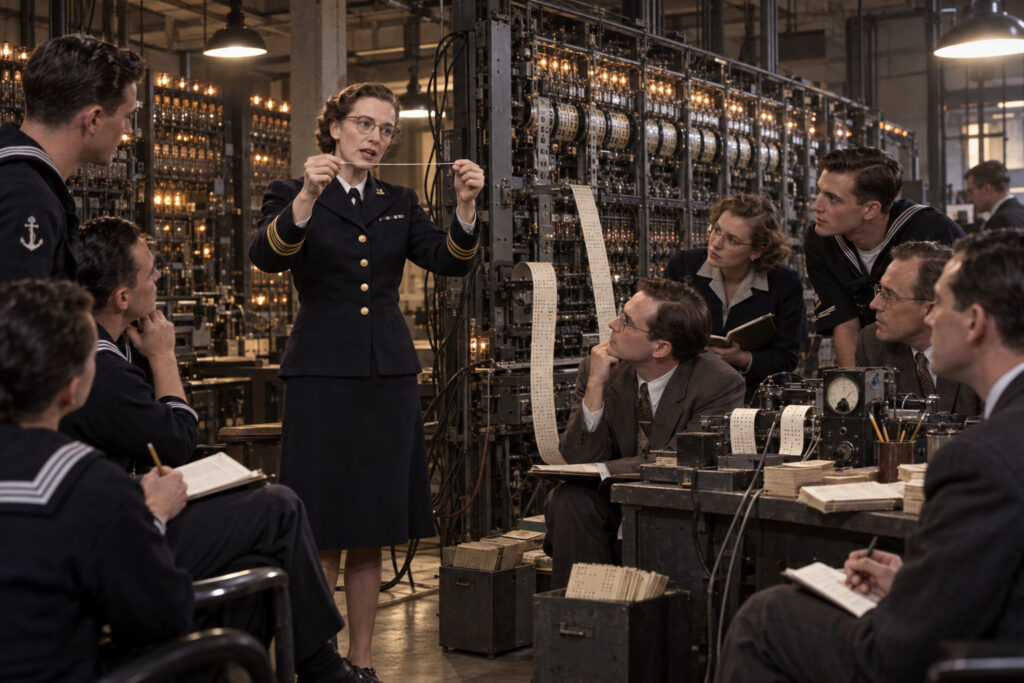
Grace Hopper began life as a mathematician and professor, not a programmer. She earned advanced degrees in mathematics and taught at a small liberal‑arts college before World War II. When she joined the Navy Reserve and was assigned to work on an early electromechanical calculator at a university lab, she moved into a new world where human problems and machine limitations collided.
Inventing the idea of a compiler
Hopper’s most consequential insight was stubbornly practical: machines should not force people to think like machines. She led work on a system that turned written instructions into machine code automatically — an early compiler — which let programmers write in something closer to English. That idea was the seed that made higher‑level programming languages possible and helped pave the way for COBOL, the language designed to be readable by managers and accountants as well as engineers.
The tools she built were not glamorous pieces of hardware but translators and standards: software that bridged how people reasoned and how computers processed information. That bridge changed who could program and how quickly software could be developed, steering computing away from a craft practiced by a tiny technical elite toward something more accessible and industrial.
A public teacher and a Navy life that refused to stop
Hopper loved demonstrations. She carried visual aids—wire lengths to show how small a “nanosecond” was, and simple props to make abstract concepts tangible. Those props became part of her reputation as a teacher who could reduce baffling technical ideas to memorable, almost theatrical moments.
Her career also blurred the line between military service and public advocacy. Hopper rose through the Navy Reserve while continuing as a persistent advocate for standardization and education in computing. When mandatory retirement came, she was recalled; she continued working well into what most people consider retirement age. Her presence in conferences, advisory committees, and classrooms made her a familiar face who could speak with authority about both policy and programming.
Conclusion
Grace Hopper’s legacy is not a single machine or a single program but a change in the terms of the conversation about computing: from one that assumed people should adapt to machines to one that demanded machines adapt to people. Her insistence on usable languages, her knack for teaching, and her long, public career in uniform helped open computing to a far broader group of minds than anyone had imagined in the machine rooms of the 1940s.