
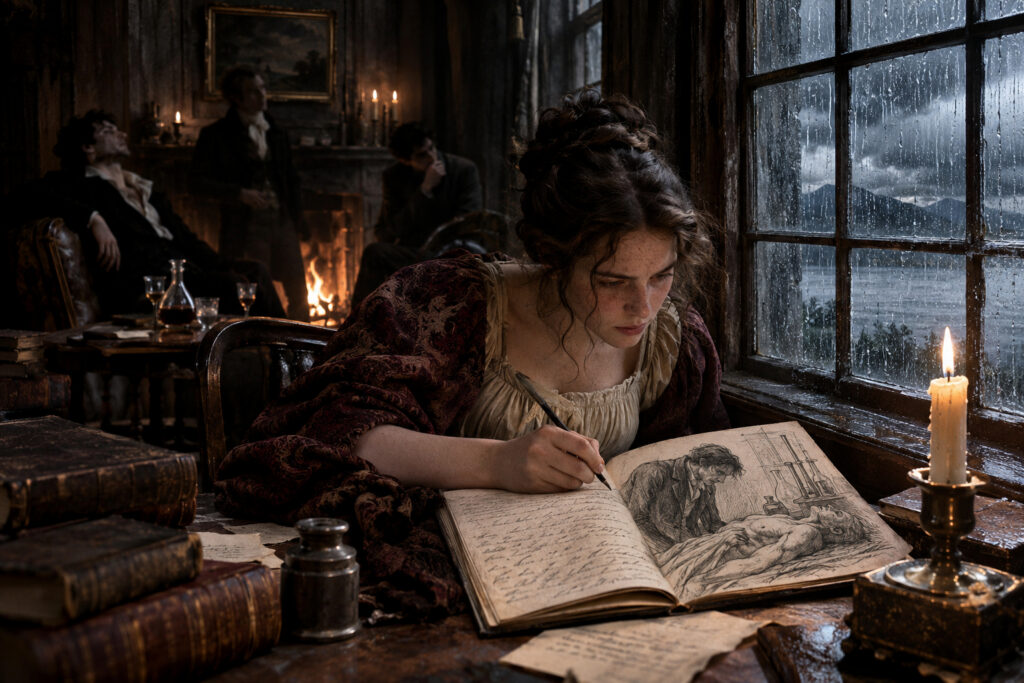
In the summer of 1816, a weather pattern gone awry turned Europe into a cold, gray place—ash from a distant volcano dimmed the sun, crops failed and travel stalled. A small group of writers and intellectuals found themselves holed up beside a Swiss lake: Lord Byron, Percy Shelley, John Polidori and an eighteen‑year‑old Mary Godwin (soon to be Mary Shelley). Faced with long, damp evenings, Byron proposed a contest: write a ghost story. The contest is the familiar origin myth, but the detail that matters is quieter. Mary did not manufacture Frankenstein as a headline stunt; she recorded a waking dream—an image of a scientist bent over a pale, animated body—and that image hardened into a novel that kept returning to questions about creation, responsibility and loss.
More than a single strike of inspiration
Frankenstein arrived in print anonymously in 1818, and early readers often assumed Percy Shelley had a hand in the work. That misattribution reveals one of the book’s hidden stories: it was written by a young woman raised in the shadow of radical parents—her mother was Mary Wollstonecraft—and educated in the debates of the age. The science she satirized and feared was not pure fantasy. Contemporary experiments with electricity and the idea that life might be provoked or restored by mechanical means—topics discussed in medical and philosophical circles—feed into the novel’s dread. The creature Victor Frankenstein fashions is never given a personal name; readers’ tendency to call the monster “Frankenstein” says more about cultural shorthand than about the book, which keeps returning to the consequences of abandoning what one has made.
A life of work, editing and quiet persistence
Mary Shelley did not vanish after the book’s success. Percy Shelley’s death in 1822 forced her into new roles: she edited his poems and protected his literary estate while raising their son and managing limited finances. She wrote other novels—stories of political upheaval, female experience and speculative futures—and travel writing that critics of her day sometimes dismissed. Later in life she revised the Frankenstein origin in a new 1831 introduction, a version that reshaped the memory of that rainy summer. Her energetic attention to other texts, and her willingness to revise her own, helped preserve much of the Romantics’ work for later readers.
Conclusion
Mary Shelley’s story is often reduced to the image of a girl at a shuttered villa dreaming up a monster. The book itself is less a single horror than a compact moral inquiry posed in the language of Gothic fiction. Knowing that she came of intellectual stock, that she kept working as a writer and editor under difficult circumstances, and that she returned to her own tale to shape its reception, changes the way we read Frankenstein. It becomes not merely the origin of a cultural monster, but the enduring testament of a restless novelist who asked what it means to bring something into the world and then be answerable for it.