Roots and quiet defiance
Noor Inayat Khan was born into an unlikely circle for a World War II heroine: the daughter of an Indian Sufi teacher and musician, raised between London and Paris, with a gentle childhood shaped by poetry, music, and a family commitment to spiritual service. That placid upbringing belies the steel she found when war broke across Europe. Trained as a wireless operator and a typist, she brought language skills and an unshowy courage that would surprise the German occupiers.
Into occupied France with a radio
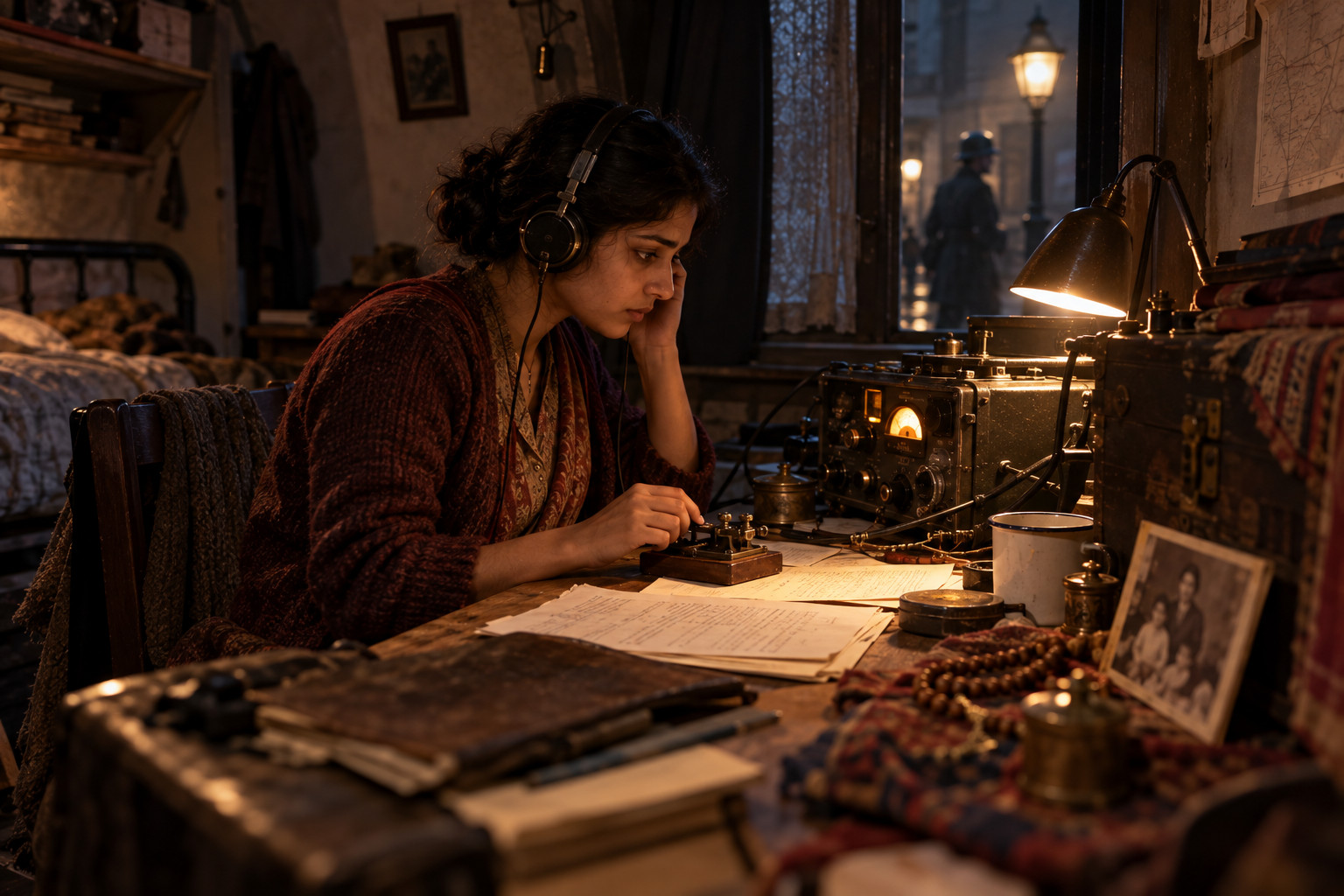
In 1943 the British Secret Intelligence Service’s Special Operations Executive sent Noor into Nazi-occupied France as a wireless operator, the network codename she used was Madeleine. Wireless operators were the linchpins of the resistance: their clandestine transmissions linked underground cells to London, directed supplies, and carried round-the-clock danger. Noor was the first woman dispatched in that role, and she kept transmitting when others were being rounded up. Operating alone, constantly moving, she maintained contact with London under intense pressure from German searches and betrayals inside the resistance.
Capture, silence, and courage under interrogation
Eventually the net closed. Noor was arrested in Paris and interrogated by the Gestapo. Unlike many captured agents who broke under torture, she gave virtually no usable information that could identify networks or endanger colleagues. Transferred to prisons in France and later to Germany, she made repeated attempts to escape and resisted every effort to bend her. She was deported to the Dachau complex, where she was killed in 1944.
The case of Noor is striking because she combined two things that the wartime world rarely expected together: a pacific, artistic background and a ruthless willingness to accept peril for others. Her moral courage—refusing to betray comrades while facing isolation and brutal treatment—becomes the central fact of her story.
Legacy beyond medals
After the war Noor Inayat Khan was honored by both Britain and France for her service; her posthumous George Cross is one symbol of recognition. But the measure of her life is also the image she leaves behind: a small, soft-voiced woman who kept a wireless humming in occupied streets and who chose duty over self-preservation. Her story serves as a reminder that wartime courage often arrived in unexpected forms, that ordinary biographies can contain extraordinary choices.
Conclusion
Noor’s life is not a tale of battlefield glory but of persistence in the shadowy work that makes resistance possible. The wireless she carried was a thin, crackling lifeline—and when the silence finally came, it was the stubbornness of her sending and the quiet steadiness of her refusal to talk that kept others alive.