Uncover History’s Secrets with Daily Updates!
Daily News Entertainment
  • Home
  • History
  • Biographies
  • Eras
  • Regions
  • Timeline
No Result
View All Result
History Ours
  • Home
  • History
  • Biographies
  • Eras
  • Regions
  • Timeline
No Result
View All Result
History Ours
No Result
View All Result
Home Biographies

Practical Habits for Trustworthy Biographical Research

in Biographies
Practical Habits for Trustworthy Biographical Research

Good biographical work rests on steady habits as much as dramatic discoveries. A clear approach helps turn scattered records into coherent, fair portraits without overstating what the evidence allows. This article outlines practical steps that help researchers evaluate sources, situate lives in context, and record uncertainty responsibly. The aim is to offer routines that support accuracy, empathy, and readable narrative.

These habits are not a formula for storytelling but a set of checks and balances. They make it easier to justify interpretive moves and to communicate limits to readers. Adopting them early saves time and preserves trustworthiness.

Clarify Purpose and Scope

Begin by specifying what you want to know and why the subject matters to your project. Define temporal, thematic, and evidentiary boundaries so that research stays focused and manageable. Clarifying scope helps you prioritize archives, oral histories, and secondary sources that are most likely to yield relevant material. It also prevents mission creep, where a biography balloons into an unfocused social history.

State the limits of your inquiry in notes or a research brief. Doing so makes later editorial decisions easier and more defensible.

Assess and Annotate Sources

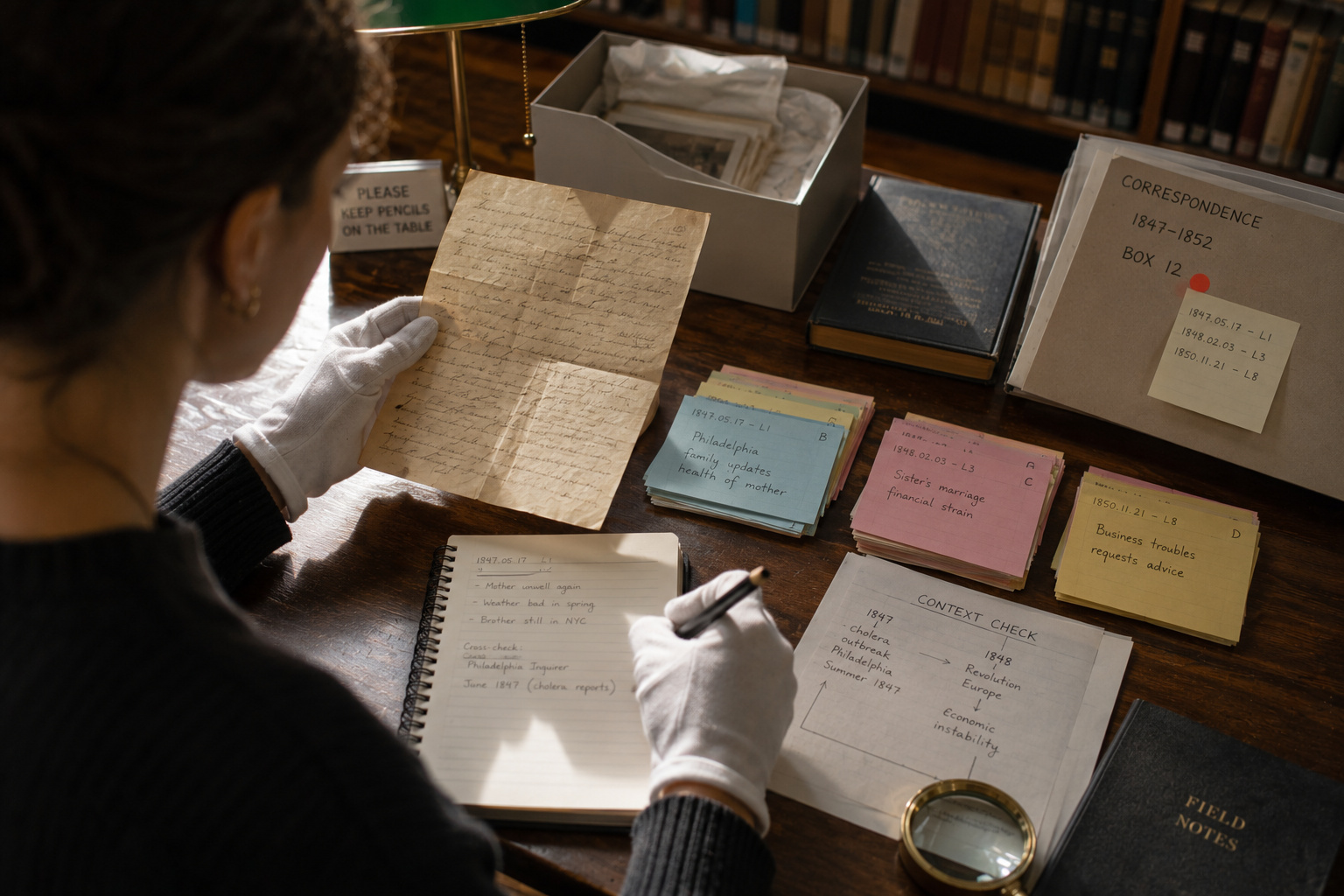
Evaluate each source for origin, purpose, and reliability rather than treating all evidence equally. Create brief annotations describing provenance and any evident bias, contradiction, or gap. Cross-check dates, names, and claims where possible and flag items that require corroboration. Maintain a searchable log so you can trace how particular details entered your narrative.

  • Record archival references and interview dates.
  • Note uncertainties directly in your notes.

These annotations become the backbone of transparent citation and help avoid repeating unchecked assertions.

Contextualize and Resist Overreach

Place individual choices and events within broader social, institutional, or familial contexts to make sense of actions and constraints. Use context to illuminate motives without substituting general trends for specific evidence. Where direct evidence is absent, be explicit about when you are suggesting possibilities rather than asserting facts. That restraint preserves credibility and invites readers to weigh interpretations.

Label speculative passages clearly and separate them from established facts. This habit builds reader trust and encourages critical engagement.

Ethics, Voice, and Attribution

Respect for subjects and sources should guide both research and prose. Attribute claims accurately, obtain permissions when necessary, and avoid sensationalizing private details. Reflect on power dynamics in your sources and how your position shapes the narrative choices you make. When using oral testimony or unpublished materials, document consent and consider how publication might affect living relatives or communities.

Ethical practice also includes acknowledging uncertainties and providing readers with the evidence trail needed to follow your reasoning.

Conclusion

Trustworthy biographies grow from disciplined habits: clear scope, careful source annotation, contextual restraint, and ethical sensitivity. Together these practices help writers turn partial records into responsible accounts that respect both subject and reader. Adopting them improves accuracy and deepens the quality of historical understanding.

Previous Post

Mapping Lives from Sparse Historical Evidence

Next Post

Establishing Useful Timeframes for Historical Study

Related Posts

Mary Seacole: The Jamaican Nurse Who Went to War
Biographies

Mary Seacole: The Jamaican Nurse Who Went to War

October 30, 2026
Ada Lovelace: The Poet Who Helped Imagine Modern Computers
Biographies

Ada Lovelace: The Poet Who Helped Imagine Modern Computers

October 30, 2026
Katherine Johnson: The Numbers Behind America’s First Orbits
Biographies

Katherine Johnson: The Numbers Behind America’s First Orbits

October 25, 2026
Bessie Coleman: How a Texan Manicurist Conquered the Skies
Biographies

Bessie Coleman: How a Texan Manicurist Conquered the Skies

October 25, 2026
Next Post
Establishing Useful Timeframes for Historical Study

Establishing Useful Timeframes for Historical Study

Search..

No Result
View All Result

Recent Articles

Mary Seacole: The Jamaican Nurse Who Went to War

Mary Seacole: The Jamaican Nurse Who Went to War

October 30, 2026
Ada Lovelace: The Poet Who Helped Imagine Modern Computers

Ada Lovelace: The Poet Who Helped Imagine Modern Computers

October 30, 2026
John Snow, the Broad Street Pump, and Cholera’s Fall

John Snow, the Broad Street Pump, and Cholera’s Fall

October 29, 2026
The Vasa: Sweden’s Giant Ship That Couldn’t Sail

The Vasa: Sweden’s Giant Ship That Couldn’t Sail

October 29, 2026
How the Black Death Spread Across Europe, 1347–1351

How the Black Death Spread Across Europe, 1347–1351

October 28, 2026

Subscribe Us

By clicking submit, I authorize History Ours and its affiliated companies to: (1) use, sell, and share my information for marketing purposes, including cross-context behavioral advertising, as described in our Terms of Service and Privacy Policy, (2) supplement the information that I provide with additional information lawfully obtained from other sources, like demographic data from public sources, interests inferred from web page views, or other data relevant to what might interest me, like past purchase or location data, (3) contact me or enable others to contact me by email with offers for goods and services from any category at the email address provided, and (4) retain my information while I am engaging with marketing messages that I receive and for a reasonable amount of time thereafter. I understand I can opt out at any time through an email that I receive, or by clicking here

Subscribe To Our Newsletter

By clicking submit, I authorize History Ours and its affiliated companies to: (1) use, sell, and share my information for marketing purposes, including cross-context behavioral advertising, as described in our Terms of Service and Privacy Policy, (2) supplement the information that I provide with additional information lawfully obtained from other sources, like demographic data from public sources, interests inferred from web page views, or other data relevant to what might interest me, like past purchase or location data, (3) contact me or enable others to contact me by email with offers for goods and services from any category at the email address provided, and (4) retain my information while I am engaging with marketing messages that I receive and for a reasonable amount of time thereafter. I understand I can opt out at any time through an email that I receive, or by clicking here.

© 2026 History Ours | All Rights Reserved

  • Contact Us
  • Privacy Policy
  • Terms of Service
  • Unsubscribe
  • Privacy Choices
  • Contact Us
  • Privacy Policy
  • Terms of Service
  • Unsubscribe
  • Privacy Choices

© 2026 History Ours | All Rights Reserved

No Result
View All Result
  • Home
  • History
  • Biographies
  • Eras
  • Regions
  • Timeline

© 2026 History Ours | All Rights Reserved

Skip to content
Open toolbar Accessibility Tools

Accessibility Tools

  • Increase TextIncrease Text
  • Decrease TextDecrease Text
  • GrayscaleGrayscale
  • High ContrastHigh Contrast
  • Negative ContrastNegative Contrast
  • Light BackgroundLight Background
  • Links UnderlineLinks Underline
  • Readable FontReadable Font
  • Reset Reset