
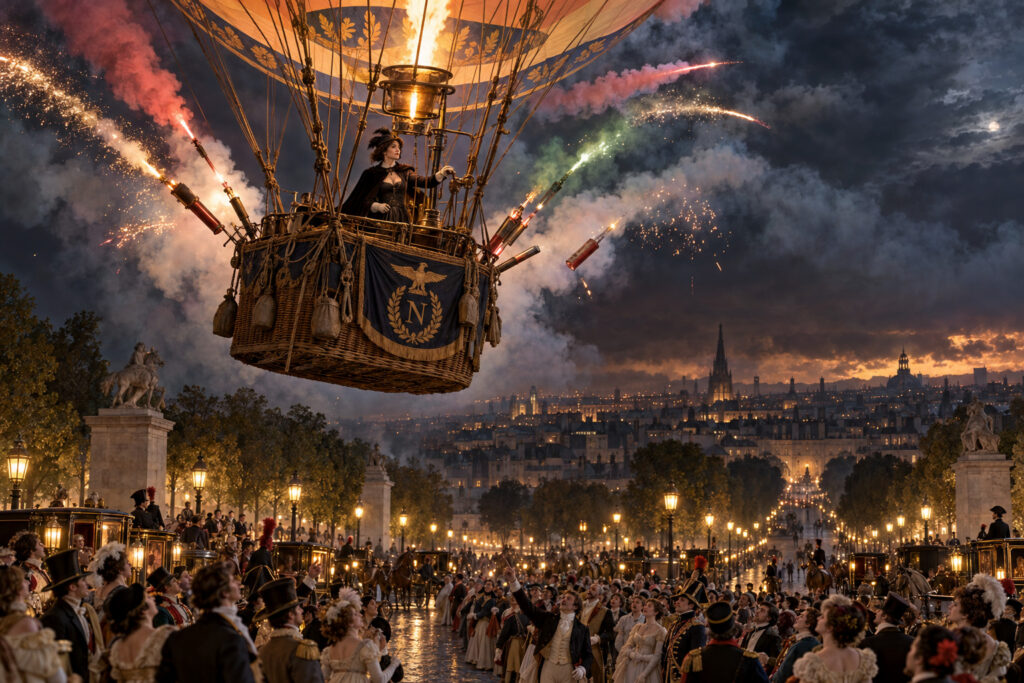
Sophie Blanchard cut a startling figure above Paris. Born in 1778 and married to the balloonist Jean‑Pierre Blanchard, she did something few women of her day could imagine: she turned flight into a profession. After her husband’s death she continued launching herself into the air, not as a passing curiosity but as a public performer whose nightly ascents drew crowds from the Champs‑Élysées to private salons.
Shows, Spectacles, and a Woman in Control
Blanchard specialized in spectacle. Her displays mixed daring with theatre—nighttime ascents lit by rockets and fireworks, carefully timed to thrill viewers below. The sight of a lone woman in a gas balloon, drifting above city roofs while pyrotechnics painted the clouds, felt both modern and uncanny to contemporaries. Reporters and pamphleteers christened her a star of Parisian leisure, a figure who blurred the line between science demonstration and entertainment.
She also occupied an official place in the public imagination. During the Napoleonic era and afterward she received government support at times, which helped make her performances regular events rather than one‑off stunts. That steadiness turned Sophie from a novelty into a professional: the first woman to build a career piloting lighter‑than‑air craft.
Danger at Every Turn
Ballooning was visibly glamorous, but it was dangerous. Night flights required managing flammable gases and fireworks in close quarters—conditions that left little margin for error. In 1819 a display in Paris ended catastrophically when her balloon caught fire; Sophie Blanchard fell and died. The accident was reported across Europe, and it forced observers to reckon with the risks beneath the romance of aerial showmanship.
Her death did not erase her achievement. In an era when women’s public roles were tightly circumscribed, Blanchard insisted on being the one who climbed into the balloon, who worked the burners, who steered the spectacle. She refused to be a prop in someone else’s act.
Conclusion
Sophie Blanchard remains a striking example of how early aeronauts mixed entertainment, experiment, and entrepreneurship. She shaped the way Parisians imagined the sky—less as empty space than as a stage where a woman could be both the draw and the operator. Her life ended in tragedy, but the image of her lanterned balloon hovering above the city lingers as an early and memorable chapter in the long story of human flight.
- Born: 1778
- Died: 1819, in a balloon accident during a Paris display
- Why remembered: One of the first women to pursue ballooning as a professional career