

Uncover History’s Secrets with Daily Updates!
Daily News Entertainment
  • Home
  • History
  • Biographies
  • Eras
  • Regions
  • Timeline
No Result
View All Result
History Ours
  • Home
  • History
  • Biographies
  • Eras
  • Regions
  • Timeline
No Result
View All Result
History Ours
No Result
View All Result
Home Eras

A Guide for Educators: Teaching Historical Eras Effectively

in Eras
A Guide for Educators: Teaching Historical Eras Effectively

Teaching historical eras helps students see patterns and change across time.
Good periodization supports comparative thinking and clarifies curricular scope.
Educators can balance thematic threads, chronology, and local detail to make eras meaningful.
Clear labels are tools, not answers: they should invite inquiry rather than close it.
This guide offers practical strategies, classroom activities, and cautions to improve instruction.

Choosing Boundaries That Serve Learning Goals

When selecting period boundaries, begin by identifying what you want students to learn and why. Prioritize demonstrable shifts in political structures, economic systems, technology, or social practices that can be supported with accessible sources. Avoid treating dates as fixed truths; emphasize the reasons a historian might choose one boundary over another and how that choice highlights different continuities. Framing decisions in terms of evidence helps students understand periods as interpretive tools rather than facts.

Make these choices explicit in your syllabus and in class conversations so students understand your rationale. Encourage exercises that ask learners to propose and defend alternative boundaries based on different themes or perspectives.

Integrating Themes and Local Contexts

Complement chronological frames with recurring themes such as labor, gender, or environment to give students multiple lenses for analysis. Demonstrate how the same era can look different in various regions or communities by using case studies and primary sources that highlight local variation. Teach students to move between broad syntheses and close readings so they appreciate both macro-level change and micro-level continuity. This approach reduces the temptation to treat eras as monolithic and opens space for more nuanced interpretation.

Model comparison by asking students to contrast thematic developments across two periods or places. Small-group projects that focus on local archives or oral histories can surface underrepresented experiences within broader eras.

Practical Classroom Activities

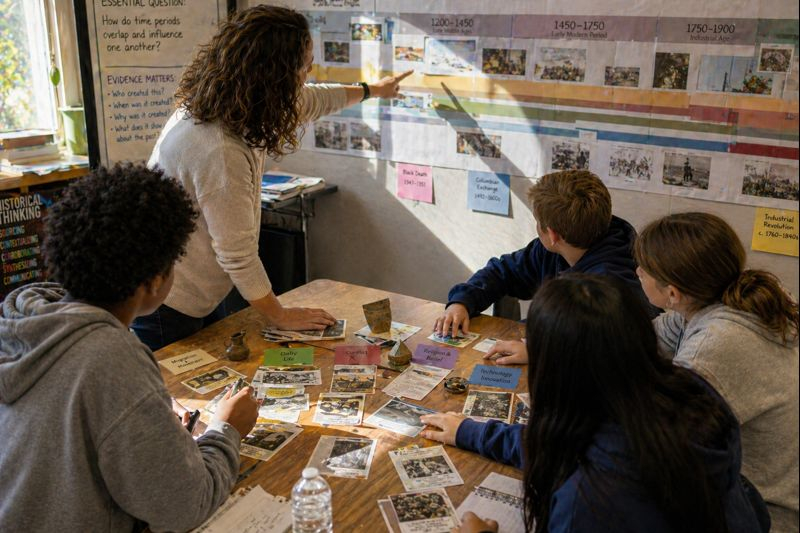
Active tasks help students practice periodization and test its utility. Use timeline workshops, source-based debates, and role-play simulations to animate transitions and contested boundaries. Scaffolding prompts—such as asking what changed, what stayed the same, and why—guide learners through analytical thinking and evidence-based argumentation. Provide clear rubrics that reward argument quality and source use rather than memorized labels.

  • Timeline construction with layered themes.
  • Document clusters comparing artifacts across proposed boundaries.
  • Position papers defending alternative periodizations.

Rotate activity types across units to build confidence and skill. Reflection assignments that ask students to revise an earlier periodization reinforce learning and show intellectual growth.

Conclusion

Clear, flexible periodization helps students connect events and trends without flattening complexity.
Teaching eras as tools fosters critical thinking and empowers learners to assess evidence.
With practice and explicit reasoning, students gain durable skills for interpreting the past.


Previous Post

The Unseen Leadership of a Pioneering Reformer

Next Post

Connecting Microhistory and Macro Eras for Clearer Narratives

Related Posts

Pax Mongolica: How Mongol Rule Rewired the Old World
Eras

Pax Mongolica: How Mongol Rule Rewired the Old World

September 15, 2026
Life Under the Tokugawa: How Edo Japan Rewrote Social Order
Eras

Life Under the Tokugawa: How Edo Japan Rewrote Social Order

September 15, 2026
When Empires Fell: The Late Bronze Age Collapse
Eras

When Empires Fell: The Late Bronze Age Collapse

September 15, 2026
1816: How a Volcano Turned Summer Into Crisis
Eras

1816: How a Volcano Turned Summer Into Crisis

September 15, 2026
Next Post
Connecting Microhistory and Macro Eras for Clearer Narratives

Connecting Microhistory and Macro Eras for Clearer Narratives

Search..

No Result
View All Result

Recent Articles

The Disguise That Broke Chains: Ellen and William Craft

The Disguise That Broke Chains: Ellen and William Craft

September 15, 2026
Bass Reeves: The Marshal Who Hunted Outlaws in Indian Territory

Bass Reeves: The Marshal Who Hunted Outlaws in Indian Territory

September 15, 2026
How the Crystal Palace Turned Glass and Iron into a Modern Stage

How the Crystal Palace Turned Glass and Iron into a Modern Stage

September 15, 2026
Anne Bonny: The Pirate Who Broke Rules and Expectations

Anne Bonny: The Pirate Who Broke Rules and Expectations

September 15, 2026
How Haiti Broke Its Chains: A 1791–1804 Timeline

How Haiti Broke Its Chains: A 1791–1804 Timeline

September 15, 2026

Subscribe Us

By clicking submit, I authorize History Ours and its affiliated companies to: (1) use, sell, and share my information for marketing purposes, including cross-context behavioral advertising, as described in our Terms of Service and Privacy Policy, (2) supplement the information that I provide with additional information lawfully obtained from other sources, like demographic data from public sources, interests inferred from web page views, or other data relevant to what might interest me, like past purchase or location data, (3) contact me or enable others to contact me by email with offers for goods and services from any category at the email address provided, and (4) retain my information while I am engaging with marketing messages that I receive and for a reasonable amount of time thereafter. I understand I can opt out at any time through an email that I receive, or by clicking here

Subscribe To Our Newsletter

By clicking submit, I authorize History Ours and its affiliated companies to: (1) use, sell, and share my information for marketing purposes, including cross-context behavioral advertising, as described in our Terms of Service and Privacy Policy, (2) supplement the information that I provide with additional information lawfully obtained from other sources, like demographic data from public sources, interests inferred from web page views, or other data relevant to what might interest me, like past purchase or location data, (3) contact me or enable others to contact me by email with offers for goods and services from any category at the email address provided, and (4) retain my information while I am engaging with marketing messages that I receive and for a reasonable amount of time thereafter. I understand I can opt out at any time through an email that I receive, or by clicking here.

© 2026 History Ours | All Rights Reserved

  • Contact Us
  • Privacy Policy
  • Terms of Service
  • Unsubscribe
  • Privacy Choices
  • Contact Us
  • Privacy Policy
  • Terms of Service
  • Unsubscribe
  • Privacy Choices

© 2026 History Ours | All Rights Reserved

No Result
View All Result
  • Home
  • History
  • Biographies
  • Eras
  • Regions
  • Timeline

© 2026 History Ours | All Rights Reserved

Skip to content
Open toolbar Accessibility Tools

Accessibility Tools

  • Increase TextIncrease Text
  • Decrease TextDecrease Text
  • GrayscaleGrayscale
  • High ContrastHigh Contrast
  • Negative ContrastNegative Contrast
  • Light BackgroundLight Background
  • Links UnderlineLinks Underline
  • Readable FontReadable Font
  • Reset Reset