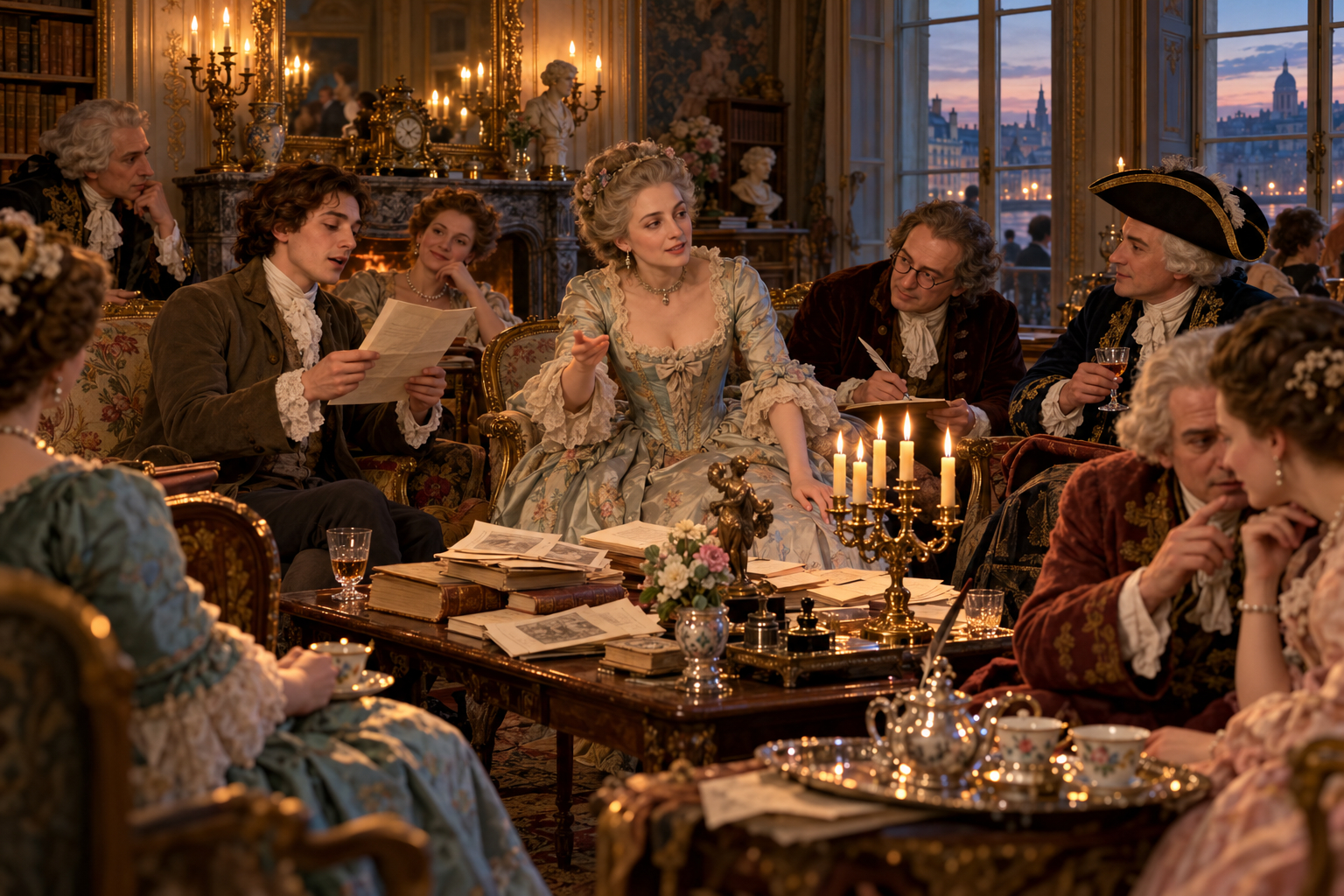
By the late 1600s and into the 1700s, a discreet shift took place in French homes. Wealthy women opened their salons—private gatherings in richly furnished rooms—where writers, jurists, aristocrats, and merchants assembled to argue, translate, read, and trade news. These were not mere social calls. Over tea and candlelight, hosts shaped who sat beside whom, which essays were read aloud, and which jokes were allowed to land. Conversation itself became an instrument: quick, public-spirited, and often sharper than a pamphlet.
Who ran the show and what got talked about
Contrary to many public institutions of the era, salons were commonly run by women—known as salonnières—whose names and reputations mattered as much as their drawing rooms. Figures such as Madame de Rambouillet in the 17th century set the template; in the 18th century Madame Geoffrin and Madame du Deffand curated regular company that included philosophers, magazine editors, and foreign envoys. They weren’t neutral hosts: their taste and friendships could lift a writer’s career or steer a conversation toward commerce, science, or constitutional questions.
The topics were strikingly modern. Guests read and debated new histories and novels, sifted through scientific reports, dissected legal reforms, and weighed questions about religious tolerance and governance. The salon was a nexus between oral wit and printed texts: what premiered in a salon often found its way into pamphlets, periodicals, and the emerging public sphere.
Networks, influence, and limits
Salons knitted local cliques into international circuits. A Parisian salon could send reputations to Berlin, Vienna, or St. Petersburg through visitors, letters, and translated essays. They helped popularize ideas that later circulated in the Republic of Letters and fed projects such as the Encyclopédie, where contributors depended on social networks as much as on publishers. For many writers, salon introductions led to patrons or subscribers; for rulers and diplomats, salons were listening posts for public sentiment.
But salons were not democratic town squares. They largely excluded the urban poor and relied on social rank; they reflected prevailing prejudices and could reinforce elite tastes. Women exercised cultural power, yet legal and political authority remained elsewhere.
Conclusion
The Salon Era left a quieter legacy than a battlefield but a durable one: it taught an age to debate publicly, to see conversation as part of the machinery of change. By turning private parlors into stages for testing ideas, salonnières and their guests helped move Europe toward a world where opinions, printed or spoken, mattered beyond the walls of palace and church.