Uncover History’s Secrets with Daily Updates!
Daily News Entertainment
  • Home
  • History
  • Biographies
  • Eras
  • Regions
  • Timeline
No Result
View All Result
History Ours
  • Home
  • History
  • Biographies
  • Eras
  • Regions
  • Timeline
No Result
View All Result
History Ours
No Result
View All Result
Home Eras

Tenement New York: Life in Vertical Slums, 1870–1910

in Eras
Tenement New York: Life in Vertical Slums, 1870–1910

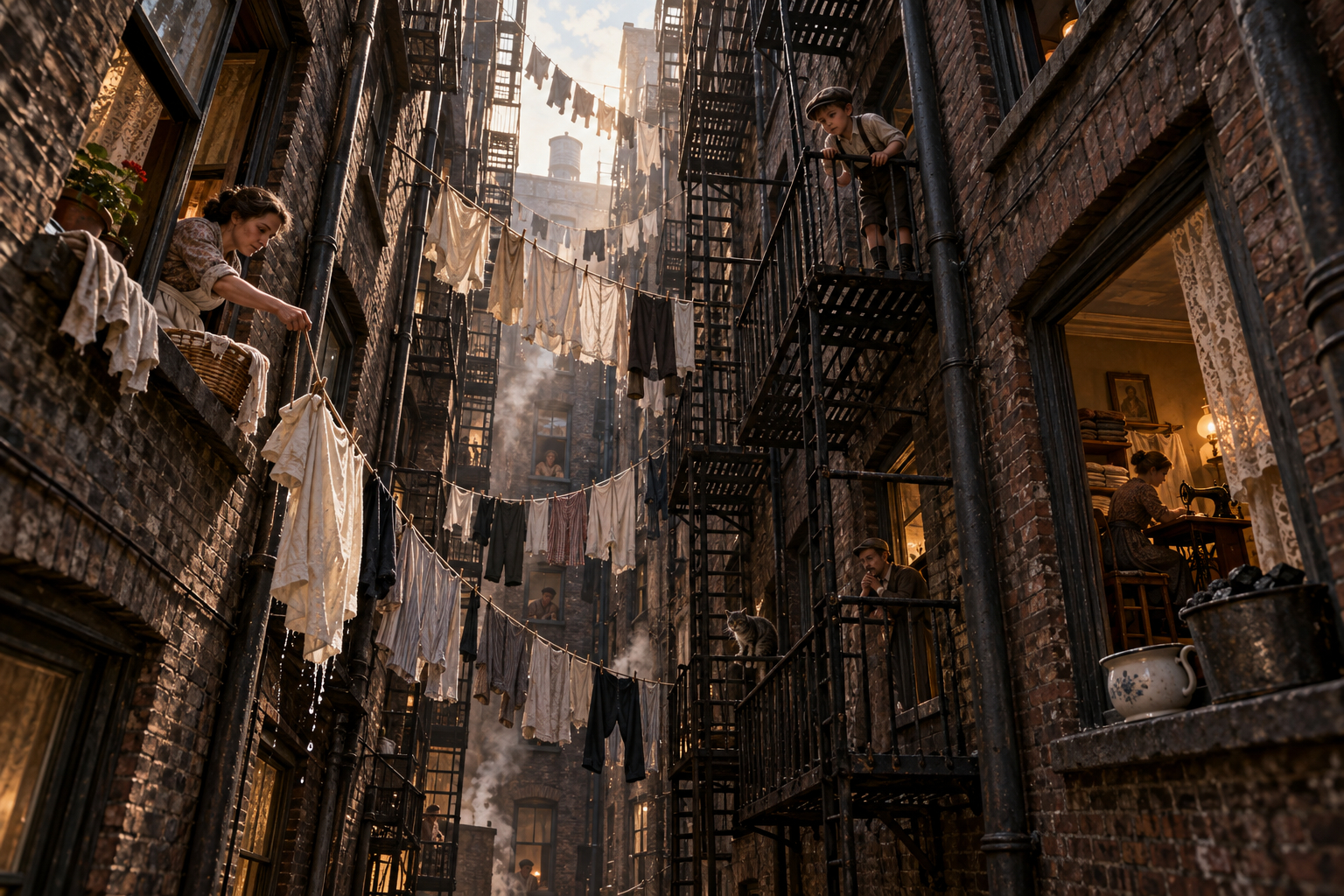
By the late 19th century Manhattan had a single problem: more people than comfortable places to sleep. Waves of immigrants, rural migrants, and newly arrived laborers found housing scarce and landlords eager to squeeze space into profit. Builders answered with narrow, multi‑story apartment blocks that fit dozens of families on a tiny lot. From the street they often looked like ordinary brick row houses; inside they stretched up and up, rooms stacked one above another with shared stairs and alley‑thin courtyards.

Inside: sights, smells, and strategies for survival

Tenement life was an economy of improvisation. Kitchens were also bedrooms and workshops; coal stoves shared corridors; chamber pots waited for night. Lack of indoor plumbing or ventilation turned rooms into humid, smoky places where illness spread easily. Children turned stairwells and sidewalks into classrooms and markets; street vendors and pushcarts threaded between laundry lines and fire escapes. The “air shaft”—a narrow light well cut between buildings—promised air and sun but often became a vertical garbage chute.

Work and home blurred. Many families took in sewing, button‑sewing, or piecework to survive. That kept wages in the home but also made family rooms into tiny factories. At night the city hummed with voices, radios (later), and the click of machines; privacy was scarce, and bodily boundaries were negotiable.

Pressure and change: photographers, reformers, and legislation

Outrage over conditions grew as reformers documented daily life. Photojournalists captured darkness, cramped rooms, and coughing children; published accounts shocked middle‑class readers who could not imagine such density within sight of gleaming commercial blocks. Activists pushed for inspectors, sewers, and sunlight—the kind of municipal interventions that compelled builders to change the rules of construction.

One notable outcome was new housing regulation around the turn of the century that required better light, air, and plumbing in new buildings. The era’s reforms didn’t erase poverty, but they remade how cities thought about public health, building codes, and the state’s role in private housing—shifting the responsibility for humane living conditions onto law and design rather than leaving it solely to charity.

Conclusion

Those cramped blocks shaped modern New York. They concentrated cultures, languages, and industries; they forced municipal governments to act; and they left a material imprint of iron fire escapes and narrow windows that still define old neighborhoods. Tenement New York wasn’t just a condition of poverty. It was the urban experiment—messy, creative, brutal—that helped build the modern city’s expectations about what a home should be.


Previous Post

Mary Seacole: The Jamaican Nurse Who Went to War

Next Post

The Salon Era: How Conversation Shaped the Enlightenment

Related Posts

The Salon Era: How Conversation Shaped the Enlightenment
Eras

The Salon Era: How Conversation Shaped the Enlightenment

October 31, 2026
Song China: Paper Money, Canals, and an Urban Boom
Eras

Song China: Paper Money, Canals, and an Urban Boom

October 26, 2026
The Coffeehouse Century: How Conversation Fueled Early Modern Change
Eras

The Coffeehouse Century: How Conversation Fueled Early Modern Change

October 26, 2026
How Rome Built an Empire One Road at a Time
Eras

How Rome Built an Empire One Road at a Time

October 21, 2026
Next Post
The Salon Era: How Conversation Shaped the Enlightenment

The Salon Era: How Conversation Shaped the Enlightenment

Search..

No Result
View All Result

Recent Articles

The Salon Era: How Conversation Shaped the Enlightenment

The Salon Era: How Conversation Shaped the Enlightenment

October 31, 2026
Tenement New York: Life in Vertical Slums, 1870–1910

Tenement New York: Life in Vertical Slums, 1870–1910

October 31, 2026
Mary Seacole: The Jamaican Nurse Who Went to War

Mary Seacole: The Jamaican Nurse Who Went to War

October 30, 2026
Ada Lovelace: The Poet Who Helped Imagine Modern Computers

Ada Lovelace: The Poet Who Helped Imagine Modern Computers

October 30, 2026
John Snow, the Broad Street Pump, and Cholera’s Fall

John Snow, the Broad Street Pump, and Cholera’s Fall

October 29, 2026

Subscribe Us

By clicking submit, I authorize History Ours and its affiliated companies to: (1) use, sell, and share my information for marketing purposes, including cross-context behavioral advertising, as described in our Terms of Service and Privacy Policy, (2) supplement the information that I provide with additional information lawfully obtained from other sources, like demographic data from public sources, interests inferred from web page views, or other data relevant to what might interest me, like past purchase or location data, (3) contact me or enable others to contact me by email with offers for goods and services from any category at the email address provided, and (4) retain my information while I am engaging with marketing messages that I receive and for a reasonable amount of time thereafter. I understand I can opt out at any time through an email that I receive, or by clicking here

Subscribe To Our Newsletter

By clicking submit, I authorize History Ours and its affiliated companies to: (1) use, sell, and share my information for marketing purposes, including cross-context behavioral advertising, as described in our Terms of Service and Privacy Policy, (2) supplement the information that I provide with additional information lawfully obtained from other sources, like demographic data from public sources, interests inferred from web page views, or other data relevant to what might interest me, like past purchase or location data, (3) contact me or enable others to contact me by email with offers for goods and services from any category at the email address provided, and (4) retain my information while I am engaging with marketing messages that I receive and for a reasonable amount of time thereafter. I understand I can opt out at any time through an email that I receive, or by clicking here.

© 2026 History Ours | All Rights Reserved

  • Contact Us
  • Privacy Policy
  • Terms of Service
  • Unsubscribe
  • Privacy Choices
  • Contact Us
  • Privacy Policy
  • Terms of Service
  • Unsubscribe
  • Privacy Choices

© 2026 History Ours | All Rights Reserved

No Result
View All Result
  • Home
  • History
  • Biographies
  • Eras
  • Regions
  • Timeline

© 2026 History Ours | All Rights Reserved

Skip to content
Open toolbar Accessibility Tools

Accessibility Tools

  • Increase TextIncrease Text
  • Decrease TextDecrease Text
  • GrayscaleGrayscale
  • High ContrastHigh Contrast
  • Negative ContrastNegative Contrast
  • Light BackgroundLight Background
  • Links UnderlineLinks Underline
  • Readable FontReadable Font
  • Reset Reset