
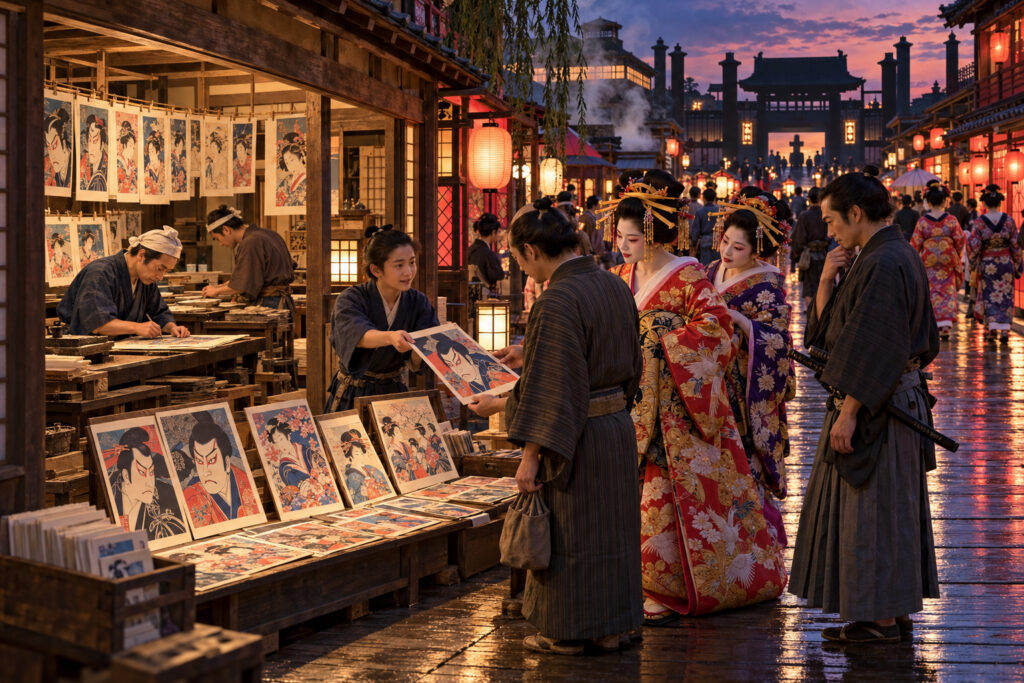
By the seventeenth century, a string of riverine towns had swelled into bustling urban centers under the Tokugawa shogunate. Edo—today’s Tokyo—grew from a castle town into a city of samurai bureaucrats, shopkeepers, artisans, and merchants. The policy of sankin-kotai, which rotated daimyo between their domains and the capital, helped funnel wealth, people, and goods into city life. Streets lined with wooden shops, teahouses, and bathhouses became the backbone of a new public culture, where a largely literate urban population created demand for entertainment, images, and printed matter.
Where the “floating world” took shape
The phrase ukiyo, literally “floating world,” came to describe the ephemeral pleasures of these cities: theaters that erupted with color, licensed pleasure districts where fashions changed fast, and afternoon promenades that doubled as social theater. Yoshiwara in Edo was the most famous of those quarters—a regulated, walled neighborhood that nevertheless set trends in dress, manners, and music across the islands. Kabuki theater, with its exaggerated acting and bold stagecraft, drew audiences from samurai to merchants and gave rise to celebrity actors whose images circulated widely.
Woodblock prints, newspapers, and a new visual economy
One of the era’s most enduring legacies is ukiyo-e, the woodblock print. These images—actors, courtesans, landscapes, and humorous scenes—were produced in series and sold cheaply on streets and in shops, making art part of everyday urban life. Printers, carvers, and publishers formed an efficient production chain, and the prints’ vivid colors and bold lines became a kind of mass media. Alongside them, simple newspapers and popular pamphlets spread gossip, poetry, and practical news across neighborhoods, linking a dispersed population through shared tastes and information.
Commerce, law, and the social paradox
Merchants grew wealthy in this urban economy but occupied a lower rung in the official class order. The shogunate imposed sumptuary laws to curb ostentation—mandating who could wear what—but those rules were often evaded or reshaped by fashion. Money flowed into luxury goods, theater tickets, and printed images, turning consumption into cultural expression. Meanwhile, daily routines—communal baths, market bargaining, seasonal festivals—gave ordinary people a public life that was both regulated and surprisingly creative.
Conclusion
The Tokugawa cities were at once disciplined and exuberant. They produced a culture that celebrated transience: printed portraits that could be bought by anyone, performances that lasted a night, fashions that changed with the season. That combination of commercial energy, visual culture, and urban sociability left a visible imprint on Japan—and on how the modern city could be imagined: a place where art, business, and pleasure circulate together, if only for a moment in the “floating world.”