
Uncover History’s Secrets with Daily Updates!
Daily News Entertainment
  • Home
  • History
  • Biographies
  • Eras
  • Regions
  • Timeline
No Result
View All Result
History Ours
  • Home
  • History
  • Biographies
  • Eras
  • Regions
  • Timeline
No Result
View All Result
History Ours
No Result
View All Result
Home Eras

Edo Japan’s Floating World: Cities, Pleasure, and Paper

in Eras
Edo Japan’s Floating World: Cities, Pleasure, and Paper

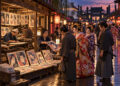
By the seventeenth century, a string of riverine towns had swelled into bustling urban centers under the Tokugawa shogunate. Edo—today’s Tokyo—grew from a castle town into a city of samurai bureaucrats, shopkeepers, artisans, and merchants. The policy of sankin-kotai, which rotated daimyo between their domains and the capital, helped funnel wealth, people, and goods into city life. Streets lined with wooden shops, teahouses, and bathhouses became the backbone of a new public culture, where a largely literate urban population created demand for entertainment, images, and printed matter.

Where the “floating world” took shape

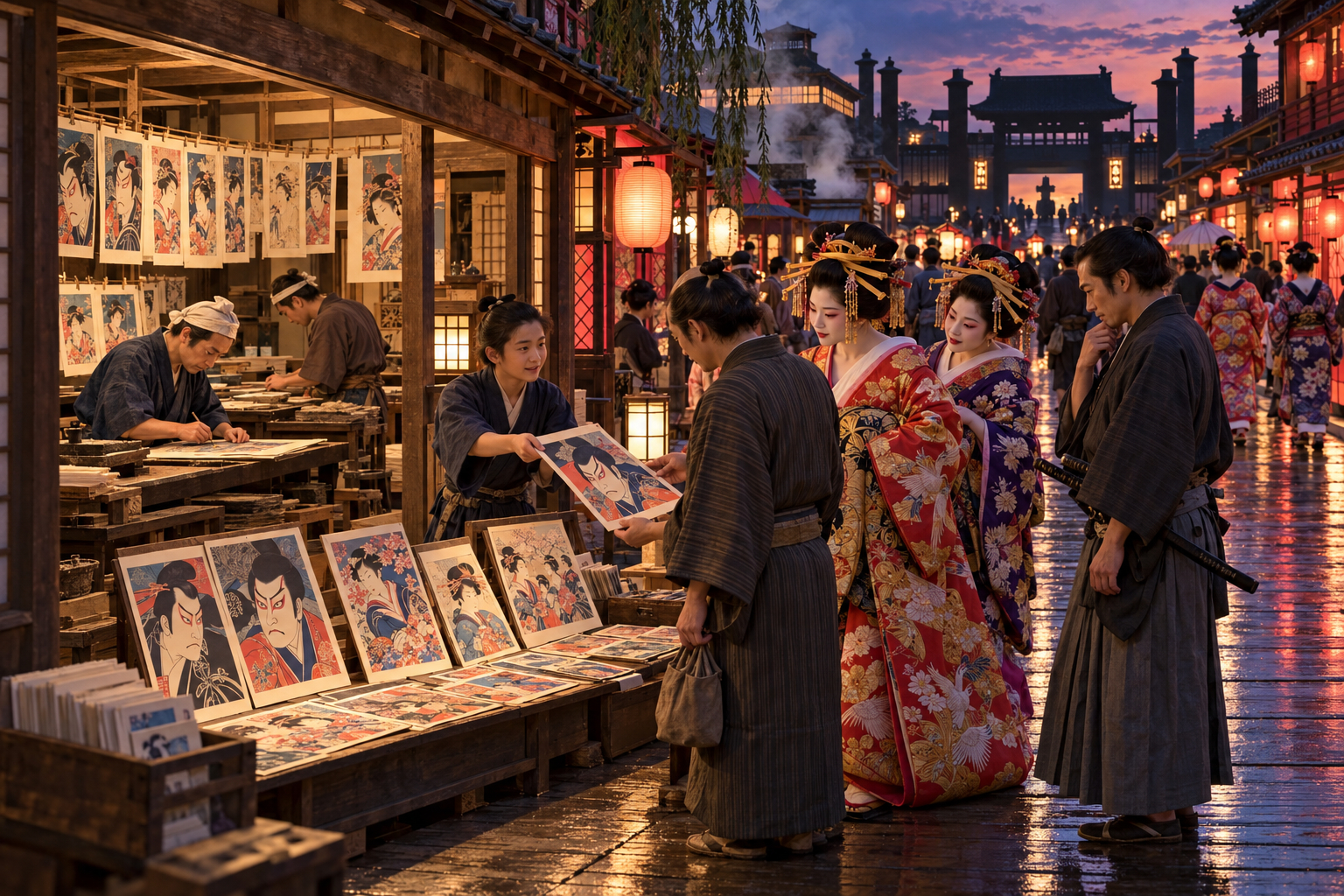
The phrase ukiyo, literally “floating world,” came to describe the ephemeral pleasures of these cities: theaters that erupted with color, licensed pleasure districts where fashions changed fast, and afternoon promenades that doubled as social theater. Yoshiwara in Edo was the most famous of those quarters—a regulated, walled neighborhood that nevertheless set trends in dress, manners, and music across the islands. Kabuki theater, with its exaggerated acting and bold stagecraft, drew audiences from samurai to merchants and gave rise to celebrity actors whose images circulated widely.

Woodblock prints, newspapers, and a new visual economy

One of the era’s most enduring legacies is ukiyo-e, the woodblock print. These images—actors, courtesans, landscapes, and humorous scenes—were produced in series and sold cheaply on streets and in shops, making art part of everyday urban life. Printers, carvers, and publishers formed an efficient production chain, and the prints’ vivid colors and bold lines became a kind of mass media. Alongside them, simple newspapers and popular pamphlets spread gossip, poetry, and practical news across neighborhoods, linking a dispersed population through shared tastes and information.

Commerce, law, and the social paradox

Merchants grew wealthy in this urban economy but occupied a lower rung in the official class order. The shogunate imposed sumptuary laws to curb ostentation—mandating who could wear what—but those rules were often evaded or reshaped by fashion. Money flowed into luxury goods, theater tickets, and printed images, turning consumption into cultural expression. Meanwhile, daily routines—communal baths, market bargaining, seasonal festivals—gave ordinary people a public life that was both regulated and surprisingly creative.

Conclusion

The Tokugawa cities were at once disciplined and exuberant. They produced a culture that celebrated transience: printed portraits that could be bought by anyone, performances that lasted a night, fashions that changed with the season. That combination of commercial energy, visual culture, and urban sociability left a visible imprint on Japan—and on how the modern city could be imagined: a place where art, business, and pleasure circulate together, if only for a moment in the “floating world.”
Previous Post

Hedy Lamarr: The Hollywood Star Who Also Patented a New Kind of Radio

Next Post

Inside Chang’an: Life in the Tang Dynasty Capital

Related Posts

Inside Chang’an: Life in the Tang Dynasty Capital
Eras

Inside Chang’an: Life in the Tang Dynasty Capital

October 16, 2026
Mapping Time: Understanding How Eras Shape Histories
Eras

Mapping Time: Understanding How Eras Shape Histories

October 11, 2026
Interpreting Eras: Patterns That Define Historical Change
Eras

Interpreting Eras: Patterns That Define Historical Change

October 11, 2026
The Printing Press Era: How Movable Type Remade Europe
Eras

The Printing Press Era: How Movable Type Remade Europe

October 6, 2026
Next Post
Inside Chang’an: Life in the Tang Dynasty Capital

Inside Chang'an: Life in the Tang Dynasty Capital

Search..

No Result
View All Result

Recent Articles

Silk and Revolt: How Lyon’s Weavers Made a Region

Silk and Revolt: How Lyon’s Weavers Made a Region

October 17, 2026
Mocha and the Mountains: How Coffee Shaped Yemeni Regions

Mocha and the Mountains: How Coffee Shaped Yemeni Regions

October 17, 2026
Inside Chang’an: Life in the Tang Dynasty Capital

Inside Chang’an: Life in the Tang Dynasty Capital

October 16, 2026
Edo Japan’s Floating World: Cities, Pleasure, and Paper

Edo Japan’s Floating World: Cities, Pleasure, and Paper

October 16, 2026
Hedy Lamarr: The Hollywood Star Who Also Patented a New Kind of Radio

Hedy Lamarr: The Hollywood Star Who Also Patented a New Kind of Radio

October 15, 2026

Subscribe Us

By clicking submit, I authorize History Ours and its affiliated companies to: (1) use, sell, and share my information for marketing purposes, including cross-context behavioral advertising, as described in our Terms of Service and Privacy Policy, (2) supplement the information that I provide with additional information lawfully obtained from other sources, like demographic data from public sources, interests inferred from web page views, or other data relevant to what might interest me, like past purchase or location data, (3) contact me or enable others to contact me by email with offers for goods and services from any category at the email address provided, and (4) retain my information while I am engaging with marketing messages that I receive and for a reasonable amount of time thereafter. I understand I can opt out at any time through an email that I receive, or by clicking here

Subscribe To Our Newsletter

By clicking submit, I authorize History Ours and its affiliated companies to: (1) use, sell, and share my information for marketing purposes, including cross-context behavioral advertising, as described in our Terms of Service and Privacy Policy, (2) supplement the information that I provide with additional information lawfully obtained from other sources, like demographic data from public sources, interests inferred from web page views, or other data relevant to what might interest me, like past purchase or location data, (3) contact me or enable others to contact me by email with offers for goods and services from any category at the email address provided, and (4) retain my information while I am engaging with marketing messages that I receive and for a reasonable amount of time thereafter. I understand I can opt out at any time through an email that I receive, or by clicking here.

© 2026 History Ours | All Rights Reserved

  • Contact Us
  • Privacy Policy
  • Terms of Service
  • Unsubscribe
  • Privacy Choices
  • Contact Us
  • Privacy Policy
  • Terms of Service
  • Unsubscribe
  • Privacy Choices

© 2026 History Ours | All Rights Reserved

No Result
View All Result
  • Home
  • History
  • Biographies
  • Eras
  • Regions
  • Timeline

© 2026 History Ours | All Rights Reserved

Skip to content
Open toolbar Accessibility Tools

Accessibility Tools

  • Increase TextIncrease Text
  • Decrease TextDecrease Text
  • GrayscaleGrayscale
  • High ContrastHigh Contrast
  • Negative ContrastNegative Contrast
  • Light BackgroundLight Background
  • Links UnderlineLinks Underline
  • Readable FontReadable Font
  • Reset Reset