
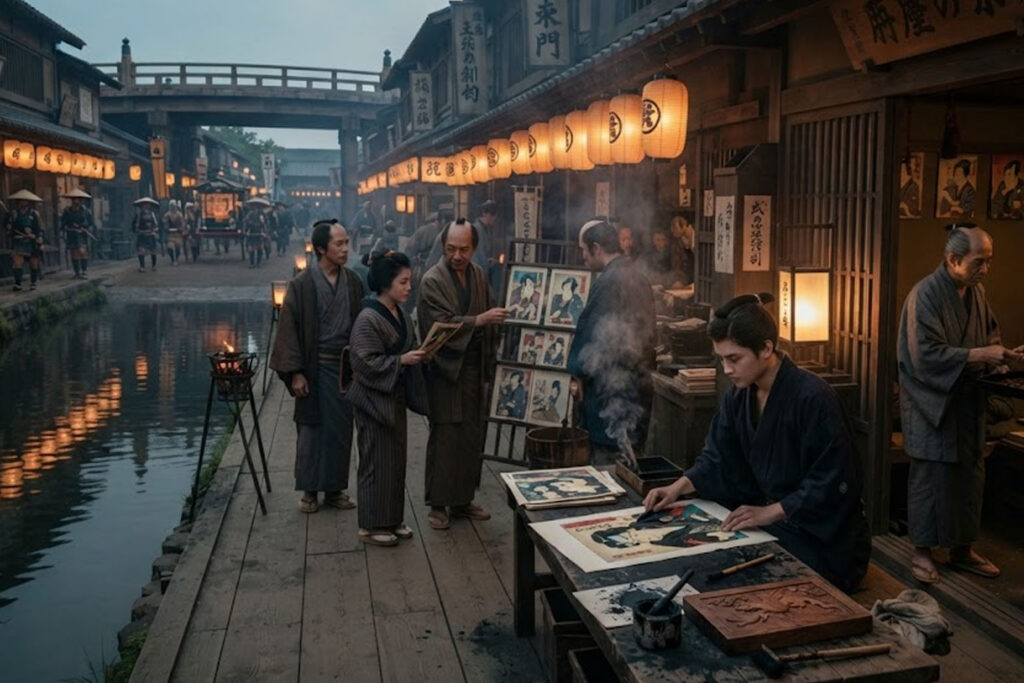
City of rivers, lanterns, and constant rebuilding
The Tokugawa or Edo period (1603–1868) turned what had been a feudal capital into one of the world’s great urban experiments. Edo—modern Tokyo—grew from a castle town into a city of wooden houses, narrow canals, and paper lanterns, swelling to roughly a million inhabitants by the early 18th century. That density came with bright life and persistent hazards: fires were a regular catastrophe (the Great Fire of Meireki in 1657 is one notorious example), and rebuilding itself became part of daily routine.
Orderly on paper, the city lived by an uneasy balance of regulation and ingenuity. The shogunate issued sumptuary rules to keep visible status in check, yet merchants found ways to display wealth through fashion, leisure, and the arts—sparking a distinctive urban culture.
Roads, daimyo processions, and the rise of the chōnin
One policy shaped everyday Japan more than any other: sankin-kōtai, the requirement that regional lords spend alternate years in Edo. Entire retinues moved along paved highways and stopped at post towns where inns, teahouses, and craftsmen flourished. These processions pumped money into the economy, supported inns and staging posts, and made long-distance travel familiar to many.
That flow of people and cash elevated the chōnin—the city’s merchant and artisan class. Legally beneath samurai, these townspeople became tastemakers: they sponsored theatres, commissioned prints, and funded publishing. Their tastes produced goods designed for urban consumption rather than courtly display, laying groundwork for a consumer culture built on novelty and affordability.
The floating world: kabuki, ukiyo-e, and mass culture
Edo’s entertainment districts—most famously Yoshiwara—served as laboratories for new forms of pleasure and art. Kabuki theatre, part dance and part spectacle, evolved into a central urban pastime; after women were banned from the stage in the early 17th century, male actors specialized in female roles (onnagata). Bunraku puppet theatre offered a darker, literary counterpoint.
At the same time woodblock print technology made images cheap and collectible. Ukiyo-e prints captured actors, courtesans, landscapes, and scenes from daily life. Artists such as Hokusai and Hiroshige would come later in the period, but the format itself democratized art: people who could not afford paintings bought prints to hang in their homes.
Conclusion
The Edo era’s claim to interest lies less in sweeping reform than in the texture of ordinary life. Within a tightly ordered political system, a bustling urban public invented new pleasures, new markets, and new visual languages. Wooden streets, lanternlight, travelling processions, kabuki cries, and stacks of prints made Edo a place where modern urban culture—consumer habits, mass entertainment, and graphic art—was born from centuries of very human improvisation.