By the mid-1200s, the Mongols had stitched an enormous empire across Eurasia. What looks from a distance like a single political sweep was, for merchants and travelers, something else: a period of unusually steady long-distance movement historians call the Pax Mongolica. For a few generations after Genghis Khan and his successors carved out their realm, caravans, envoys, and missionaries found routes guarded, relay stations staffed, and travel documents honored across borders that not long before had been hostile or impassable.
Roads, relays, and official passes
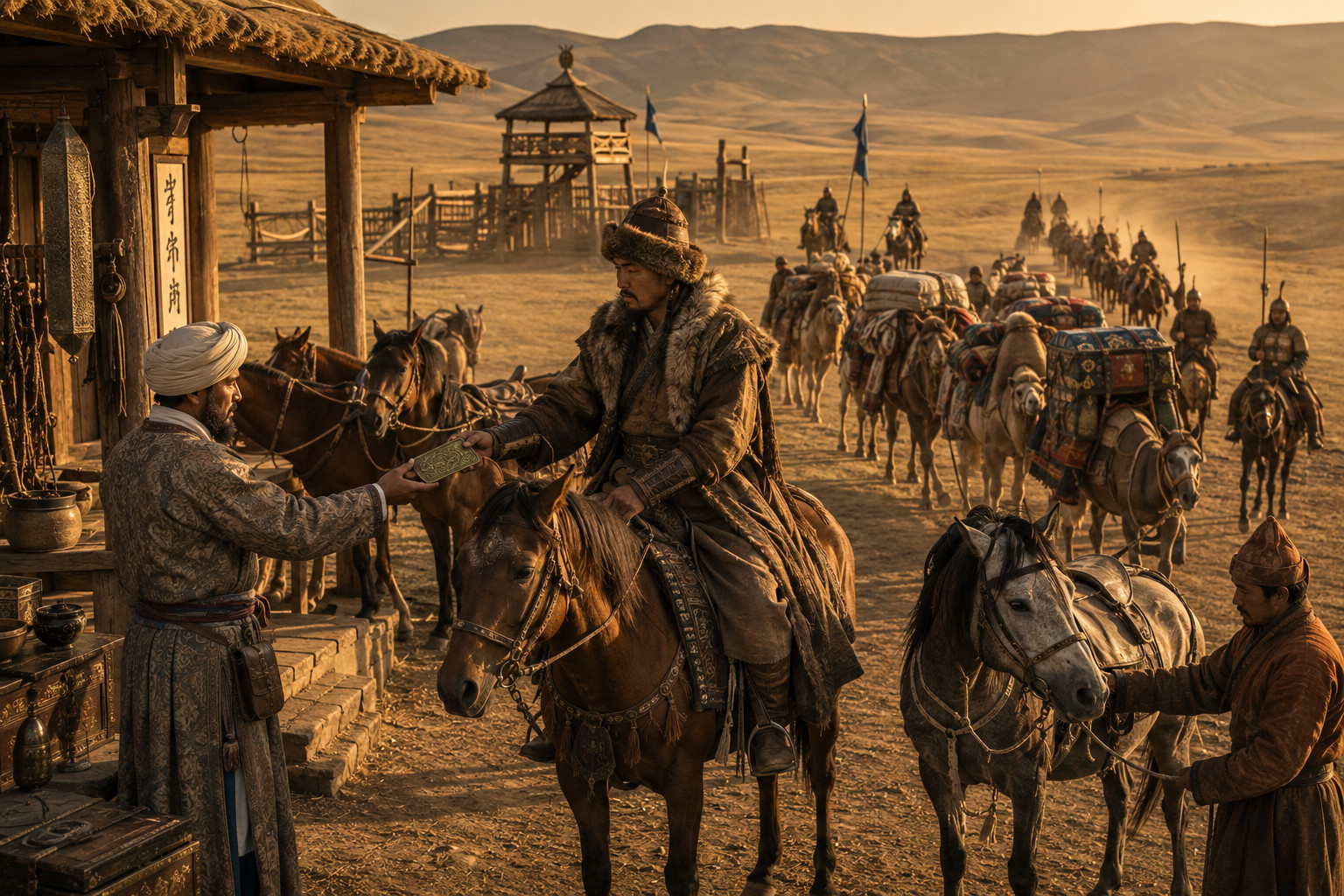
The empire’s backbone was practical. The yam — a network of relay stations with fresh horses, food, and shelter — let mounted couriers cover staggering distances. Merchants carrying silk bolts, spices, horses, or horseshoes could ask for protection with a paiza, a metal tablet granting privileges and access to official support. That combination of infrastructure and imperial interest in commerce cut the hazards of travel: banditry declined in many stretches, and information moved faster than in most earlier premodern systems.
What moved besides goods
Trade under Mongol rule was not just about silk and silver. Ideas, technologies, and people flowed in both directions. Chinese papermaking and military techniques, Central Asian astronomical knowledge, Persian artisans, and new crops circulated along the same tracks that carried velvet and spices. Travelers such as Marco Polo reached Kublai Khan’s court, and missionaries, diplomats, and artisans left colorful, sometimes contradictory, accounts of life across the empire’s many cultures.
That openness had a darker side. The same routes that enabled commerce also connected human and animal populations in ways they hadn’t been before. Many historians link the rapid westward spread of the mid-14th-century plague to these intensified Eurasian links — a reminder that integration can transmit both wealth and catastrophe.
Conclusion
Pax Mongolica didn’t create a globalized world in modern terms, but it rewired Eurasia’s map of exchange. For a few decades it lowered the cost—literally and figuratively—of moving goods, people, and ideas from China to Persia to the Mediterranean. The result was a burst of contact that reshaped tastes, weapons, and knowledge across continents. When the Mongol system fractured in the 14th century, those flows didn’t vanish; they had already altered markets, cities, and technologies in ways that shaped the late medieval world that followed.