
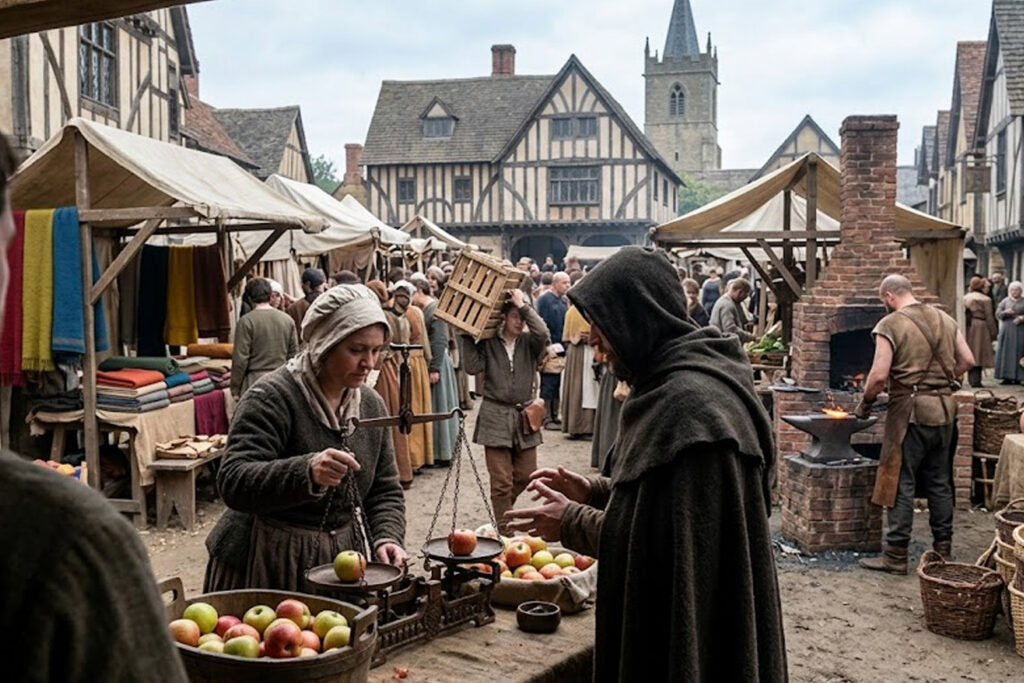
Medieval market towns were lively hubs where commerce, craft, and community intersected day by day.
Their streets, stalls, and guildhalls shaped rhythms of work and social life for residents and visitors alike.
Understanding these towns helps illuminate how ordinary people experienced economy, governance, and culture in their era.
This article explores the town layout, daily occupations, social interactions, and cultural practices that defined everyday life.
Market Town Structure
Market towns typically grew near trade routes or river crossings and developed a compact layout around a central market square. The square hosted weekly or seasonal markets where farmers, artisans, and merchants exchanged goods, news, and services. Narrow streets led to specialized quarters — tanners, bakers, weavers, and metalworkers often clustered together to share resources and customers. Civic buildings such as the guildhall, church, and tollhouse provided administrative and social anchors for the town.
This physical structure made the market square a focal point of daily life and a stage for public events and regulation. It also helped create recognizable neighborhoods where identities and local economies developed over generations.
Daily Work and Trade
Most residents engaged in occupations tied to production and commerce rather than large-scale farming. Artisans balanced workshop production with market sales, while itinerant traders brought exotic or distant goods that broadened choices. The timing of markets, fairs, and guild regulations shaped labor patterns and opportunities for apprentices and journeymen. Trade was both local and regional, dependent on seasons, transport conditions, and legal privileges granted by authorities.
For many people, economic survival required adaptability and social networks that could provide credit, information, and work. Markets reinforced ties between rural producers and urban consumers in practical and cultural ways.
Social and Cultural Life
Social life in market towns mixed work with ritual, leisure, and conflict in shared public spaces. Festivals, religious observances, and public punishments all occurred in or near the square, reinforcing communal norms and hierarchies. Guilds regulated not only production standards but also social welfare and charity for members and their families. Inns and alehouses offered informal centers for news, negotiations, and entertainment beyond formal institutions.
Everyday culture balanced communal obligations with personal advancement, often within visible and rule-bound settings. This combination of commerce and community produced identities tied closely to place and occupation.
Conclusion
Market towns were dynamic environments where economic, social, and cultural life overlapped daily.
Their structures and institutions shaped opportunities, responsibilities, and communal bonds for ordinary people.
Studying these towns offers a grounded perspective on how people lived, worked, and connected in their era.