
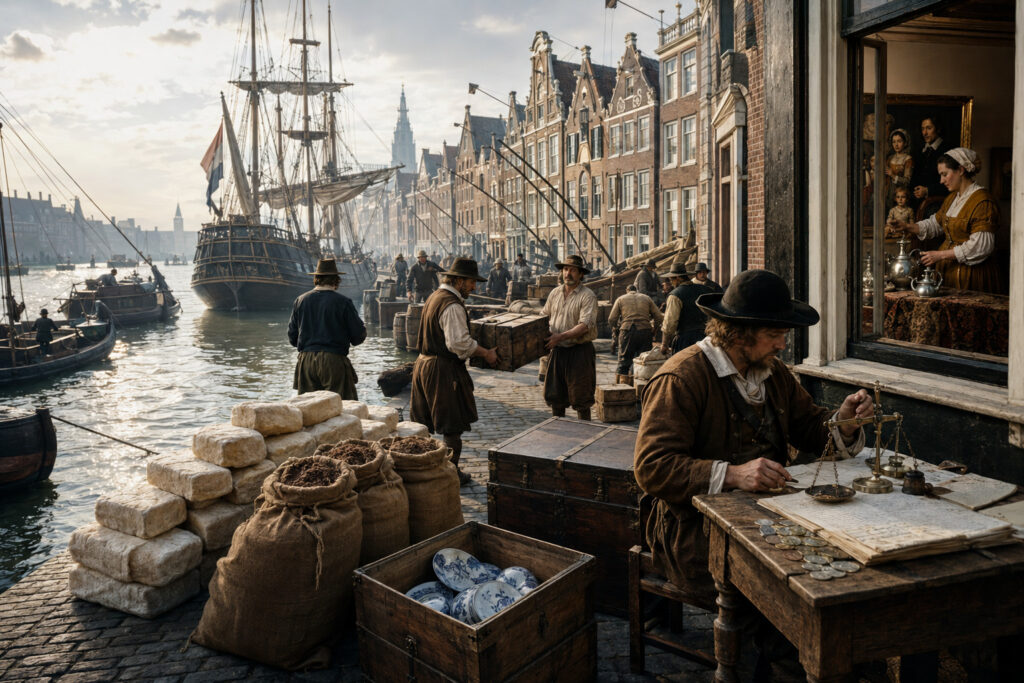
By the 1600s the low countries had turned ocean trade into a machine. Amsterdam’s merchants sailed to the Baltic for grain, to the Mediterranean for spices, and beyond the Cape of Good Hope to the East Indies. The Dutch East India Company, founded in 1602, organized fleets, shared risk through tradable shares and helped make Amsterdam a hub for goods and money. Ports, shipyards and warehouses drew labor, capital and a bewildering variety of imports: sugar and coffee, Baltic timber, Brazilian tobacco. That mix transformed not just elites but daily life across northern Europe, because luxury imports were no longer curiosities but parts of ordinary diets and fashions.
Homes, canals, and the art of looking close
The face of Dutch towns changed with prosperity. Canals threaded cities into neat halves; narrow canal houses rose tall and thin, their hooked beams visible at the roofline for hoisting trunks and barrels up cramped stairways. Interiors became a public statement—bright windows, carefully arranged tableware, thick rugs, and painted portraits of merchant families. Painters such as Rembrandt and Vermeer turned those domestic details into a new kind of fame: genre scenes that celebrated everyday objects—maps on the wall, a gleaming pewter jug, a trimmed beard. Their paintings were both advertisement and mirror: they show what people owned and what they admired about themselves.
Practical modernities and global strain
Behind the glamour were innovations that look familiar today: sophisticated bookkeeping, early stock trading, insurance contracts, and a network of credit that kept ships moving. The republic also experimented with religious tolerance, which attracted skilled refugees—Jews, Huguenots, and others—whose trades boosted urban economies. But growth brought friction. Competition on the seas led to violent clashes with England in the mid-1600s and constant pressure to protect shipping. Speculative bubbles—most famously the tulip mania that imploded around 1637—reminded citizens that the new financial tools could be unstable.
Conclusion
The Dutch Golden Age was less a single flash of riches than a cluster of changes: maritime networks, financial practices, urban architecture and a culture that turned ordinary objects into stories. Its reach was practical—coffee in a modest Dutch cup or maps tucked into a merchant’s study—but the ripple effects mattered across Europe: new tastes, new money, and a model of how a maritime, commercial society could organize itself. That mix of the intimate and the global is why 17th-century Dutch life still feels familiar and surprising at once.