
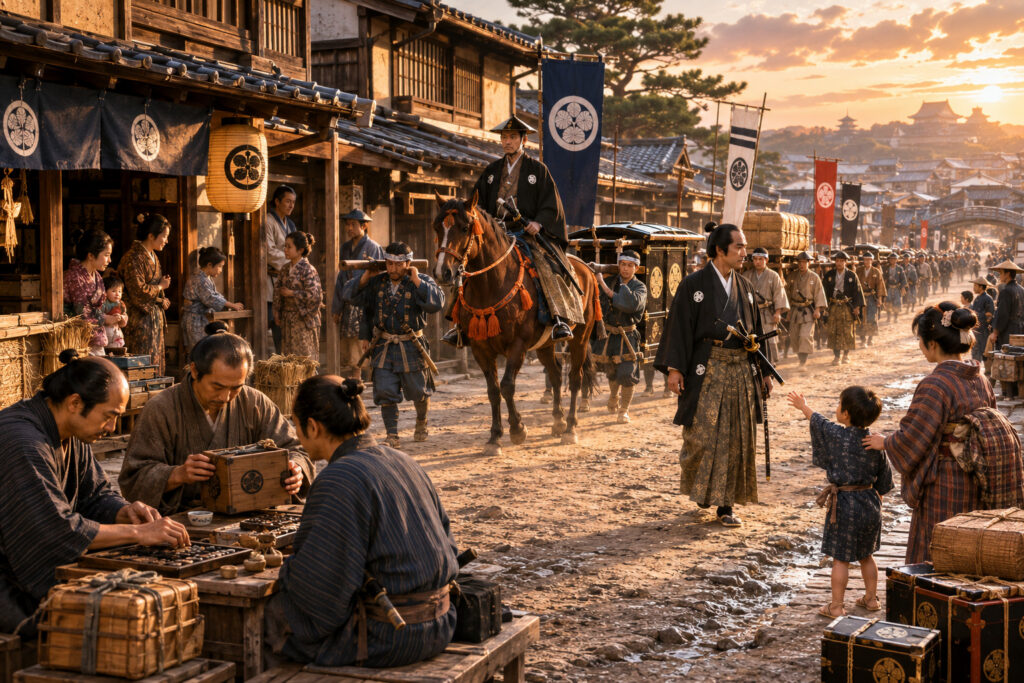
When Tokugawa Ieyasu finished the long wars of the 16th century and established his shogunate in Edo, Japan entered a peace it had not known for generations. That calm reshaped every rung of society. The government froze a four-tier legal order—samurai, peasants, artisans, merchants—with strict expectations about clothing, residence, and occupation. The samurai, once battlefield leaders, became salaried bureaucrats. Peasants were legally tied to the land. Merchants, though officially lowest, quietly amassed real power through cash, credit, and trade.
Travel, taxation, and the politics of presence
One of the shogunate’s most effective tools was sankin-kotai, the system of alternate attendance. Daimyō (regional lords) were required to maintain a residence in Edo and spend alternating years at court and in their domains. The measure was practical and psychological: it drained rival treasuries, kept families effectively hostage in the capital, and turned Edo into a political stage. Processions of retainers, coaches, and gifts became a regular spectacle, moving money into the capital and stimulating inns, craftsmen, and porters along the highways.
Cities, culture, and cash
Edo swelled into one of the world’s largest cities of the time. Osaka and Kyoto remained vital—Osaka as a rice and commodity market, Kyoto as ceremonial heart—but Edo’s growth signaled a shift from land wealth to money wealth. Rice was still the official measure of value (stipends were often paid in koku), yet a sophisticated cash economy and credit networks emerged. That money underwrote an explosion of urban culture: kabuki theaters, pleasure districts like Yoshiwara, and ukiyo-e prints that celebrated the tastes of townspeople. Meanwhile, rising literacy and terakoya schools meant merchants’ children learned reading and arithmetic, translating economic clout into cultural influence.
Daily contradictions
Life under Tokugawa rule was full of small ironies. Samurai wore topknots and swords but often lived on tight stipends and ran up debts to merchants. Peasants, idealized as the productive backbone of society, faced heavy taxes and periodic famines. Sumptuary laws tried to prevent visible displays of wealth, yet fashion found ways around rules; merchants bought land or used proxies to gain status. The shogunate’s isolationist policies limited foreign contact, but goods, ideas, and illicit trade still flowed—Dutch books, Chinese medicines, and smuggled silver found eager markets.
Conclusion
The Tokugawa era didn’t freeze Japan so much as rearrange its ambitions. It created a durable order that encouraged commerce, concentrated power in Edo, and fostered urban cultures that would later feed the ferment of the 19th century. Under its calm surface, social roles were being rewritten—sometimes quietly, sometimes in the noise of kabuki drums and merchants’ ledgers.