

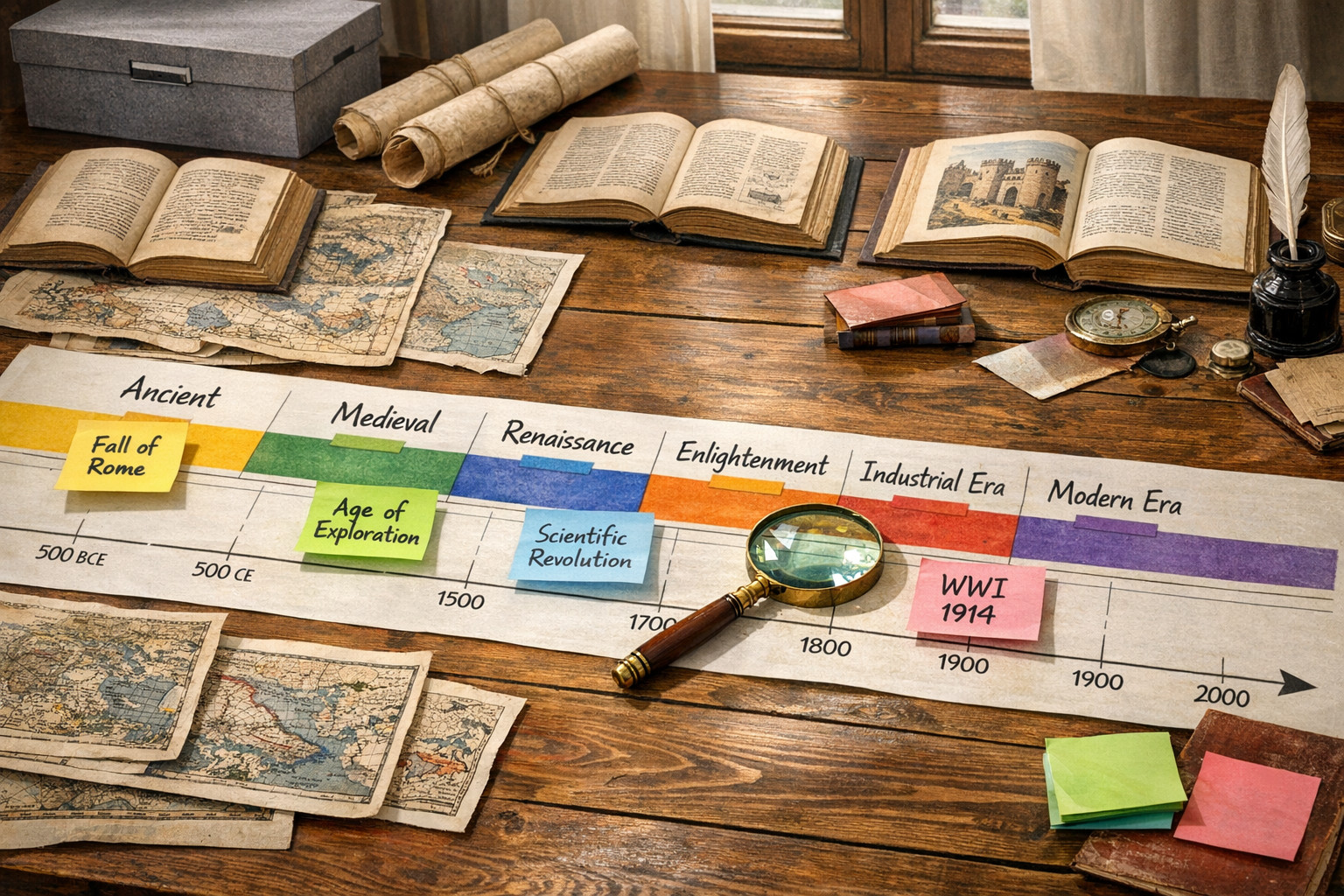
Historians and educators use eras to turn vast chronologies into understandable narratives. Period labels highlight patterns and guide inquiry without replacing detailed local study. This article presents practical ways to define, critique, and apply eras in research and teaching. It aims to help readers balance clarity with complexity when framing the past.
Why periodization matters
Periodization is a tool for interpretation: it shapes questions, organizes evidence, and suggests causal linkages across time. By naming an era, scholars make comparative work possible and give audiences a framework for remembering change. At the same time, rigid or retrospective eras can obscure diversity and impose teleology where none exists. Recognizing these trade-offs encourages historians to justify period choices and remain open to revision.
Good periodization communicates both continuity and change and points to meaningful transformations. Clear signals about why a boundary is chosen help readers evaluate claims and follow arguments.
Common approaches to defining eras
Scholars use several methods to set eras, each suited to different research aims. Political periodization focuses on regimes or institutions, economic periodization emphasizes market and production shifts, and cultural periodization centers on ideas and practices. Technological or environmental turning points can also serve as useful markers when they produce broad social consequences.
Choosing among these approaches depends on the questions at hand and the scale of analysis. Combining perspectives often produces more nuanced eras that reflect multiple dimensions of change.
Applying eras in teaching and research
In classrooms, eras help students build chronological literacy and link events to larger processes. In research, explicit definitions make comparisons transparent and enable others to test claims against different boundaries. Both contexts benefit when instructors and authors state the criteria behind period labels and acknowledge exceptions or overlaps.
- State the temporal bounds and criteria for any era used.
- Illustrate with varied case studies to show exceptions and continuities.
- Reassess boundaries as new evidence or perspectives emerge.
Practical habits—clear definitions, illustrative cases, and openness to revision—reduce misunderstandings and strengthen arguments. These steps help eras serve as productive heuristics rather than restrictive templates.
Conclusion
Thoughtful periodization enhances clarity while preserving complexity. Always explain why a boundary was chosen and remain attentive to exceptions. Responsible use of eras improves communication and fosters better historical reasoning.