

Uncover History’s Secrets with Daily Updates!
Daily News Entertainment
  • Home
  • History
  • Biographies
  • Eras
  • Regions
  • Timeline
No Result
View All Result
History Ours
  • Home
  • History
  • Biographies
  • Eras
  • Regions
  • Timeline
No Result
View All Result
History Ours
No Result
View All Result
Home Eras

Organizing the Past: Practical Guides to Historical Eras

in Eras
Organizing the Past: Practical Guides to Historical Eras

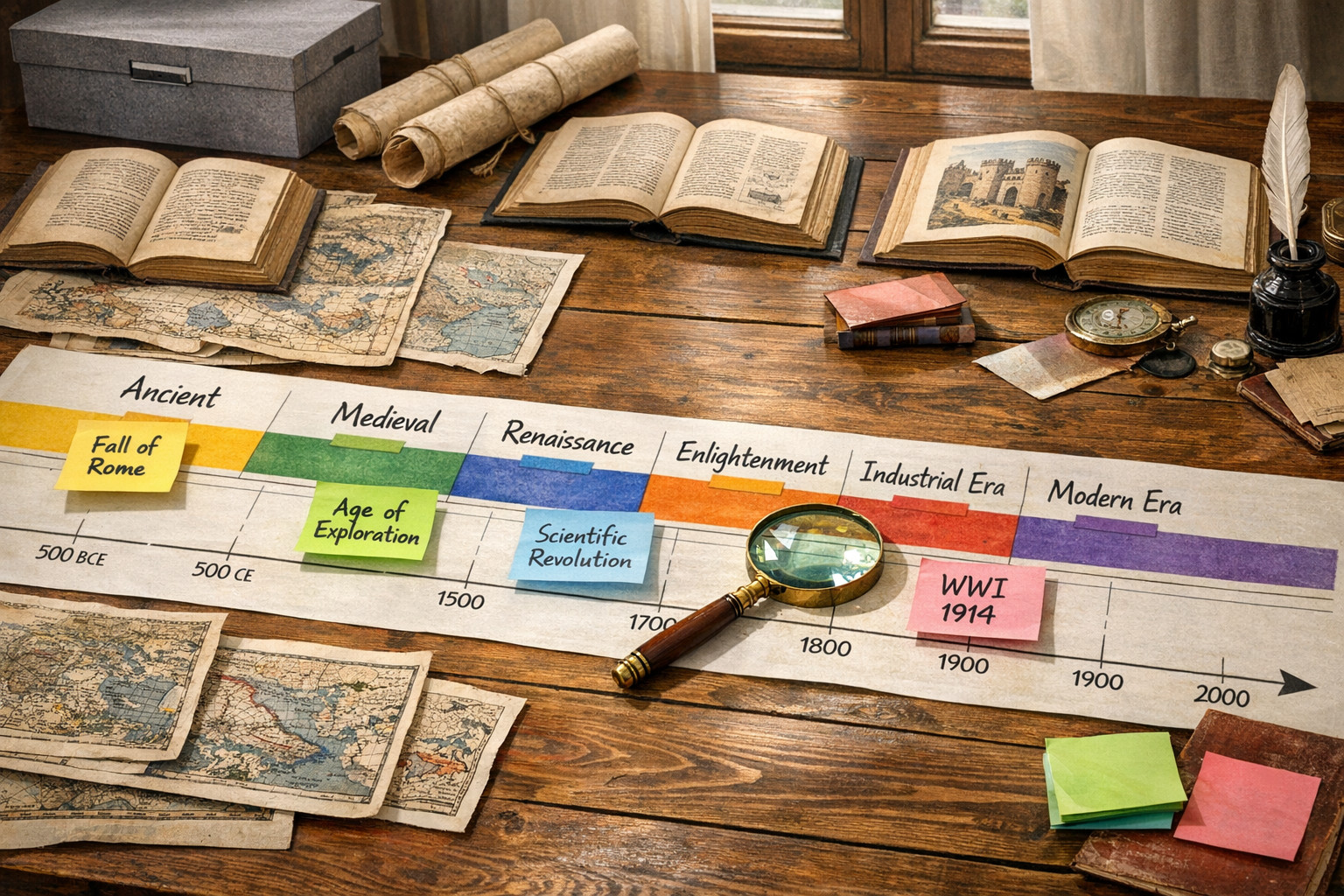
Historians and educators use eras to turn vast chronologies into understandable narratives. Period labels highlight patterns and guide inquiry without replacing detailed local study. This article presents practical ways to define, critique, and apply eras in research and teaching. It aims to help readers balance clarity with complexity when framing the past.

Why periodization matters

Periodization is a tool for interpretation: it shapes questions, organizes evidence, and suggests causal linkages across time. By naming an era, scholars make comparative work possible and give audiences a framework for remembering change. At the same time, rigid or retrospective eras can obscure diversity and impose teleology where none exists. Recognizing these trade-offs encourages historians to justify period choices and remain open to revision.

Good periodization communicates both continuity and change and points to meaningful transformations. Clear signals about why a boundary is chosen help readers evaluate claims and follow arguments.

Common approaches to defining eras

Scholars use several methods to set eras, each suited to different research aims. Political periodization focuses on regimes or institutions, economic periodization emphasizes market and production shifts, and cultural periodization centers on ideas and practices. Technological or environmental turning points can also serve as useful markers when they produce broad social consequences.

Choosing among these approaches depends on the questions at hand and the scale of analysis. Combining perspectives often produces more nuanced eras that reflect multiple dimensions of change.

Applying eras in teaching and research

In classrooms, eras help students build chronological literacy and link events to larger processes. In research, explicit definitions make comparisons transparent and enable others to test claims against different boundaries. Both contexts benefit when instructors and authors state the criteria behind period labels and acknowledge exceptions or overlaps.

  • State the temporal bounds and criteria for any era used.
  • Illustrate with varied case studies to show exceptions and continuities.
  • Reassess boundaries as new evidence or perspectives emerge.

Practical habits—clear definitions, illustrative cases, and openness to revision—reduce misunderstandings and strengthen arguments. These steps help eras serve as productive heuristics rather than restrictive templates.

Conclusion

Thoughtful periodization enhances clarity while preserving complexity. Always explain why a boundary was chosen and remain attentive to exceptions. Responsible use of eras improves communication and fosters better historical reasoning.


Previous Post

Mapping Cultural Shifts Across Major Historical Eras and Meanings

Next Post

How Local Landscapes Shape Regional Memory and Identity

Related Posts

Pax Mongolica: How Mongol Rule Rewired the Old World
Eras

Pax Mongolica: How Mongol Rule Rewired the Old World

September 15, 2026
Life Under the Tokugawa: How Edo Japan Rewrote Social Order
Eras

Life Under the Tokugawa: How Edo Japan Rewrote Social Order

September 15, 2026
When Empires Fell: The Late Bronze Age Collapse
Eras

When Empires Fell: The Late Bronze Age Collapse

September 15, 2026
1816: How a Volcano Turned Summer Into Crisis
Eras

1816: How a Volcano Turned Summer Into Crisis

September 15, 2026
Next Post
How Local Landscapes Shape Regional Memory and Identity

How Local Landscapes Shape Regional Memory and Identity

Search..

No Result
View All Result

Recent Articles

The Disguise That Broke Chains: Ellen and William Craft

The Disguise That Broke Chains: Ellen and William Craft

September 15, 2026
Bass Reeves: The Marshal Who Hunted Outlaws in Indian Territory

Bass Reeves: The Marshal Who Hunted Outlaws in Indian Territory

September 15, 2026
How the Crystal Palace Turned Glass and Iron into a Modern Stage

How the Crystal Palace Turned Glass and Iron into a Modern Stage

September 15, 2026
Anne Bonny: The Pirate Who Broke Rules and Expectations

Anne Bonny: The Pirate Who Broke Rules and Expectations

September 15, 2026
How Haiti Broke Its Chains: A 1791–1804 Timeline

How Haiti Broke Its Chains: A 1791–1804 Timeline

September 15, 2026

Subscribe Us

By clicking submit, I authorize History Ours and its affiliated companies to: (1) use, sell, and share my information for marketing purposes, including cross-context behavioral advertising, as described in our Terms of Service and Privacy Policy, (2) supplement the information that I provide with additional information lawfully obtained from other sources, like demographic data from public sources, interests inferred from web page views, or other data relevant to what might interest me, like past purchase or location data, (3) contact me or enable others to contact me by email with offers for goods and services from any category at the email address provided, and (4) retain my information while I am engaging with marketing messages that I receive and for a reasonable amount of time thereafter. I understand I can opt out at any time through an email that I receive, or by clicking here

Subscribe To Our Newsletter

By clicking submit, I authorize History Ours and its affiliated companies to: (1) use, sell, and share my information for marketing purposes, including cross-context behavioral advertising, as described in our Terms of Service and Privacy Policy, (2) supplement the information that I provide with additional information lawfully obtained from other sources, like demographic data from public sources, interests inferred from web page views, or other data relevant to what might interest me, like past purchase or location data, (3) contact me or enable others to contact me by email with offers for goods and services from any category at the email address provided, and (4) retain my information while I am engaging with marketing messages that I receive and for a reasonable amount of time thereafter. I understand I can opt out at any time through an email that I receive, or by clicking here.

© 2026 History Ours | All Rights Reserved

  • Contact Us
  • Privacy Policy
  • Terms of Service
  • Unsubscribe
  • Privacy Choices
  • Contact Us
  • Privacy Policy
  • Terms of Service
  • Unsubscribe
  • Privacy Choices

© 2026 History Ours | All Rights Reserved

No Result
View All Result
  • Home
  • History
  • Biographies
  • Eras
  • Regions
  • Timeline

© 2026 History Ours | All Rights Reserved

Skip to content
Open toolbar Accessibility Tools

Accessibility Tools

  • Increase TextIncrease Text
  • Decrease TextDecrease Text
  • GrayscaleGrayscale
  • High ContrastHigh Contrast
  • Negative ContrastNegative Contrast
  • Light BackgroundLight Background
  • Links UnderlineLinks Underline
  • Readable FontReadable Font
  • Reset Reset