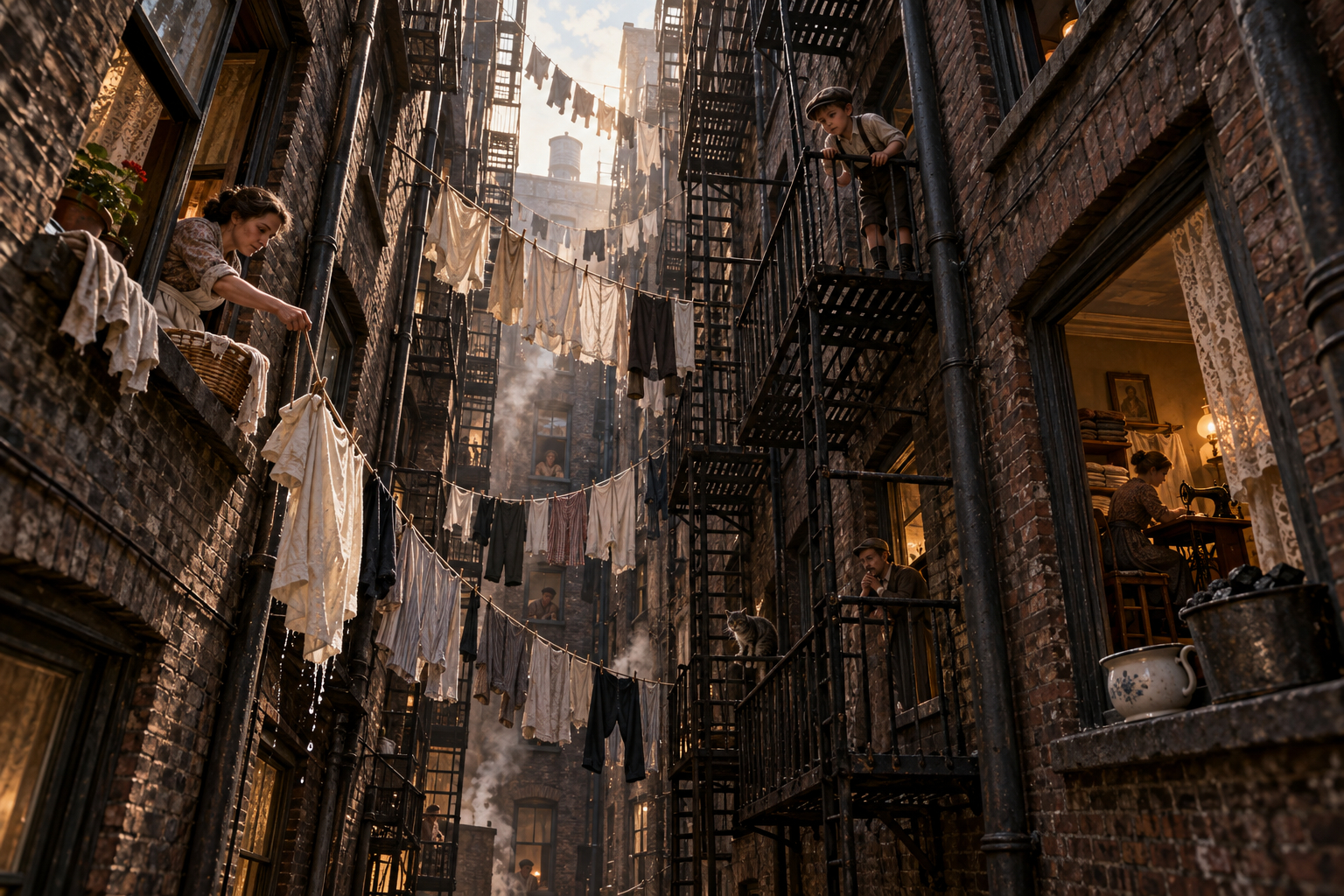
By the late 19th century Manhattan had a single problem: more people than comfortable places to sleep. Waves of immigrants, rural migrants, and newly arrived laborers found housing scarce and landlords eager to squeeze space into profit. Builders answered with narrow, multi‑story apartment blocks that fit dozens of families on a tiny lot. From the street they often looked like ordinary brick row houses; inside they stretched up and up, rooms stacked one above another with shared stairs and alley‑thin courtyards.
Inside: sights, smells, and strategies for survival
Tenement life was an economy of improvisation. Kitchens were also bedrooms and workshops; coal stoves shared corridors; chamber pots waited for night. Lack of indoor plumbing or ventilation turned rooms into humid, smoky places where illness spread easily. Children turned stairwells and sidewalks into classrooms and markets; street vendors and pushcarts threaded between laundry lines and fire escapes. The “air shaft”—a narrow light well cut between buildings—promised air and sun but often became a vertical garbage chute.
Work and home blurred. Many families took in sewing, button‑sewing, or piecework to survive. That kept wages in the home but also made family rooms into tiny factories. At night the city hummed with voices, radios (later), and the click of machines; privacy was scarce, and bodily boundaries were negotiable.
Pressure and change: photographers, reformers, and legislation
Outrage over conditions grew as reformers documented daily life. Photojournalists captured darkness, cramped rooms, and coughing children; published accounts shocked middle‑class readers who could not imagine such density within sight of gleaming commercial blocks. Activists pushed for inspectors, sewers, and sunlight—the kind of municipal interventions that compelled builders to change the rules of construction.
One notable outcome was new housing regulation around the turn of the century that required better light, air, and plumbing in new buildings. The era’s reforms didn’t erase poverty, but they remade how cities thought about public health, building codes, and the state’s role in private housing—shifting the responsibility for humane living conditions onto law and design rather than leaving it solely to charity.
Conclusion
Those cramped blocks shaped modern New York. They concentrated cultures, languages, and industries; they forced municipal governments to act; and they left a material imprint of iron fire escapes and narrow windows that still define old neighborhoods. Tenement New York wasn’t just a condition of poverty. It was the urban experiment—messy, creative, brutal—that helped build the modern city’s expectations about what a home should be.