

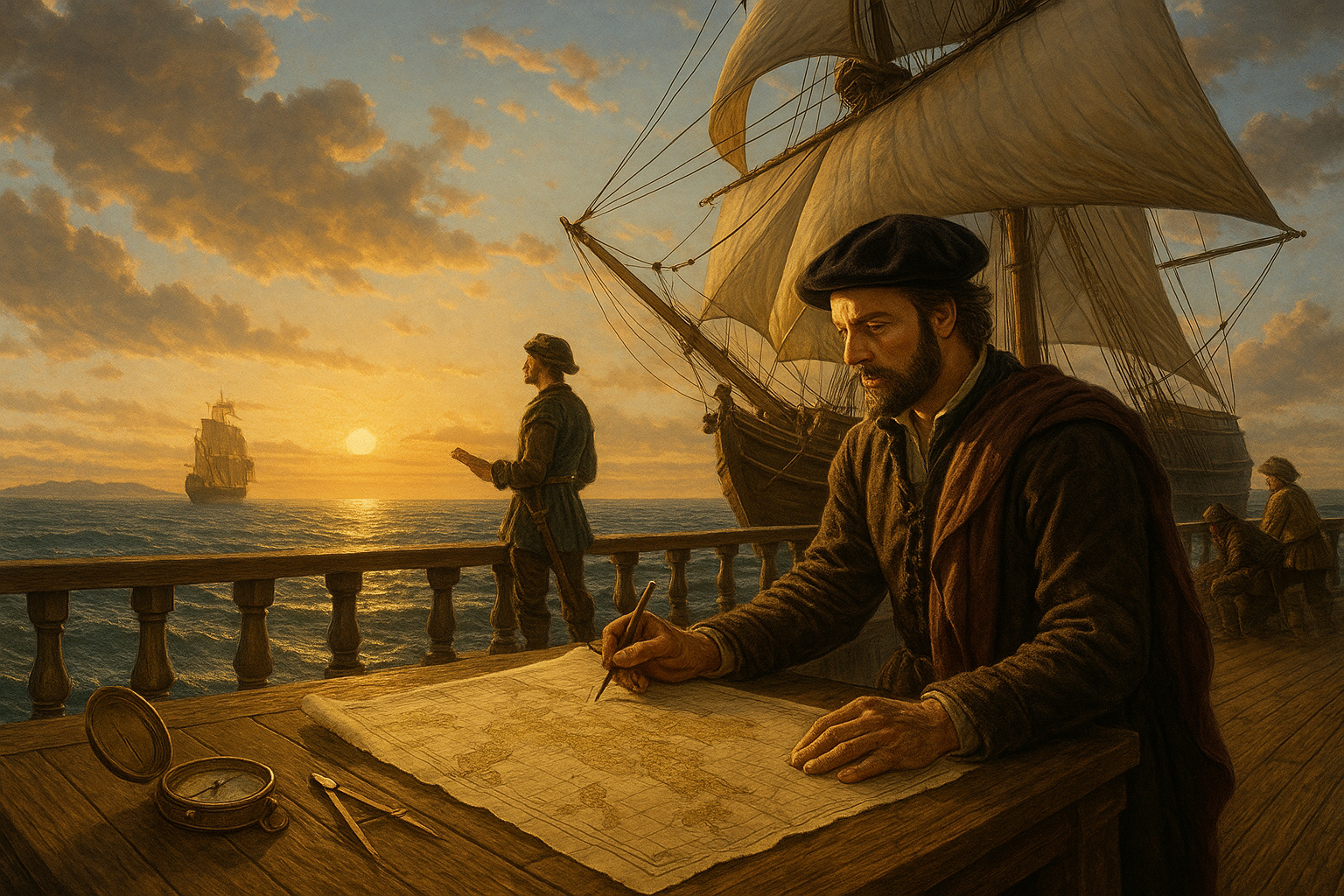
The Age of Exploration, spanning the 15th to 17th centuries, was a period that transformed the world forever. Driven by curiosity, ambition, and the promise of wealth, explorers set sail across uncharted seas to discover lands, peoples, and trade routes previously unknown to Europe. What began as a quest for spices and gold became a global era of discovery, mapping, and cultural exchange that reshaped the course of human history.
The Spirit of Discovery
Europe in the late Middle Ages was buzzing with curiosity and competition. Advances in navigation, shipbuilding, and cartography made long-distance sea travel possible. Nations like Portugal and Spain led the charge, sending brave explorers into the vast unknown. Prince Henry the Navigator established schools for sailors, while explorers like Bartolomeu Dias and Vasco da Gama charted new routes around Africa to reach Asia. The spirit of adventure combined with religious zeal and economic ambition created a generation of explorers eager to map the edges of the world.
Christopher Columbus and the New World
In 1492, Christopher Columbus embarked on his historic voyage across the Atlantic under the Spanish crown. His discovery of the Americas, though unintentional, marked a turning point in world history. It connected continents and cultures that had evolved separately for millennia. The arrival of Europeans in the New World initiated centuries of colonization, trade, and cultural exchange — but also exploitation, disease, and conflict that would reshape indigenous civilizations.
Mapping the Unknown
As explorers charted new territories, cartographers transformed their findings into increasingly accurate maps. Early maps were filled with mythological creatures and imaginative coastlines, reflecting both wonder and ignorance. Over time, exploration brought precision. The work of mapmakers like Gerardus Mercator, who introduced the famous Mercator projection in 1569, revolutionized navigation. For the first time, the world began to take shape as a connected globe, and the dream of global exploration became reality.
The Cultural and Economic Impact
The Age of Exploration did more than redraw maps — it connected the world through the Columbian Exchange, a massive transfer of plants, animals, ideas, and technologies between continents. Potatoes, tomatoes, and cocoa traveled to Europe, while horses, sugarcane, and wheat spread to the Americas. This global interaction transformed economies and diets but also led to the darker legacies of slavery and empire.
Conclusion
The Age of Exploration was both a triumph of human curiosity and a cautionary tale of conquest. It expanded horizons, united continents, and ignited an age of globalization that continues today. As explorers mapped the unknown, they not only discovered new lands but also revealed humanity’s enduring drive to understand, connect, and push beyond boundaries.