
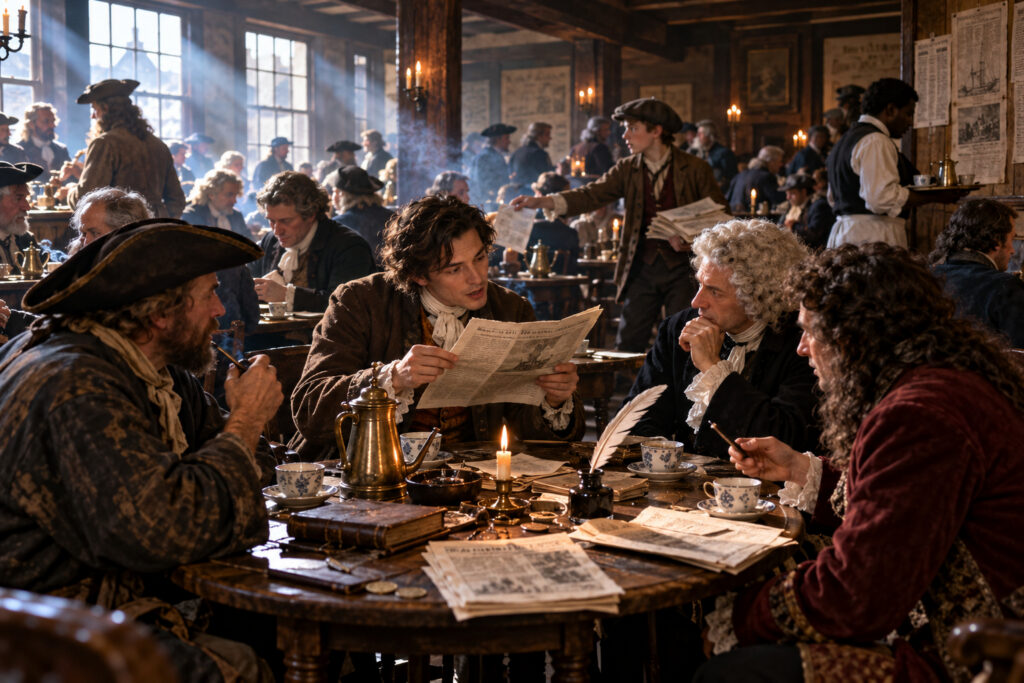
By the mid-17th century a new kind of room began appearing across port cities from Constantinople to Venice and, soon after, in London and Paris: the coffeehouse. Unlike taverns, which centered on food and drinking, these places specialized in a single, energizing commodity—coffee—and in the company it produced. For a modest price, an assortment of strangers could gather around small tables, exchange news, and read the latest gazettes and pamphlets. The coffeehouse was less a refined salon than a bustling crossroads where merchants, clerks, lawyers, sailors, and scholars met on roughly equal terms.
What Happened Inside
Conversation was the product. Newspapers and letters were passed from table to table; merchants compared ship arrivals and cargoes; students argued science and philosophy; political gossip traveled faster than official proclamations. Coffeehouses developed reputations—some for literary conversation, others for financial talk. The nickname “penny universities” captured the sense that, for the price of a cup, a customer could access news, instruction, and networks that once required wealth or patronage.
From News to Networks
The practical outcomes were unmistakable. Information flows that had been slow or localized became rapid and portable. Insurance and brokerage practices grew out of commercial gatherings; the clustered conversations in certain coffeehouses helped concentrate the people who would found markets and institutions. Scientific ideas found public audiences and testing grounds; learned men read journals aloud and debated experiments in plain sight. At the same time, coffeehouses shaped politics: they became arenas for debate and, at times, surveillance and regulation, because authorities recognized how quickly opinion could be formed and spread.
Conclusion
The era of the coffeehouse was not a tidy revolution, nor did it replace older institutions. But for roughly a century and more, these rooms rewired public life. They accelerated the exchange of information, knitted commercial and intellectual communities, and helped create social rituals—reading aloud, coffee-table argument, rapid pamphlet circulation—that are recognizably modern. Look at how we consume news and network today: the pattern of meeting, sharing snippets, and turning conversation into business can trace a clear ancestor to the clatter of cups and saucers in the early modern coffeehouse.
**IMAGE PROMPT**
Midday inside a bustling late‑17th‑century London coffeehouse: a low‑beamed room lit by shafts of daylight and a blue haze of pipe smoke, small round wooden tables crowded with men in waistcoats and periwigs, a sailor in a oilcloth coat, and a merchant leaning over a leather ledger. At the center a young scholar reads a folded gazette aloud while a lawyer and a broker lean in, a newsboy threads between tables handing out folded pamphlets, coins, quills and an ink‑stained receipt scattered on the tabletop and a brass coffee pot steaming on a tray; broadsides tacked to the wall show blurred type rather than legible text. The composition emphasizes animated conversation and the exchange of information that turned cups and saucers into networks — 1536×1024 landscape.