
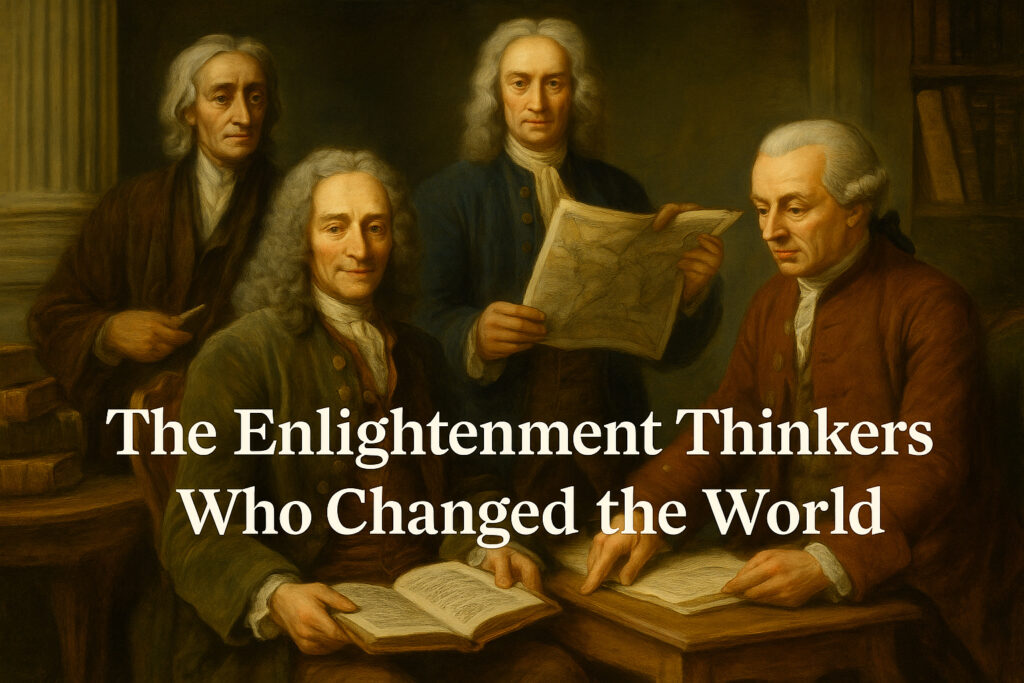
The Enlightenment was a transformative intellectual movement that reshaped how people understood society, politics, science, and human rights. Spanning the 17th and 18th centuries, this era challenged traditional authority and championed reason, logic, and individual freedom. The ideas emerging from this period laid the foundation for modern democracies, scientific advancement, and philosophical thought. Today, the influence of Enlightenment thinkers can still be felt in the systems, values, and rights that shape our everyday lives.
Reason at the Center of Human Progress
At the heart of the Enlightenment was the belief that human beings could solve problems through logic and evidence rather than tradition or superstition. Thinkers such as René Descartes encouraged individuals to question accepted truths and seek knowledge through rational inquiry. This shift marked the beginning of a new scientific and philosophical era—one where curiosity, skepticism, and exploration became essential tools for progress.
The emphasis on reason spread across Europe and beyond, influencing writers, scientists, and political leaders. Their ideas helped redefine how people viewed their relationship with government, religion, and society, setting the stage for revolutions in thought and action.
Philosophers Who Reimagined Society
Several Enlightenment thinkers transformed the way societies understand power and rights. John Locke introduced the revolutionary idea that individuals are born with natural rights—life, liberty, and property—and that governments must protect these rights rather than violate them. His work became the intellectual backbone for modern democracies and constitutional frameworks.
Voltaire, known for his sharp wit, advocated for freedom of speech, religious tolerance, and protection against tyranny. His criticisms of injustice and corruption made him one of the period’s most influential voices. Meanwhile, Jean-Jacques Rousseau explored the relationship between individuals and society, arguing that governments derive their authority from the people’s collective will. His ideas inspired political movements seeking equality and civic responsibility.
Thinkers Who Transformed Knowledge and Culture
The Enlightenment also sparked breakthroughs in science and human understanding. Isaac Newton revealed the laws governing motion and gravity, proving that the universe follows predictable, measurable patterns. His discoveries reshaped the scientific world and became a cornerstone of modern physics.
Other contributors, like Montesquieu, introduced concepts such as the separation of powers—ideas that directly shaped the structure of modern governments. Their impact extended far beyond their lifetimes, influencing constitutions, legal systems, and global political thought.
Conclusion
The Enlightenment was more than a historical moment—it was a revolution of ideas that continues to shape the modern world. Through their commitment to reason, freedom, and human dignity, Enlightenment thinkers created a foundation for science, democracy, and civil rights. Their work reminds us that questioning, learning, and imagining better systems can lead to profound change. Even today, their ideas inspire societies to seek truth, promote justice, and strive for progress built on knowledge and human potential.