Uncover History’s Secrets with Daily Updates!
Daily News Entertainment
  • Home
  • History
  • Biographies
  • Eras
  • Regions
  • Timeline
No Result
View All Result
History Ours
  • Home
  • History
  • Biographies
  • Eras
  • Regions
  • Timeline
No Result
View All Result
History Ours
No Result
View All Result
Home Eras

Understanding Transitional Eras and Their Lasting Impacts

in Eras
Understanding Transitional Eras and Their Lasting Impacts

Introduction

Transitional eras mark moments when societies reorganize their political, economic, and cultural foundations. These periods often arise from environmental pressures, technological breakthroughs, or wide social movements, and they reshape everyday life. Studying transitions helps historians trace patterns of continuity and rupture across time. The goal here is to outline key dynamics and provide a framework for comparative study.

Cultural and Social Shifts

Cultural and social shifts are often the most visible signs of a transitional era. Language, art, and family structures adapt as populations respond to new economic realities or ideological currents. Migration and urbanization can accelerate cultural exchange while also producing tension over identity and resources. Observing everyday practices gives insight into how communities navigate uncertainty and create new norms. Religious movements and educational reforms often accompany these cultural transformations.

These shifts are rarely uniform, and they reveal competing visions for the future. Paying attention to local differences prevents oversimplified narratives. Context matters and shapes outcomes.

Technological and Economic Change

Technological advances often trigger economic reorganization, creating new industries while rendering some skills obsolete. Infrastructure investments and shifts in production reshape labor markets and regional influence. Monetary systems and trade networks respond to innovations, which can accelerate growth but also deepen inequality. Understanding the material basis of change clarifies why political institutions adapt at different rates. Financial innovations and credit systems can amplify both opportunity and vulnerability across regions.

  • Mechanization of agriculture and industry
  • Communication breakthroughs enabling new markets

Policy choices determine who benefits from technological shifts. Historical comparison exposes recurring trade-offs between innovation and social protection. Timely regulation can mitigate harms while preserving benefits.

Interconnected Legacies

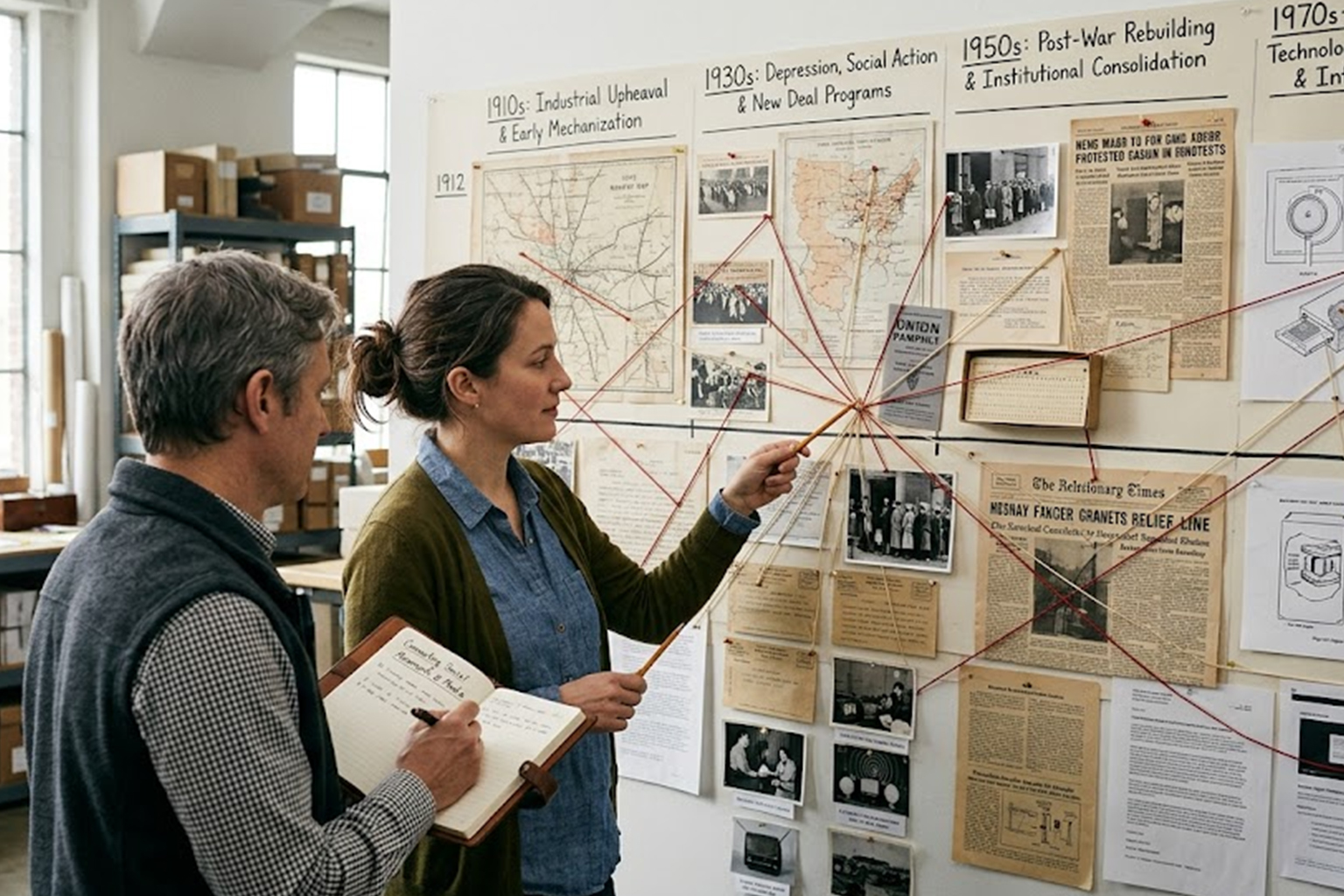
Legacies from transitional eras are seldom isolated; cultural, economic, and political changes feed back into one another. Long-term institutions—education systems, legal codes, and public infrastructure—often carry the imprint of earlier choices. By mapping these legacies, historians show how past transformations set paths that influence later decisions. These interactions often appear as institutional inertia or reform movements that carry forward former priorities.

This perspective emphasizes continuity as well as disruption. It invites careful study of causal chains across decades. Scholars must trace both intended and unintended consequences.

Approaches to Comparative Study

Comparative study of transitional eras relies on diverse sources, from archival documents to material culture and oral histories. Cross-disciplinary methods help connect economic data with social experience and cultural expression. Scaling analysis across local, regional, and global levels uncovers similarities and divergences. Clear hypotheses and careful chronology improve the rigor of such research.

Engaging multiple perspectives reduces bias and highlights different scales of impact. Collaborative projects and comparative databases accelerate discovery.

Conclusion

Transitional eras refract into multiple domains, leaving layered effects. Recognizing their complexity improves historical understanding and contemporary policy thinking. Continued analysis helps societies negotiate change more equitably.


Previous Post

How Historical Eras Shape Long-Term Social Change

Next Post

Mapping Regional Histories: Layers, Stories, and Identity

Related Posts

Song China: Paper Money, Canals, and an Urban Boom
Eras

Song China: Paper Money, Canals, and an Urban Boom

October 26, 2026
The Coffeehouse Century: How Conversation Fueled Early Modern Change
Eras

The Coffeehouse Century: How Conversation Fueled Early Modern Change

October 26, 2026
How Rome Built an Empire One Road at a Time
Eras

How Rome Built an Empire One Road at a Time

October 21, 2026
536: The Year the Sun Went Dim and the World Cooled
Eras

536: The Year the Sun Went Dim and the World Cooled

October 21, 2026
Next Post
Mapping Regional Histories: Layers, Stories, and Identity

Mapping Regional Histories: Layers, Stories, and Identity

Search..

No Result
View All Result

Recent Articles

Mary Seacole: The Jamaican Nurse Who Went to War

Mary Seacole: The Jamaican Nurse Who Went to War

October 30, 2026
Ada Lovelace: The Poet Who Helped Imagine Modern Computers

Ada Lovelace: The Poet Who Helped Imagine Modern Computers

October 30, 2026
John Snow, the Broad Street Pump, and Cholera’s Fall

John Snow, the Broad Street Pump, and Cholera’s Fall

October 29, 2026
The Vasa: Sweden’s Giant Ship That Couldn’t Sail

The Vasa: Sweden’s Giant Ship That Couldn’t Sail

October 29, 2026
How the Black Death Spread Across Europe, 1347–1351

How the Black Death Spread Across Europe, 1347–1351

October 28, 2026

Subscribe Us

By clicking submit, I authorize History Ours and its affiliated companies to: (1) use, sell, and share my information for marketing purposes, including cross-context behavioral advertising, as described in our Terms of Service and Privacy Policy, (2) supplement the information that I provide with additional information lawfully obtained from other sources, like demographic data from public sources, interests inferred from web page views, or other data relevant to what might interest me, like past purchase or location data, (3) contact me or enable others to contact me by email with offers for goods and services from any category at the email address provided, and (4) retain my information while I am engaging with marketing messages that I receive and for a reasonable amount of time thereafter. I understand I can opt out at any time through an email that I receive, or by clicking here

Subscribe To Our Newsletter

By clicking submit, I authorize History Ours and its affiliated companies to: (1) use, sell, and share my information for marketing purposes, including cross-context behavioral advertising, as described in our Terms of Service and Privacy Policy, (2) supplement the information that I provide with additional information lawfully obtained from other sources, like demographic data from public sources, interests inferred from web page views, or other data relevant to what might interest me, like past purchase or location data, (3) contact me or enable others to contact me by email with offers for goods and services from any category at the email address provided, and (4) retain my information while I am engaging with marketing messages that I receive and for a reasonable amount of time thereafter. I understand I can opt out at any time through an email that I receive, or by clicking here.

© 2026 History Ours | All Rights Reserved

  • Contact Us
  • Privacy Policy
  • Terms of Service
  • Unsubscribe
  • Privacy Choices
  • Contact Us
  • Privacy Policy
  • Terms of Service
  • Unsubscribe
  • Privacy Choices

© 2026 History Ours | All Rights Reserved

No Result
View All Result
  • Home
  • History
  • Biographies
  • Eras
  • Regions
  • Timeline

© 2026 History Ours | All Rights Reserved

Skip to content
Open toolbar Accessibility Tools

Accessibility Tools

  • Increase TextIncrease Text
  • Decrease TextDecrease Text
  • GrayscaleGrayscale
  • High ContrastHigh Contrast
  • Negative ContrastNegative Contrast
  • Light BackgroundLight Background
  • Links UnderlineLinks Underline
  • Readable FontReadable Font
  • Reset Reset