
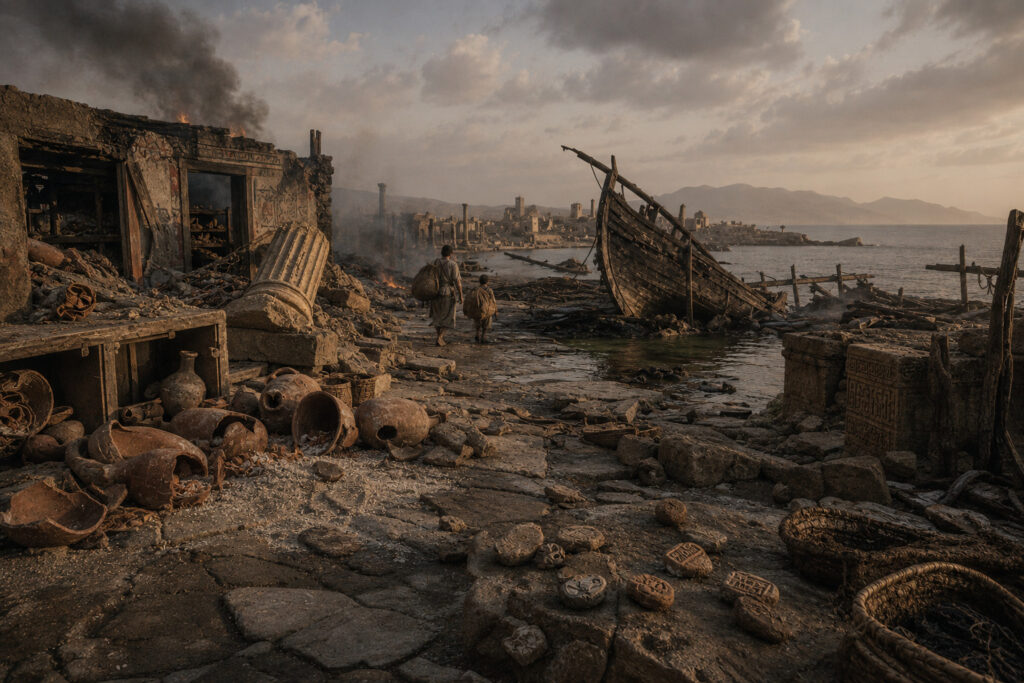
Around 1200 BCE, the map of the eastern Mediterranean looked as if someone had cut out whole swathes of civilization. Palaces at Mycenae and Pylos in Greece, the prosperous port city of Ugarit on the Syrian coast, and the Hittite capital at Hattusa show signs of rapid destruction or abandonment. Once-bustling trade routes that linked Cyprus, Anatolia, Egypt, and the Levant became patchworks of ruined ports and empty warehouses. Written records thin out: Linear B disappears from mainland Greece, Hittite clay archives stop, and cities that had kept detailed letters and inventories fall silent.
What might have caused the collapse?
Scholars no longer point to a single smoking gun. Instead, the collapse looks like a perfect storm of stresses arriving together. Archaeology and ancient texts suggest a mix of invasions—most famously the enigmatic “Sea Peoples” mentioned in Egyptian records—internal rebellions, and cascading economic failures after trade networks broke down. Environmental clues from tree rings and pollen cores add drought and crop failure to the list. Seismic activity in an earthquake-prone region probably toppled walls and disrupted food storage, while the loss of centralized palaces undermined administrative systems that once organized labor, grain, and trade.
Aftershocks: how societies remade themselves
The immediate result was fragmentation. Large bureaucratic states gave way to smaller, more localized polities and new kinds of social organization. In Greece, the fall of palace centers ushered in the so-called Greek Dark Ages, a period of reduced population and simpler material culture that nonetheless set the stage for later innovations. In the Levant and along the Phoenician coast, smaller merchant cities survived and eventually reinvented long-distance trade on different terms. Ironworking, once a niche technology, spread more widely; communities that could work and forge iron tools and weapons gained advantages in the unstable years that followed.
Conclusion
The Late Bronze Age collapse remains one of history’s juicier mysteries precisely because it is both dramatic and messy. It wasn’t a single apocalypse but an era of cascading failures: economic ties snapped, climactic trouble stressed harvests, human violence reshaped borders, and administrative systems crumbled. What followed was not simply regression but transformation—new languages, new technologies, and new political forms grew from the rubble. The lesson for us is oddly modern: complex systems can appear stable until multiple shocks make them unsteady all at once, and out of collapse come unexpected reinventions.