
Background: Wheat, Veterans, and Hungry Birds
In the aftermath of World War I, Australian governments encouraged returned servicemen to take up farming in Western Australia. By the early 1930s many of those soldier-settlers were growing wheat on fragile, newly cleared land. A poor harvest season, falling prices and a mass emu migration converged into a recipe for disaster: thousands of emus moved inland from the coast to the wheatbelt, trampling fences, stripping crops and wrecking seedbeds.
Local farmers, already stretched thin, pressed the federal government for help. The issue was not simply nuisance birds eating grain; it was an economic and social crisis for communities trying to survive a harsh rural decade.
The Campaign: Soldiers, Lewis Guns, and an Unlikely Enemy
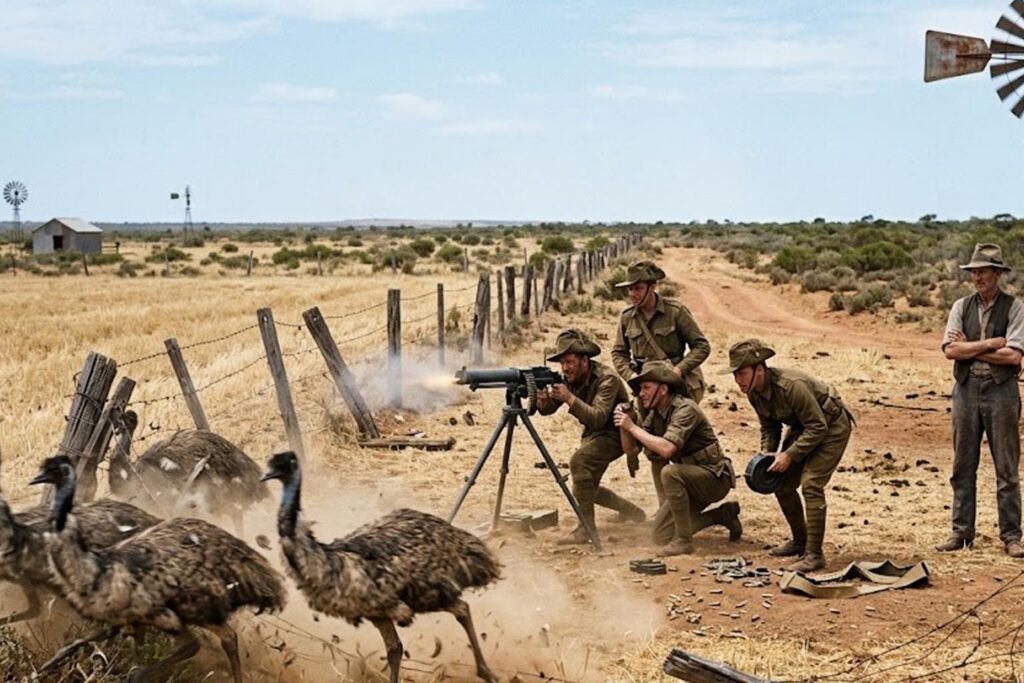
In late 1932 the government responded by loaning military support. A small party of soldiers from the Royal Australian Artillery, led by Major G. P. W. Meredith, arrived with machine guns—Lewis guns—and ammunition. The plan sounded straightforward on paper: use concentrated firepower to reduce the emu numbers that were ravaging crops.
What followed was oddly ill-suited to warfare doctrine. Emus proved surprisingly resilient: fast, able to scatter into small groups, and adept at taking cover in the scrub. Several attempts to ambush or drive the flocks ended with little to show for spent ammunition. Machine guns clogged in dust, firing bursts that missed moving targets, and the birds’ sheer numbers meant that any apparent success barely dented their population. The operation lasted only a few weeks and was widely reported in the press at the time, often with a tone of bemusement.
Aftermath and Practical Responses
The military withdrew and the federal authorities quietly shifted tactics. Rather than sustained armed action, the response combined bounties, bounty-hunters, and agricultural measures such as fencing and modified land management. Emu-proof fencing and subsidised attempts at crop protection proved more practical and less embarrassing than sending soldiers to fight birds.
Contemporary accounts vary on how many birds were actually killed; official figures and newspaper reports did not agree, and some descriptions were clearly exaggerated for effect. What historians remember most is not a clean tally but the mismatch between military methods and a migratory, adaptable animal.
Conclusion
The so-called Emu War of 1932 has become a favorite oddity of modern history: part ecological problem, part government miscalculation, part media spectacle. It stands as a compact reminder that human solutions — even armed ones — can be clumsy when they misunderstand the behaviour of the living things they hope to control. Farmers eventually adapted their practices; emus survived and continue to be a distinct element of the Australian landscape.