

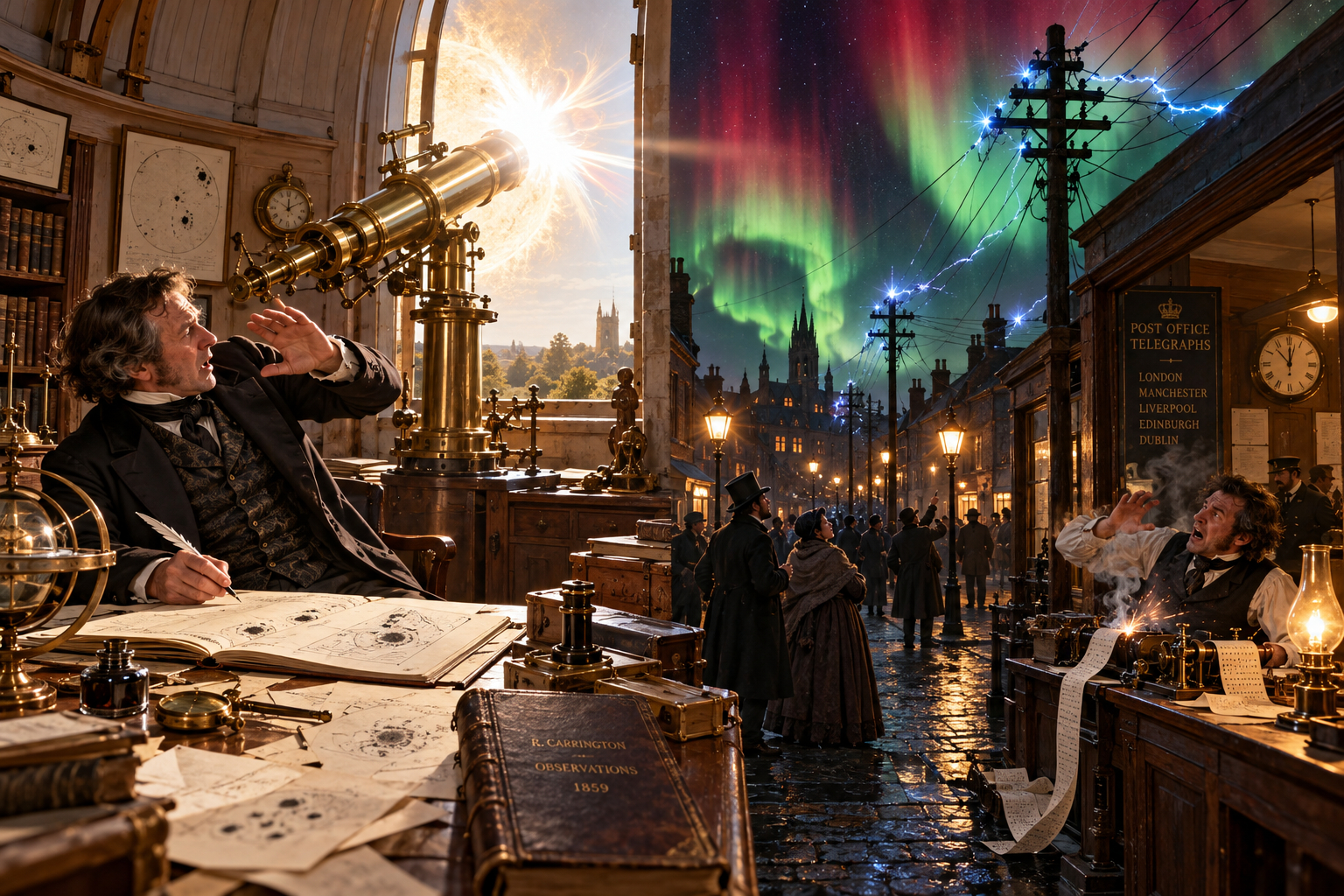
On the morning of September 1, 1859, amateur astronomer Richard Carrington was sketching sunspots when a brilliant white flash tore across his telescope’s view. He later measured the event and published the first recorded observation of a solar flare. Within eighteen hours the Earth’s magnetic field answered back. Telegraph lines across Europe and North America began sparking, clocks misbehaved, and the night sky lit up as if it were day.
Telegraphs, fires, and glowing wires
Telegraph systems—then the backbone of long-distance communication—felt the brunt of the storm. Across the Atlantic, operators reported needles swinging wildly on instruments. Some telegraph machines worked without batteries, powered purely by currents induced in thousands of miles of wire by the storm. Other operators received electric shocks; in a few places telegraph paper smoldered. These are the concrete, repeated details from contemporary technical reports and newspaper dispatches, not folklore: the storm overloaded metallic conductors and produced easily observed, often hazardous effects in the infrastructure of the day.
The auroral display was equally dramatic. Observers described sheets and curtains of red and green light that spilled across skies as far south as the Caribbean and the American Southwest. Sailors and miners who normally would never have seen northern lights suddenly watched them blaze overhead. Telegraph operators and everyday citizens alike compared the glow to large fires on the horizon—an apt image for people used to coal smoke and candlelight.
Why the Carrington Event still matters
The Carrington storm ranks as the most intense geomagnetic storm on record because of the suddenness of Carrington’s flare and the global effects that followed. Its significance today is less rhetorical than practical. Modern society is far more dependent on long conductors—power grids, undersea cables, satellite constellations—than Victorian telegraph lines. Scientists estimate that a storm of Carrington’s magnitude striking now could damage transformers, disrupt satellite navigation and communications, and leave millions without power for weeks or months while equipment is repaired or replaced.
That possibility has shaped emergency planning. Utilities run simulations, engineers build safeguards into transformers, and space agencies monitor the Sun for telltale signs of trouble. Yet the lesson of 1859 is simple and humbling: an event that began as a bright blot on a telescope’s plate transformed everyday life across the globe, revealing how closely human systems sit beneath the Sun’s mood swings.
Conclusion
The Carrington Event reads like a Victorian parable about vulnerability—scientific curiosity, sudden catastrophe, and the fragile dance between nature and technology. It also serves as a clear warning: the sky can still surprise us, and when it does, our modern conveniences will show how connected—and how exposed—we really are.